
- September 25, 2026
- Edidiong Akpanuwa & Co
- 0
Many people assume that once a will has been signed, their wishes are guaranteed to be carried out. In reality, the existence of a will does not necessarily prevent disputes after the death of the testator.
Challenges to wills continue to arise where family members, beneficiaries, or other interested parties question the validity of the document or the circumstances in which it was made. Such disputes can result in lengthy probate proceedings, substantial legal costs, delays in administering the estate, and, perhaps most significantly, lasting conflict among family members.
For individuals who have accumulated substantial property, investments, business interests, or other assets, proper estate planning is therefore not simply about writing a will. It is about creating an estate plan that is clear, legally sound, properly executed, and capable of withstanding reasonable scrutiny after death.
Why Wills Are Challenged
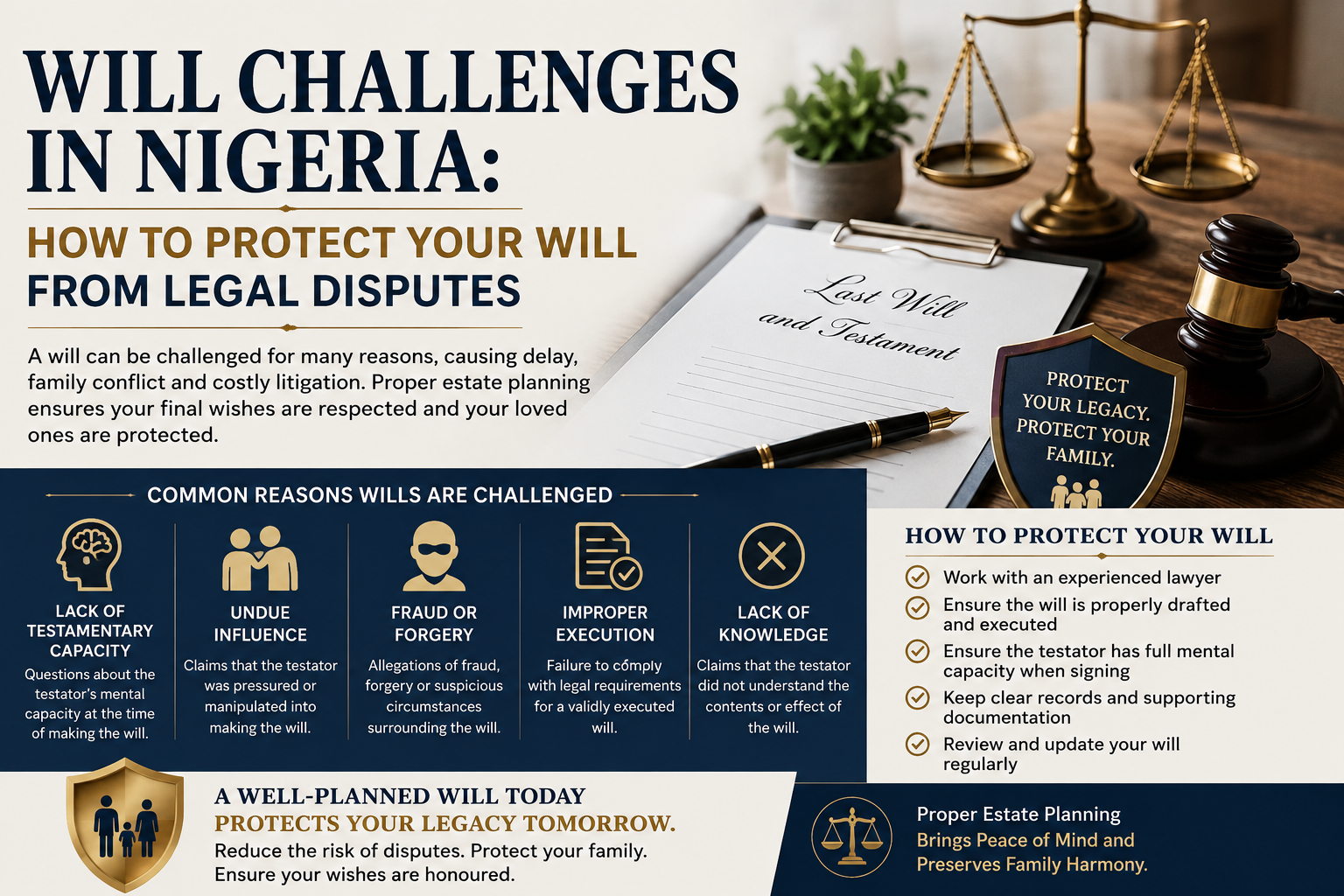
A will can be challenged for a variety of reasons. Some challenges concern the mental capacity of the person who made the will, while others focus on the circumstances surrounding its preparation or execution.
Common grounds on which the validity of a will may be questioned include:
- Lack of testamentary capacity;
- Undue influence;
- Fraud or forgery;
- Improper execution;
- Lack of knowledge or approval of the contents;
- Suspicious circumstances surrounding the making of the will;
- Allegations that the testator was coerced or pressured;
- Disputes concerning the authenticity of the document.
A challenge does not necessarily mean that the will is invalid. However, once its validity is seriously questioned, the estate may become subject to litigation before beneficiaries can fully enjoy the assets intended for them.
Testamentary Capacity: Did the Testator Understand the Will?
One of the important issues that can arise in a will dispute is testamentary capacity.
Generally, a person making a will must have sufficient mental capacity to understand that they are making a will, understand the general nature and effect of the document, appreciate the property they are disposing of, and understand the people who may reasonably have claims upon or expectations regarding their estate.
Questions concerning capacity can become particularly important where the testator was elderly, seriously ill, experiencing cognitive difficulties, or otherwise vulnerable when the will was prepared and executed.
For this reason, estate planning should ideally take place when the individual is clearly capable of understanding and communicating their wishes.
The Importance of Timing in Estate Planning
Waiting until a person is seriously ill before preparing or changing a will can create unnecessary opportunities for future disputes.
Where a will is prepared shortly before death, particularly where there has been a significant change from an earlier will, disappointed beneficiaries may question why the changes were made and whether the testator was capable of making an independent decision.
This does not mean that a person cannot change their will later in life. People are entitled to change their testamentary wishes where they have the necessary capacity and comply with applicable legal requirements.
However, careful planning and proper documentation can help establish that the decision was genuinely made by the testator.
Undue Influence and Pressure
Another significant source of potential conflict is an allegation of undue influence.
Such allegations may arise where a beneficiary is believed to have exerted improper pressure on the testator to make provisions in their favour.
These disputes can become particularly contentious where:
- One beneficiary becomes heavily involved in the testator’s personal affairs;
- There are significant changes to the distribution of the estate;
- A beneficiary receives a disproportionately large benefit;
- Family relationships are already strained;
- The testator was elderly or vulnerable;
- Other family members were excluded from the decision-making process.
It is important to distinguish ordinary influence or persuasion from legally relevant undue influence. Nevertheless, estate planning should be undertaken in circumstances that demonstrate the testator’s independent intentions as clearly as possible.
Fraud, Forgery and Authenticity of the Will
Questions may also arise concerning whether a will is genuine.
Where family members suspect that a document has been forged, altered, substituted, or improperly obtained, the dispute can become considerably more complicated.
The risk of such disputes reinforces the importance of proper documentation, secure custody of estate-planning documents, and professional involvement in the preparation and execution of important testamentary instruments.
Maintaining appropriate records can also help establish the circumstances in which the will was prepared and executed.
Proper Execution Matters
A will must comply with applicable legal requirements concerning its execution. Failure to observe required formalities can provide grounds for a challenge.
This is one reason why simply downloading a generic will template or preparing an informal document without appropriate legal guidance may create unnecessary risks.
A professionally prepared will should be carefully reviewed to ensure that:
- The testator’s intentions are clearly expressed;
- The document complies with applicable legal requirements;
- The appropriate witnesses are involved;
- The execution process is properly documented;
- Previous testamentary documents are appropriately addressed;
- The identities of beneficiaries and relevant assets are sufficiently clear.
Attention to these details can make a significant difference when the will is eventually presented for probate.
Keeping Evidence of the Testator’s Intentions
In appropriate circumstances, maintaining supporting records can help reduce uncertainty if the will is later challenged.
For example, where there may reasonably be concerns about testamentary capacity, appropriate medical evidence obtained independently and at the relevant time may provide useful evidence regarding the testator’s mental state.
Similarly, clear records of instructions given by the testator and the professional process through which the will was prepared may help demonstrate that the document reflects the individual’s genuine intentions.
The objective should not be to create unnecessary documentation, but to ensure that important decisions can be properly understood and verified if questions arise in the future.
Reviewing Your Will After Major Life Changes
A will should not necessarily be treated as a document that is prepared once and then forgotten.
Major changes in a person’s circumstances may justify reviewing an existing estate plan. These may include:
- Marriage;
- Divorce or separation;
- Birth or adoption of children;
- Death of a beneficiary;
- Acquisition of substantial property;
- Establishment or expansion of a business;
- Changes in business ownership;
- Significant changes in family relationships;
- Relocation or changes affecting the applicable legal framework.
An outdated will may fail to address assets acquired years after it was prepared or may contain provisions that no longer reflect the testator’s wishes.
Regular reviews help ensure that the estate plan remains aligned with the individual’s current circumstances.
Protecting Beneficiaries Through Clear Estate Planning
Proper estate planning is not only about protecting the testator. It is also about protecting the beneficiaries.
When a will is ambiguous or poorly structured, beneficiaries may be forced to spend considerable time and money resolving disputes before they can receive what was intended for them.
Clear drafting can reduce uncertainty regarding:
- Who is intended to benefit;
- What assets are being distributed;
- How particular assets should be dealt with;
- Who should administer the estate;
- How business interests should be managed;
- What should happen where a beneficiary dies before the testator.
The clearer the estate plan, the less room there may be for conflicting interpretations.
Special Considerations for Business Owners
Estate planning becomes particularly important where the estate includes business interests.
A business may represent a substantial portion of a person’s wealth, yet simply stating who should inherit shares or ownership interests may not resolve questions concerning management and control.
Business owners should consider how their estate plan interacts with:
- Company ownership structures;
- Shareholder agreements;
- Existing business contracts;
- Management arrangements;
- Family participation in the business;
- Succession planning;
- The interests of business partners and other stakeholders.
Without proper planning, the death of a business owner can create uncertainty that affects not only the family but also employees, business partners, creditors, customers, and other stakeholders.
The Cost of Poor Estate Planning
The consequences of inadequate estate planning can extend well beyond the courtroom.
A contested will can result in:
- Delays in estate administration;
- Increased legal and administrative costs;
- Family disagreements;
- Reduction in the value of estate assets;
- Disruption to family businesses;
- Uncertainty for beneficiaries;
- Long-term damage to family relationships.
In some cases, assets that were intended to provide financial security for future generations may instead become the subject of prolonged litigation.
This is why estate planning should be viewed as a wealth-preservation strategy rather than merely a legal formality.
Professional Legal Guidance Can Reduce Risk
Although no estate plan can guarantee that a will will never be challenged, proper legal advice can significantly reduce avoidable risks.
A legal practitioner can assist with reviewing the individual’s circumstances, identifying potential areas of conflict, structuring testamentary provisions, ensuring compliance with applicable requirements, and advising on appropriate succession arrangements.
The earlier these issues are considered, the more opportunity there is to address potential problems before they become disputes.
What This Means for Families and Estate Planners
A will is one of the most important legal documents an individual may ever sign. It determines how assets accumulated over a lifetime may be distributed and can have consequences for generations that follow.
However, a will should not be viewed in isolation. Effective estate planning involves considering the individual’s assets, family circumstances, business interests, applicable laws, and long-term objectives.
For families, the goal should be more than simply distributing wealth after death. It should be to create certainty, reduce unnecessary conflict, protect vulnerable beneficiaries, and preserve assets for future generations.
For individuals who have accumulated significant property, investments, or business interests, reviewing their estate plan periodically and obtaining appropriate professional advice can help ensure that their final wishes are clearly expressed and legally protected.
Ultimately, proper estate planning is an investment in certainty. The objective is not merely to leave behind a will, but to leave behind a clear and carefully structured plan that gives loved ones the best possible opportunity to honour the deceased’s wishes without unnecessary litigation.
A publication of Edidiong Akpanuwa & Co.