
- September 3, 2026
- Edidiong Akpanuwa & Co
- 0
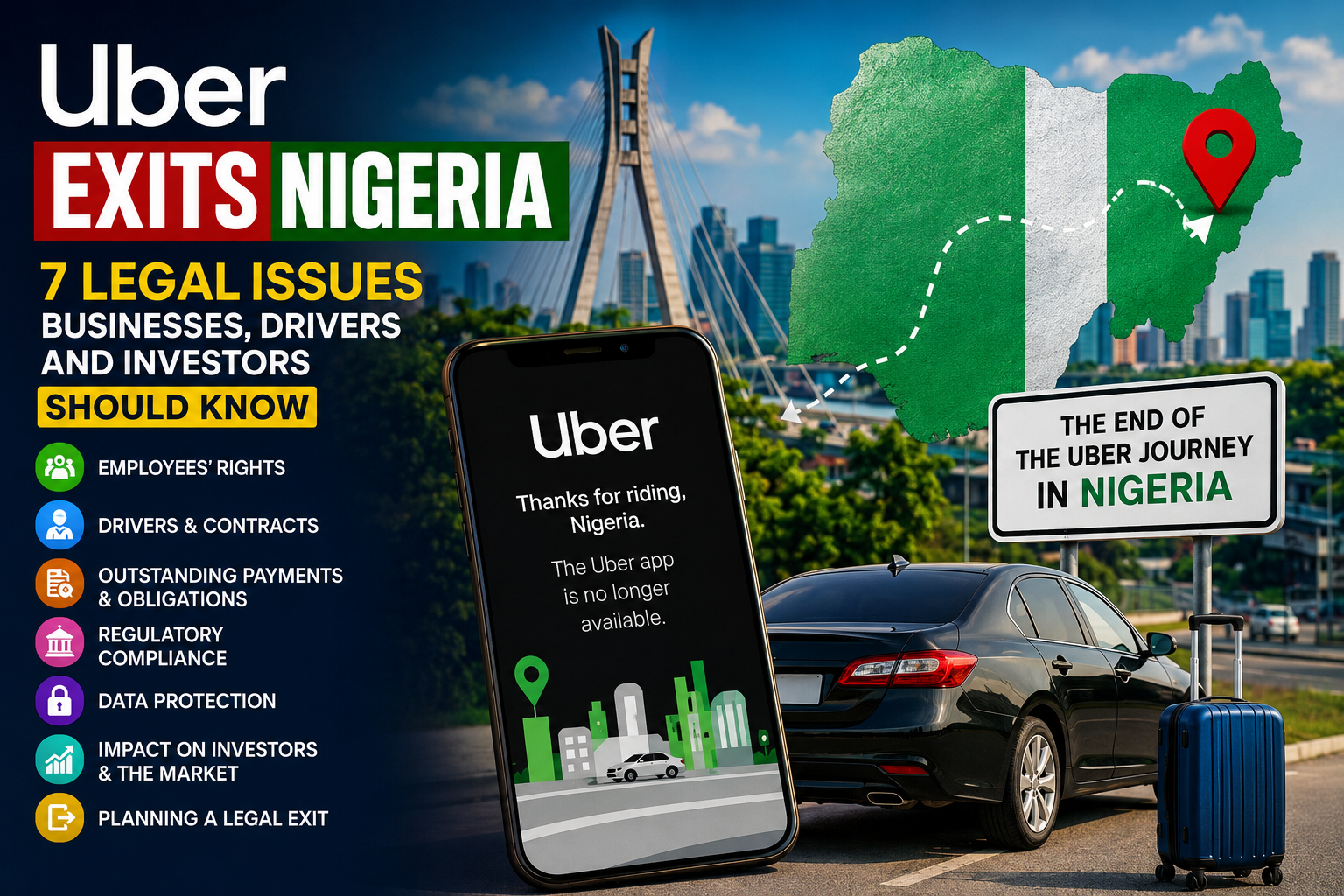
Uber Exit from Nigeria: 7 Legal Issues Businesses, Drivers and Investors Should Know
Uber’s decision to wind down its operations in Nigeria after 12 years has sent ripples through the country’s e-hailing and technology sectors.
The company announced that it would cease operations in Nigeria and Uganda effective September 2, 2026, following what it described as a “thorough review” of its operations. Its booking platform was subsequently deactivated, while the company said its Help Centre would remain available until September 23 to address final account-related queries.
Beyond the immediate commercial consequences, however, Uber’s exit raises several important legal questions for multinational companies, technology businesses, employees, drivers, regulators, investors and other stakeholders operating in Nigeria.
The development provides a useful illustration of the legal considerations that arise when a company decides to discontinue a substantial business operation in Nigeria.
1. Can a foreign company simply leave the Nigerian market?
A multinational company is generally entitled to decide that it no longer wishes to conduct business in Nigeria. However, a decision to stop operating commercially is not necessarily the same thing as legally terminating its Nigerian presence.
Where a company incorporated or registered to carry on business in Nigeria is winding down its operations, it must consider its outstanding statutory, contractual, employment, tax and regulatory obligations.
Depending on the structure through which the business operates, the company may need to address matters relating to:
- its Nigerian corporate entity or registration;
- outstanding contractual obligations;
- employees and employment-related liabilities;
- tax obligations;
- creditors and other outstanding liabilities;
- regulatory licences and permits;
- customer and driver agreements;
- data protection obligations; and
- repatriation or transfer of assets.
In other words, closing an app is not necessarily the same thing as closing a business in the eyes of the law.
A proper exit strategy therefore requires a legal and financial reconciliation of the company’s affairs before its Nigerian operations are finally brought to an end.
2. What happens to Uber’s employees?
One of the immediate legal issues arising from the exit concerns the company’s Nigerian employees.
The termination of employment resulting from a business closure or restructuring does not remove the employer’s obligations under Nigerian employment law.
The applicable employment contracts, the Labour Act, where applicable, and other relevant employment regulations must be considered when determining issues such as notice, termination, accrued entitlements and other payments due to affected employees.
This is particularly important because report indicates that Uber’s Nigerian workforce could be affected by the company’s broader global restructuring.
The legal question is therefore not simply whether Uber can discontinue its Nigerian operations, but how the resulting employment relationships are brought to an end lawfully.
Companies undertaking major restructuring or market exits should obtain employment-law advice before issuing termination notices or implementing mass redundancies.
3. What about Uber drivers?
The position of Uber drivers presents a more complicated legal question.
Unlike conventional employees, drivers operating through digital platforms may be engaged under contractual arrangements that define their relationship with the platform differently.
Consequently, the legal status of individual drivers cannot automatically be determined merely because they earned their income through Uber.
The relevant questions may include:
Were they employees, independent contractors, agents or participants in another contractual arrangement?
The answer could have significant consequences for their rights and remedies.
It may affect questions concerning termination, notice, outstanding payments, contractual claims and statutory protections.
The distinction between an employee and an independent contractor has become increasingly important as Nigeria’s digital economy expands.
Uber’s exit therefore highlights a broader policy question: should Nigerian law provide additional protections for workers whose livelihoods depend substantially on digital platforms but whose contractual status may fall outside traditional employment models?
4. What happens to outstanding payments, commissions and contractual obligations?
The report that consultants and an audit firm sought reconciliation of their retainership account immediately following the announcement illustrates another important aspect of corporate exit: account reconciliation.
Before withdrawing from a market, a company must identify and settle, where due, outstanding obligations to relevant stakeholders.
These may include:
- professional advisers;
- employees;
- drivers and fleet operators;
- landlords;
- vendors and suppliers;
- technology providers;
- government agencies;
- contractors; and
- other creditors.
The existence of a corporate exit does not automatically extinguish contractual obligations.
Where a party believes that money remains outstanding under a contract, it may potentially pursue contractual remedies available under Nigerian law.
For companies contemplating an exit, a legal and financial close-out audit is therefore essential.
5. Regulatory compliance does not end when operations stop
The Uber situation also highlights the importance of regulatory compliance in Nigeria’s technology sector.
E-hailing companies have faced regulations from state governments and federal agencies, including restrictions concerning airport operations.
Uber has reportedly clarified that the Federal Airports Authority of Nigeria (FAAN) was not responsible for its decision to exit Nigeria.
That distinction is significant.
A company’s decision to withdraw from a market may result from a combination of commercial, regulatory and operational considerations. It should not automatically be assumed that a particular regulatory action caused the exit unless the company itself establishes that connection.
At the same time, the development demonstrates how regulatory requirements can materially affect the economics of technology-enabled businesses.
For companies operating in regulated sectors, regulatory compliance should therefore be considered as part of market-entry and market-exit planning, rather than treated as an issue that arises only after the business encounters a regulatory dispute.
6. Data protection obligations may survive the shutdown of the platform
Perhaps one of the less obvious legal issues concerns customer and driver data.
An e-hailing platform necessarily processes substantial amounts of personal data, including information relating to riders, drivers, payments, locations and transactions.
The deactivation of the booking platform does not necessarily mean that all data-related obligations disappear.
The company would need to consider its obligations under Nigeria’s data protection framework, including matters concerning the retention, security, use, transfer and eventual deletion or disposal of personal data.
This is particularly important during a corporate exit because shutting down a digital platform creates a potentially significant data-governance event.
Companies exiting Nigeria’s digital economy should therefore have a specific data-protection exit plan rather than simply switch off their technology platform.
7. What does the exit mean for investors and other foreign businesses?
Perhaps the most significant legal lesson from the Uber development is broader than Uber itself.
Foreign investors considering Nigeria will inevitably examine not only the size of the market but also the predictability of regulation, cost of compliance, contractual enforceability, taxation, labour obligations and the ability to restructure or exit when a business model becomes commercially unsustainable.
Nigeria remains a significant consumer and technology market. However, market size alone does not guarantee commercial viability.
For investors, the question is increasingly becoming:
Can the business enter, operate, scale and, if necessary, exit Nigeria in a legally predictable and commercially efficient manner?
That makes regulatory due diligence and exit planning just as important as market-entry due diligence.
A lesson for Nigeria’s digital economy
Uber’s departure should therefore be viewed as more than the exit of a major e-hailing company.
It raises questions about the relationship between regulation, investment, employment, digital platforms and commercial sustainability in Nigeria.
For government, the challenge is to create a regulatory environment that protects consumers and workers without making legitimate digital businesses commercially unviable.
For technology companies and investors, the lesson is equally important: legal compliance, contractual structuring, employment planning, tax planning, data protection and an eventual exit strategy should be considered from the beginning of the investment, not when the decision to leave has already been made.
The Uber exit may ultimately have a limited effect on Nigeria’s overall GDP, as some drivers and customers migrate to competing platforms. But from a legal and policy perspective, it provides a valuable case study of the challenges facing multinational businesses operating in Nigeria’s rapidly evolving digital economy.
For businesses entering Nigeria, the lesson is clear: having a viable business model is only one part of the equation. Understanding the legal environment in which that business model operates and planning for both growth and exit is equally important.
A publication of Edidiong Akpanuwa & Co.