
- May 25, 2026
- Edidiong Akpanuwa, Esq
- 0
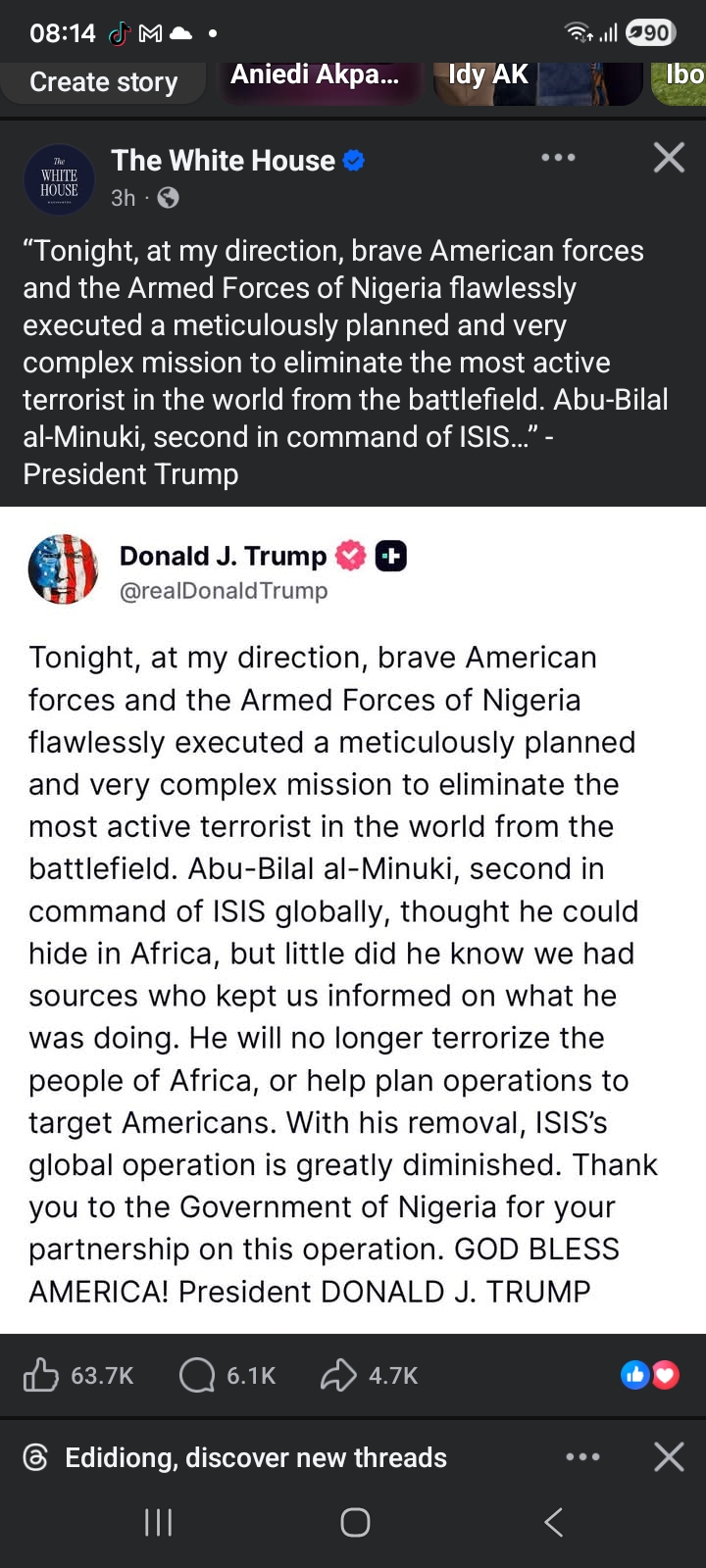
A dramatic statement attributed to Donald Trump has triggered fresh legal and diplomatic debate after he claimed that American forces and the Nigerian Armed Forces jointly carried out a complex military operation that eliminated a senior ISIS commander identified as Abu-Bilal al-Minuki.
According to the statement, the target was allegedly “the most active terrorist in the world” and “second in command of ISIS globally.” Trump further claimed the operation was conducted at his direction and praised Nigeria for partnering with the United States in the mission.
But beyond the politics and headlines lies a deeper legal question:
Could such an operation be justified under international law?
The answer may lie in one powerful provision of international law — Article 51 of the United Nations Charter.
The Article That Allows Countries To Fight Back
Article 51 of the UN Charter provides:
“Nothing in the present Charter shall impair the inherent right of individual or collective self-defence if an armed attack occurs against a Member of the United Nations…”
In simple terms, the provision gives countries the legal right to defend themselves when attacked.
But the article goes even further.
It also recognizes “collective self-defence,” meaning one country can legally assist another country facing armed attacks or terrorism.
That principle has become one of the strongest legal foundations for modern counter-terrorism coalitions around the world.
Why Nigeria Matters Under Article 51
Nigeria has spent years battling terrorist organizations including Boko Haram and ISIS-linked factions operating in parts of the country.
Thousands of civilians and security personnel have been killed in insurgent attacks, kidnappings, bombings, and mass abductions.
Under international law, such sustained attacks can qualify as armed attacks capable of triggering the right to self-defence.
This means that if Nigeria requested or consented to assistance from the United States, joint operations against terrorist targets could potentially fall within the scope of lawful collective self-defence under Article 51.
That is the critical legal point.
The legality of the operation may depend less on the strike itself and more on whether Nigeria consented to it.
Sovereignty Is Still A Big Issue
International law strongly protects the sovereignty of nations.
Ordinarily, one country cannot carry out military operations inside another country without permission.
Doing so could amount to unlawful intervention or even aggression.
However, where the territorial state consents, the legal equation changes completely.
If Nigeria authorised cooperation with the United States, then the operation may be viewed as lawful security collaboration rather than a violation of sovereignty.
This is why consent is everything in international law.
The Security Council Requirement
Article 51 also contains another important condition many people overlook.
Countries exercising self-defence are expected to report the measures taken to the United Nations Security Council.
The Charter states:
“Measures taken by Members in the exercise of this right of self-defence shall be immediately reported to the Security Council…”
That requirement exists because the Security Council remains the primary body responsible for maintaining international peace and security.
In practice, however, many counter-terrorism operations globally occur with little public disclosure, especially where intelligence and military secrecy are involved.
A New Era Of Cross-Border Counterterrorism
The alleged operation highlights how modern warfare has changed.
Terrorist organizations now operate across borders, use global financing networks, and recruit internationally. As a result, countries increasingly rely on intelligence alliances, drone operations, joint missions, and strategic military partnerships.
Article 51 has therefore evolved into one of the most frequently invoked legal justifications for international counter-terrorism cooperation.
Yet the debate never fully disappears.
Supporters argue that global terrorism requires global military cooperation.
Critics warn that powerful nations can sometimes stretch the concept of “self-defence” too far, especially when military actions occur far from their own territory.
The Bigger Legal Question
Trump’s statement may have revealed more than a successful military mission.
It may have exposed how international law, sovereignty, and counter-terrorism strategy now intersect in ways that are becoming increasingly difficult for governments to keep out of public scrutiny.And at the center of that entire debate stands one sentence from Article 51 of the UN Charter, being the right of collective self-defence.