
- September 30, 2026
- Edidiong Akpanuwa & Co
- 0
Protecting Beneficiaries and Family Assets During Probate Disputes
The death of a loved one can be a difficult period for any family. When the deceased leaves behind significant property, investments, business interests, or other valuable assets, the administration of the estate can become even more complicated.
While probate proceedings are intended to facilitate the orderly administration and distribution of a deceased person’s estate, disagreements can arise at virtually any stage of the process. Questions may be raised about the validity of a will, the identity and rights of beneficiaries, the ownership of particular assets, or the conduct of executors and administrators.
When these disputes are not addressed promptly, they can develop into prolonged litigation, leaving family assets tied up for years and creating further divisions among beneficiaries.
Proper legal guidance and careful estate administration can help protect beneficiaries, preserve estate assets, and reduce the risk that family wealth will be unnecessarily depleted through prolonged disputes.
What Is Probate and Why Does It Matter?
Probate is part of the legal process through which a deceased person’s estate is administered, particularly where there is a will. It provides a framework for establishing the authority of the appropriate personal representatives and facilitating the administration of the estate.
The administration process may involve identifying and collecting estate assets, addressing liabilities, dealing with claims, and ultimately distributing assets to those entitled to them.
Where everything is properly documented and family members agree on the relevant issues, estate administration may proceed relatively smoothly.
However, where disagreements arise, the process can become significantly more complicated.
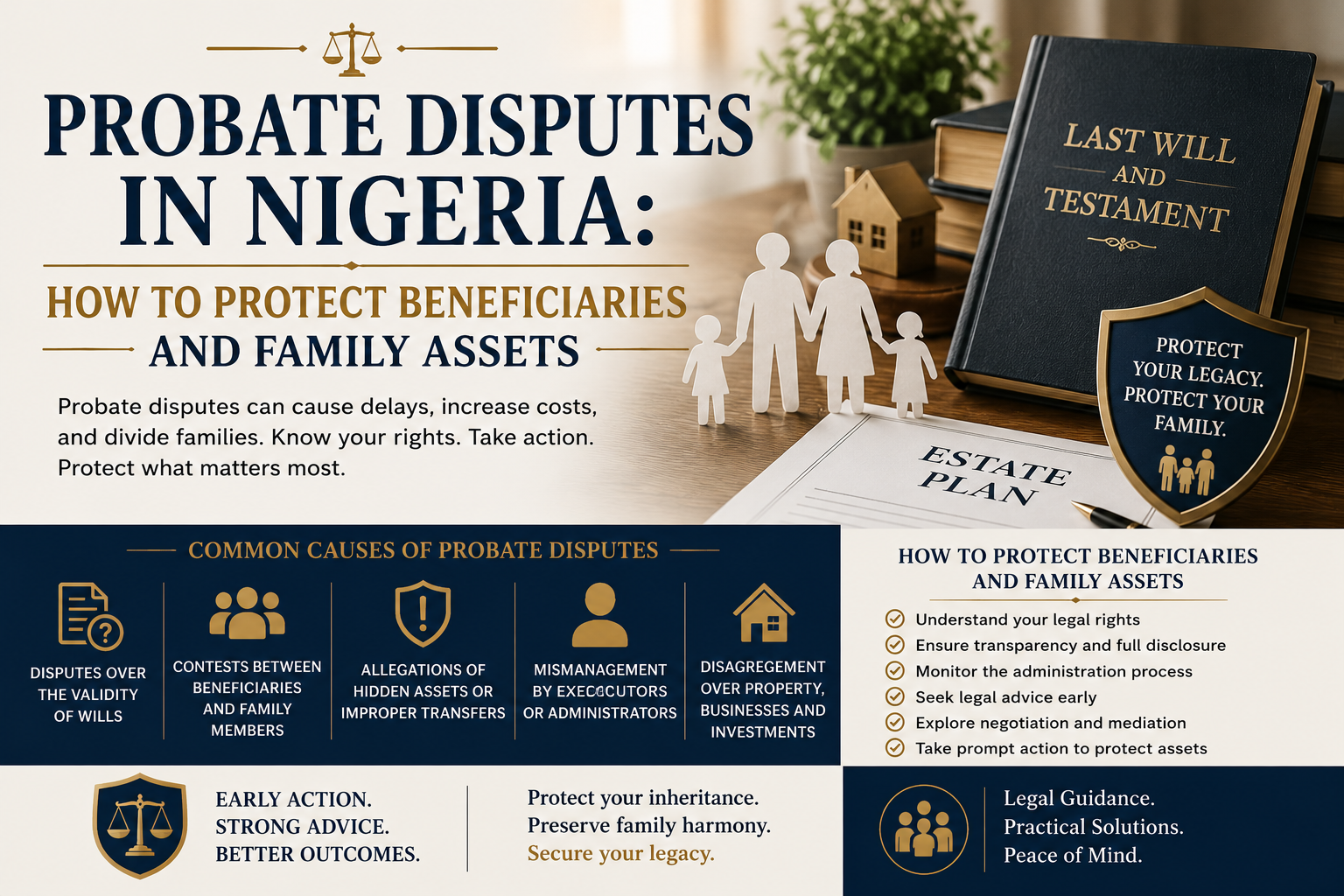
Common Causes of Probate Disputes
Probate disputes can arise for many different reasons. In some cases, the dispute concerns the will itself. In others, the disagreement relates to how the estate is being administered or who is entitled to particular assets.
Common issues include:
- Challenges to the validity of a will;
- Allegations of undue influence, fraud, or forgery;
- Questions regarding the testamentary capacity of the deceased;
- Competing wills or testamentary documents;
- Disputes over the identity or entitlement of beneficiaries;
- Allegations that estate assets have been concealed;
- Disagreements over the ownership of property;
- Allegations of mismanagement by executors or administrators;
- Disputes involving family businesses or company interests;
- Claims that assets were transferred before the deceased’s death;
- Disagreements concerning the valuation or distribution of estate assets.
Each dispute can have different legal implications, which makes early assessment of the circumstances particularly important.
Protecting Estate Assets During a Dispute
One of the greatest concerns during probate litigation is the possibility that estate assets may be lost, transferred, dissipated, or otherwise dealt with improperly while the dispute is ongoing.
This can be particularly serious where the estate includes valuable real estate, business interests, bank accounts, investments, or other assets capable of generating income.
Beneficiaries who have legitimate concerns about the treatment of estate assets should not simply wait until the dispute becomes more serious.
Depending on the circumstances, legal steps may be available to protect assets and ensure that the estate remains properly administered while the dispute is resolved.
The appropriate response will depend on the nature of the dispute, the status of the estate, and the applicable legal framework.
When Beneficiaries Suspect Assets Have Been Concealed
Estate disputes can become particularly contentious where beneficiaries believe that assets belonging to the deceased have not been disclosed.
For example, concerns may arise where a beneficiary discovers that:
- A property owned by the deceased was omitted from the estate;
- Funds appear to have been transferred before or after death;
- Shares or business interests have not been disclosed;
- Valuable personal or investment assets cannot be accounted for;
- Estate income has not been properly reported;
- Property appears to have been transferred to another person under questionable circumstances.
In such situations, beneficiaries may need appropriate information and documentation to understand the true extent of the estate.
Early legal intervention can help determine what information is available, what obligations apply to the personal representatives, and what steps may be appropriate to protect the estate.
The Role and Responsibilities of Executors and Administrators
Executors and administrators play a central role in estate administration. They are responsible for carrying out the legal and administrative functions necessary to deal with the deceased’s estate.
Their position carries significant responsibilities, particularly because they are dealing with assets that ultimately belong to the estate and are intended to be administered for the benefit of those legally entitled to them.
Where beneficiaries believe that a personal representative is failing to properly perform their responsibilities, questions may arise concerning the administration of the estate.
This may include concerns about:
- Failure to properly account for estate assets;
- Unreasonable delays;
- Improper dealings with estate property;
- Failure to provide relevant information;
- Conflicts of interest;
- Mismanagement of estate assets;
- Distribution of assets contrary to the applicable legal framework.
The appropriate legal response depends on the specific circumstances and evidence available.
When Can a Personal Representative Become the Subject of a Dispute?
Not every disagreement with an executor or administrator amounts to misconduct. Estate administration can involve legitimate delays, complex assets, outstanding liabilities, tax matters, or other issues that require time to resolve.
However, where there are serious concerns about the manner in which an estate is being administered, beneficiaries may need to consider whether legal intervention is appropriate.
Depending on the circumstances, courts may have powers to supervise estate administration and make orders designed to protect the estate and the interests of those entitled to it.
This may include applications relating to disclosure, preservation of assets, accounting, disputed property, or the continued role of a personal representative.
Competing Wills and Disputed Inheritance Arrangements
Another common source of probate litigation is the existence of more than one purported will.
A later document may appear to alter the distribution of the estate significantly, leading beneficiaries to question whether it was genuinely made by the deceased and whether the relevant legal requirements were satisfied.
Questions may include:
- Which document represents the deceased’s final valid wishes?
- Was the deceased mentally capable when the later will was made?
- Was the document properly executed?
- Did the deceased understand and approve its contents?
- Was the deceased subjected to improper pressure?
- Has the authenticity of the document been established?
Where competing testamentary documents exist, careful legal analysis may be required before the estate can be distributed.
Family Businesses Can Be Particularly Vulnerable
Probate disputes can become especially disruptive where the deceased owned or controlled a family business.
A dispute over ownership or succession can affect not only beneficiaries but also employees, business partners, creditors, customers, and other stakeholders.
For example, disagreements may arise over:
- Ownership of shares;
- Control of the company;
- Appointment of directors;
- Management responsibilities;
- Distribution of dividends;
- The valuation of the deceased’s interest;
- The rights of family members involved in the business.
Without appropriate planning, a disagreement over inheritance can develop into a broader corporate or commercial dispute.
This is why business succession planning should ideally form part of the estate-planning process for business owners.
Real Estate and Property Disputes During Probate
Real estate frequently represents a significant component of family wealth. It can also be one of the most contentious categories of estate assets.
Disputes may arise over whether a particular property belonged to the deceased, whether it was jointly owned, whether it had already been transferred, or which beneficiary should receive it.
Where several family members claim an interest in the same property, the dispute can become complicated by issues relating to title, possession, documentation, valuation, and previous transactions.
Proper documentation and early legal review can help clarify the position and reduce the risk of valuable property becoming unnecessarily entangled in litigation.
Protecting Vulnerable Beneficiaries
Some beneficiaries may require particular protection during estate administration.
This can include minors, persons who are unable to independently manage substantial assets, or beneficiaries who may be particularly vulnerable to pressure from other family members.
Estate planning can provide mechanisms for managing assets appropriately, while careful administration can help ensure that beneficiaries receive what they are legally entitled to without unnecessary exposure to exploitation or conflict.
Where concerns arise regarding the management of assets intended for a vulnerable beneficiary, professional advice should be obtained promptly.
Litigation Is Not Always the First or Best Solution
Probate disputes can become expensive and emotionally exhausting. Court proceedings may also take considerable time, particularly where the estate involves multiple assets, beneficiaries, or competing claims.
For this reason, litigation should not necessarily be the first step in every estate dispute.
Depending on the circumstances, alternative approaches may include:
- Direct negotiation between the parties;
- Solicitor-led settlement discussions;
- Mediation;
- Family settlement arrangements;
- Voluntary disclosure of relevant estate information;
- Structured agreements concerning the management or distribution of assets.
These approaches may allow families to resolve disagreements while preserving relationships and reducing the costs associated with prolonged litigation.
However, where negotiations fail or estate assets are at risk, appropriate legal proceedings may become necessary.
Why Early Legal Intervention Matters
One of the most important lessons in estate disputes is that delay can make matters more difficult.
Where beneficiaries have legitimate concerns about the administration of an estate, waiting too long may allow disputed transactions to occur, relationships to deteriorate, or important evidence to become more difficult to obtain.
Early legal advice can help beneficiaries understand:
- Their legal position;
- The nature and value of the estate;
- The responsibilities of personal representatives;
- The documents and information they may need;
- Whether immediate protective measures should be considered;
- Whether negotiation or mediation may be appropriate;
- Whether court proceedings may ultimately be necessary.
The objective is not necessarily to commence litigation immediately, but to ensure that beneficiaries understand their options before the situation becomes more difficult to control.
Professional Estate Administration Can Preserve Family Wealth
Families with substantial estates may benefit from professional assistance in managing complex estate administration.
This is particularly relevant where the estate includes:
- Multiple properties;
- Family businesses;
- Shares and investments;
- Significant financial assets;
- Assets located in different jurisdictions;
- Complex family structures;
- Existing disputes between beneficiaries.
Professional estate administration can introduce greater structure, transparency, and accountability into the process.
It can also help ensure that important legal and administrative steps are addressed systematically.
Planning Before Death Can Reduce Probate Disputes
Although not every probate dispute can be prevented, many sources of conflict can be reduced through effective estate planning during the testator’s lifetime.
Individuals should consider preparing a clear and properly executed will and reviewing their estate plan when significant life circumstances change.
Estate planning may also need to address:
- Business succession;
- Ownership of real estate;
- Investment assets;
- Beneficiary arrangements;
- The appointment of appropriate executors;
- Protection of vulnerable beneficiaries;
- Potential family conflicts.
The more clearly an individual’s intentions are documented, the greater the opportunity to reduce uncertainty after death.
What This Means for Beneficiaries
Beneficiaries should remain informed about the administration of an estate and should not ignore concerns about how estate assets are being handled.
Where there are questions about the validity of a will, missing assets, improper transfers, delays, or the conduct of an executor or administrator, obtaining legal advice promptly can help clarify the available options.
Beneficiaries should also understand that protecting an inheritance is not necessarily about pursuing litigation at every opportunity. In many cases, early intervention, transparent communication, negotiation, or mediation may provide a more effective path to resolution.
However, where estate assets or legal rights are genuinely at risk, appropriate legal action may be necessary to preserve the estate and protect those entitled to benefit from it.
Protecting Family Wealth for Future Generations
Probate should ultimately be about administering a deceased person’s estate in accordance with the applicable legal framework and ensuring that those entitled to benefit can receive their inheritance.
Where disputes arise, the priority should be to protect the estate, establish the legal position, and resolve the issues as efficiently as possible.
For families with significant assets, effective estate planning and professional estate administration can provide an important layer of protection against avoidable conflict.
The goal of estate planning is not simply to determine who inherits. It is also to create a clear framework that protects family assets, reduces uncertainty, and gives beneficiaries the best opportunity to receive and preserve the wealth intended for them.
A publication of Edidiong Akpanuwa & Co.