
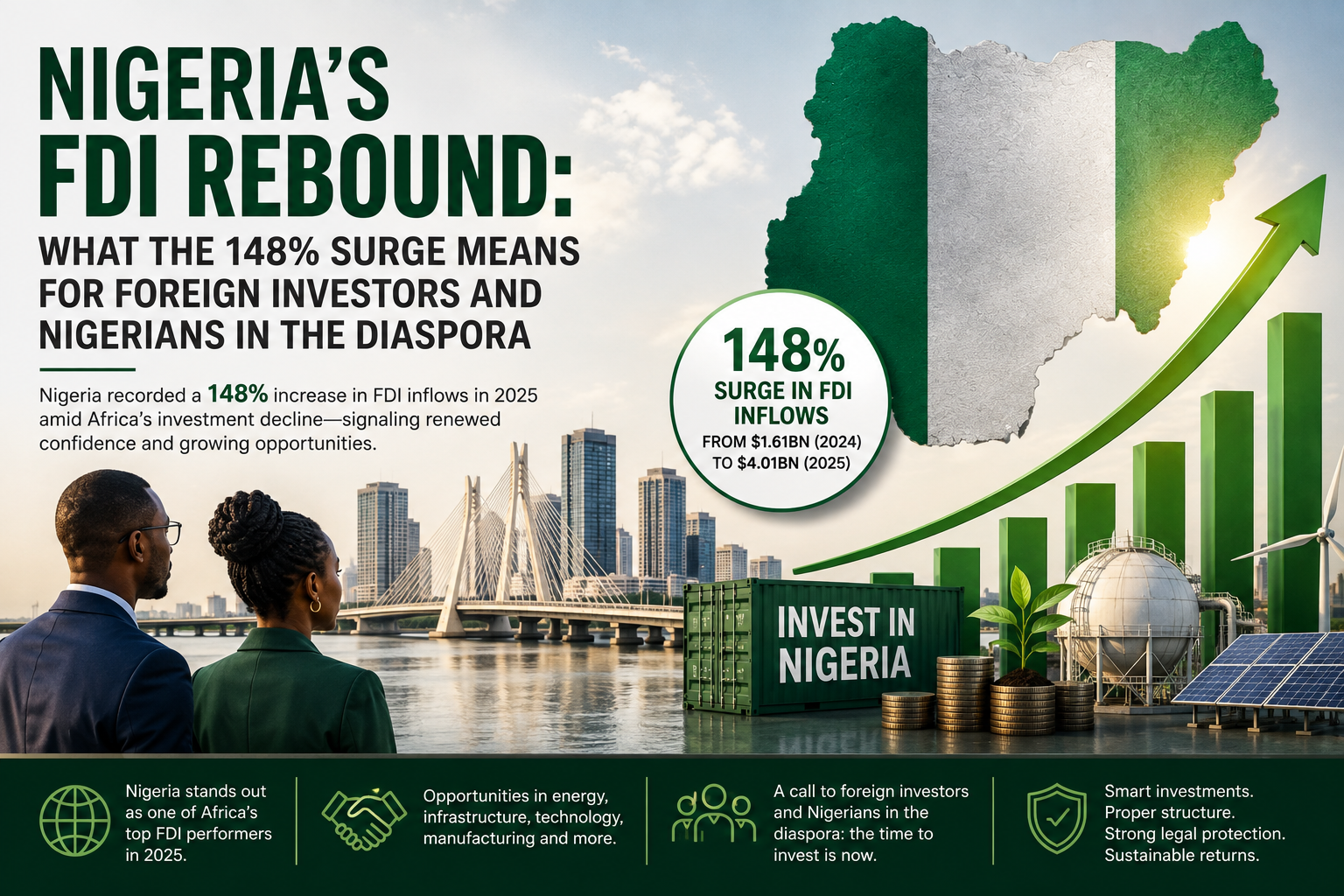
Nigeria recorded one of Africa’s strongest foreign direct investment performances in 2025, with FDI inflows rising by 148 per cent from $1.61 billion in 2024 to approximately $4.01 billion, according to the UN Trade and Development (UNCTAD) World Investment Report 2026.
The increase is significant not only because of its size, but because it occurred against a broader decline in investment across Africa. FDI flows to the continent fell by 26 per cent, from $94 billion in 2024 to $70 billion in 2025.
Nigeria’s performance therefore raises an important question: what does this rebound mean for investors looking at Nigeria, including foreign investors and Nigerians in the diaspora?
The answer goes beyond the headline 148 per cent increase.
For foreign investors considering entering or expanding in the Nigerian market, the figures suggest that significant opportunities remain available. For Nigerians in the diaspora, they may also reinforce the case for looking more closely at investment opportunities in Nigeria—but with appropriate commercial and legal safeguards.
Nigeria’s Strong Rebound in a Weak African Investment Environment
Global foreign direct investment recovered in 2025, increasing by six per cent to $1.624 trillion after two consecutive years of decline.
The recovery, however, was uneven.
Developed economies attracted approximately $723 billion, while developing Asia remained the largest destination among emerging markets, receiving about $644 billion. Africa, by contrast, recorded a significant decline in total inflows.
Against this backdrop, Nigeria’s $4.01 billion performance stands out.
Nigeria accounted for approximately 5.8 per cent of Africa’s total FDI inflows in 2025 and ranked among the continent’s leading investment destinations, although it remained behind Egypt, Guinea and Mozambique.
The figures suggest that international investors continue to identify opportunities in Nigeria despite the country’s economic and structural challenges.
But the headline figure requires closer examination.
The Deals Behind Nigeria’s FDI Numbers
A significant portion of Nigeria’s 2025 FDI performance was associated with major transactions, particularly in the oil, gas and energy sectors.
Among the notable transactions were Renaissance Africa Energy’s acquisition of Shell’s onshore assets and Huaxin Cement’s acquisition of Lafarge Africa.
Transactions of this scale can substantially increase FDI inflows in a particular year. They also demonstrate that international investors continue to see value in Nigerian assets.
However, acquisitions and large corporate transactions are different from greenfield investments.
An acquisition may transfer ownership of an existing business or asset without necessarily creating substantial new productive capacity, employment opportunities or domestic supply chains.
This distinction is important.
A sustainable investment strategy should not focus exclusively on the amount of foreign capital entering the country. It should also consider where the capital is going, what it is being used for and what economic activity it creates.
The Quality of FDI Matters
Nigeria’s 2025 figures highlight an important distinction between the volume and quality of foreign investment.
Oil and gas remain strategically important to Nigeria and will continue to attract international capital. However, an economy seeking broader and more sustainable growth needs investment across multiple sectors.
Manufacturing, technology, infrastructure, renewable energy, logistics, healthcare, agriculture, financial services and export-oriented industries all present significant opportunities.
Greenfield investments in these areas can create new productive capacity, generate employment, develop local supply chains and introduce technology and expertise into the domestic economy.
For Nigeria, the objective should therefore be to move from simply attracting large transactions to building an environment in which investors are prepared to establish and expand long-term operations.
What Does This Mean for Foreign Investors?
For foreign investors, Nigeria’s FDI rebound is a signal that the market continues to attract significant international capital.
Nigeria’s large population, consumer market, natural resources, infrastructure needs and emerging technology ecosystem create opportunities across a range of sectors.
But opportunity does not eliminate risk.
Foreign investors considering entering Nigeria must assess the regulatory, commercial and legal environment carefully before committing capital.
They may need to consider questions such as:
- What is the appropriate structure for entering the Nigerian market?
- Is a subsidiary, acquisition, joint venture or strategic partnership most suitable?
- What licences and regulatory approvals are required?
- Who owns the assets or business being acquired?
- Are there existing disputes, liabilities or encumbrances?
- What tax obligations will arise?
- How will contracts be enforced?
- How will the investment be protected?
- What mechanisms are available for resolving disputes?
- What are the implications for the eventual exit or repatriation of capital?
These are not merely legal technicalities. They can directly affect the commercial viability and risk profile of an investment.
What Does the FDI Rebound Mean for Nigerians in the Diaspora?
The story is equally relevant to Nigerians living abroad.
Nigerians in the diaspora represent an important pool of potential investment capital. Many already invest in Nigeria through property, businesses, technology, agriculture, energy and other ventures.
The increase in FDI provides another reason for diaspora investors to examine the opportunities available in the Nigerian market.
For a Nigerian living abroad, investing in Nigeria can take several forms. It may involve establishing a business, acquiring property, investing in an existing company, partnering with local entrepreneurs, financing a development project or participating in a larger investment opportunity.
However, familiarity with Nigeria does not eliminate investment risk.
Diaspora investors can face challenges involving land title, corporate ownership, local partners, regulatory approvals, documentation, contractual obligations and the management of investments from outside the country.
Distance can make these risks even more significant.
A diaspora investor may not be physically present to inspect an asset, verify documents, monitor a project or resolve problems when they arise.
This makes proper due diligence and investment structuring particularly important.
Diaspora Investment Should Go Beyond Property
Property has traditionally been a popular investment route for Nigerians in the diaspora.
However, Nigeria’s growing investment landscape presents opportunities beyond real estate.
Diaspora investors may increasingly consider sectors such as:
- Technology and digital businesses;
- Renewable energy;
- Agriculture and agribusiness;
- Manufacturing;
- Healthcare;
- Logistics;
- Infrastructure;
- Hospitality;
- Education; and
- Export-oriented businesses.
The attraction of these sectors is not simply the possibility of financial returns. Investments that build businesses and productive capacity can also contribute to employment, innovation and economic development.
The key is ensuring that the investment is properly evaluated and structured before funds are committed.
Legal Due Diligence Becomes Increasingly Important
Whether the investor is a multinational company entering Nigeria for the first time or a Nigerian in the diaspora investing in a familiar market, legal due diligence should form an important part of the investment process.
Depending on the nature of the investment, due diligence may include examining:
- Corporate ownership and shareholding structures;
- Land ownership and title;
- Regulatory approvals and sector-specific licences;
- Existing contractual obligations;
- Tax liabilities;
- Employment and labour obligations;
- Environmental and regulatory compliance;
- Intellectual property rights;
- Existing litigation and disputes;
- Debt and other encumbrances;
- The authority of local representatives and business partners; and
- Foreign exchange and capital repatriation considerations.
For an acquisition, these checks can reveal liabilities that may not be immediately apparent from the financial or commercial information provided by the seller.
For a diaspora investor purchasing property or investing in a business, they can help identify ownership, documentation and governance issues before significant funds are committed.
Structuring the Investment Properly
Investment structuring is another area that deserves attention.
The structure through which an investment is made can affect governance, taxation, liability, control, financing, regulatory obligations and the investor’s eventual exit.
For example, an investor entering into a joint venture may need to establish clear provisions governing ownership, management, funding obligations, decision-making, transfer of shares, deadlock situations and dispute resolution.
Similarly, a diaspora investor establishing or acquiring a Nigerian business should consider how the business will be owned and managed, particularly where the investor will remain outside Nigeria.
The objective should be to ensure that the legal structure supports the commercial objectives of the investment.
Local Partnerships Require Careful Attention
Foreign and diaspora investors may sometimes rely on local partners, representatives or managers to navigate the Nigerian market.
A strong local partner can provide valuable market knowledge and operational support.
However, the selection of a local partner should not be based solely on personal relationships or informal recommendations.
Appropriate due diligence can help establish the partner’s ownership structure, financial position, reputation, authority and existing business obligations.
Investment agreements should also clearly define the rights and responsibilities of each party.
Protecting the Investment
Investment decisions should also consider what happens if the relationship between investors, partners or shareholders breaks down.
Well-structured agreements can establish mechanisms for dealing with disputes, breaches of contract, changes in ownership, deadlocks and eventual exits.
Dispute-resolution provisions are particularly important for foreign and diaspora investors who may need predictable mechanisms for resolving disputes without unnecessary disruption to the underlying investment.
The objective is not to assume that a dispute will occur.
It is to ensure that the investment is adequately protected if circumstances change.
Nigeria Still Captures a Small Share of Global Capital
Despite the impressive 148 per cent increase, Nigeria’s share of global FDI remains relatively small.
Nigeria attracted approximately 0.25 per cent of global investment flows in 2025.
The comparison with other major emerging markets is instructive. Brazil attracted approximately $77 billion in FDI—more than the entire African continent—while India received approximately $39 billion.
This disparity highlights both the challenge and the opportunity.
Nigeria has a large domestic market, substantial natural resources and considerable opportunities across infrastructure and productive sectors. Yet these advantages have not translated into investment inflows proportionate to the country’s economic potential.
The issue, therefore, is not simply whether Nigeria can attract foreign investors.
It is whether Nigeria can convert its underlying economic potential into investable opportunities that international and diaspora capital can enter, operate within and exit from with greater certainty.
The Opportunity Beyond Oil and Gas
Nigeria’s continued ability to attract major energy transactions is important, but the next stage of investment growth should extend beyond traditional hydrocarbons.
Technology and digital infrastructure, manufacturing, renewable energy, agriculture, healthcare, logistics and export-oriented businesses present opportunities for investors seeking exposure to Nigeria’s long-term growth.
The development of domestic supply chains is particularly important.
An investment that creates relationships with local manufacturers, suppliers, technology providers and service businesses can have a significantly broader economic impact than a transaction that simply transfers ownership of an existing asset.
For Nigeria, attracting this type of capital should be a major policy objective.
Reforms Must Translate Into Investor Confidence
Nigeria has undertaken significant economic reforms, including changes affecting the foreign exchange market, fiscal policy and the petroleum sector.
These reforms can contribute to improving investor confidence, but their long-term effect will depend partly on consistency and predictability.
Investors generally need to know not only what the rules are today, but whether they can reasonably anticipate the regulatory environment over the life of a long-term investment.
That is particularly important for infrastructure, manufacturing, energy and other capital-intensive projects where investors may commit substantial funds over many years.
Infrastructure and Regulatory Certainty Remain Critical
Nigeria’s investment potential continues to be constrained by structural challenges.
Unreliable electricity, inadequate infrastructure, insecurity, logistics bottlenecks, high financing costs and regulatory uncertainty can increase the cost and complexity of doing business.
Addressing these constraints could have an effect beyond attracting more FDI.
A stronger investment environment could also make Nigerian businesses more competitive, encourage domestic investment and improve the ability of local companies to participate in international supply chains.
What the 148% Increase Really Tells Us
Nigeria’s 148 per cent increase in FDI is undoubtedly encouraging.
It demonstrates that international investors continue to identify valuable opportunities in the Nigerian market, even during a period when Africa as a whole experienced a substantial decline in investment inflows.
But the more important question is what happens next.
If Nigeria can build on this momentum by attracting more greenfield investments, diversifying beyond oil and gas, strengthening infrastructure and improving regulatory certainty, the country could potentially convert a strong one-year rebound into a more sustainable investment trend.
For foreign investors and Nigerians in the diaspora, the opportunity is significant—but so is the importance of getting the investment structure right.
Nigeria remains a complex market, but complexity can also create opportunities for investors who undertake appropriate commercial and legal due diligence, select reliable partners and understand the regulatory environment before committing capital.
The 2025 FDI figures should therefore be viewed not simply as evidence that more foreign money entered Nigeria.
They are a signal that Nigeria remains firmly on the investment map—and that foreign investors and Nigerians in the diaspora have an opportunity to participate in the country’s next phase of economic growth.
The challenge is to ensure that capital entering Nigeria is not only protected, but also structured in a way that supports sustainable returns, productive investment and long-term value creation.
For Investors Considering Nigeria
Whether you are a foreign investor exploring the Nigerian market or a Nigerian in the diaspora considering an investment at home, the starting point should be more than identifying an attractive opportunity.
Before committing capital, consider:
1. Conduct proper due diligence.
Verify the ownership, legal status, financial position, assets, liabilities and regulatory standing of the investment.
2. Choose the right investment structure.
Consider whether a subsidiary, joint venture, acquisition, partnership or other structure best suits your objectives.
3. Understand the regulatory environment.
Identify the approvals, licences and compliance requirements applicable to the investment.
4. Investigate local partners.
Where a partner or representative is involved, undertake appropriate due diligence before entrusting them with capital or control.
5. Protect your contractual position.
Investment and shareholder agreements should clearly address governance, funding, decision-making, disputes and exit arrangements.
6. Plan for the future.
Consider taxation, foreign exchange, repatriation, succession, exit strategies and other issues that could affect the investment over its lifetime.
Conclusion
Nigeria’s 148 per cent FDI increase in 2025 is a positive signal for the country and for investors watching the Nigerian market.
For foreign investors, it demonstrates that Nigeria continues to attract substantial international capital and offers opportunities across a wide range of sectors.
For Nigerians in the diaspora, it reinforces the opportunity to participate in Nigeria’s economic growth through carefully selected and properly structured investments.
But the ultimate measure of success will not simply be whether Nigeria attracts more billions of dollars in foreign capital.
It will be whether those investments create new businesses, expand productive capacity, strengthen domestic supply chains, transfer technology, generate employment and contribute to sustainable economic growth.
Nigeria’s investment story is therefore not just about how much capital comes into the country. It is about what that capital builds—and whether investors have the legal and commercial protections necessary to build for the long term.
A publication of Edidiong Akpanuwa & Co.