
- October 5, 2026
- Edidiong Akpanuwa & Co
- 0
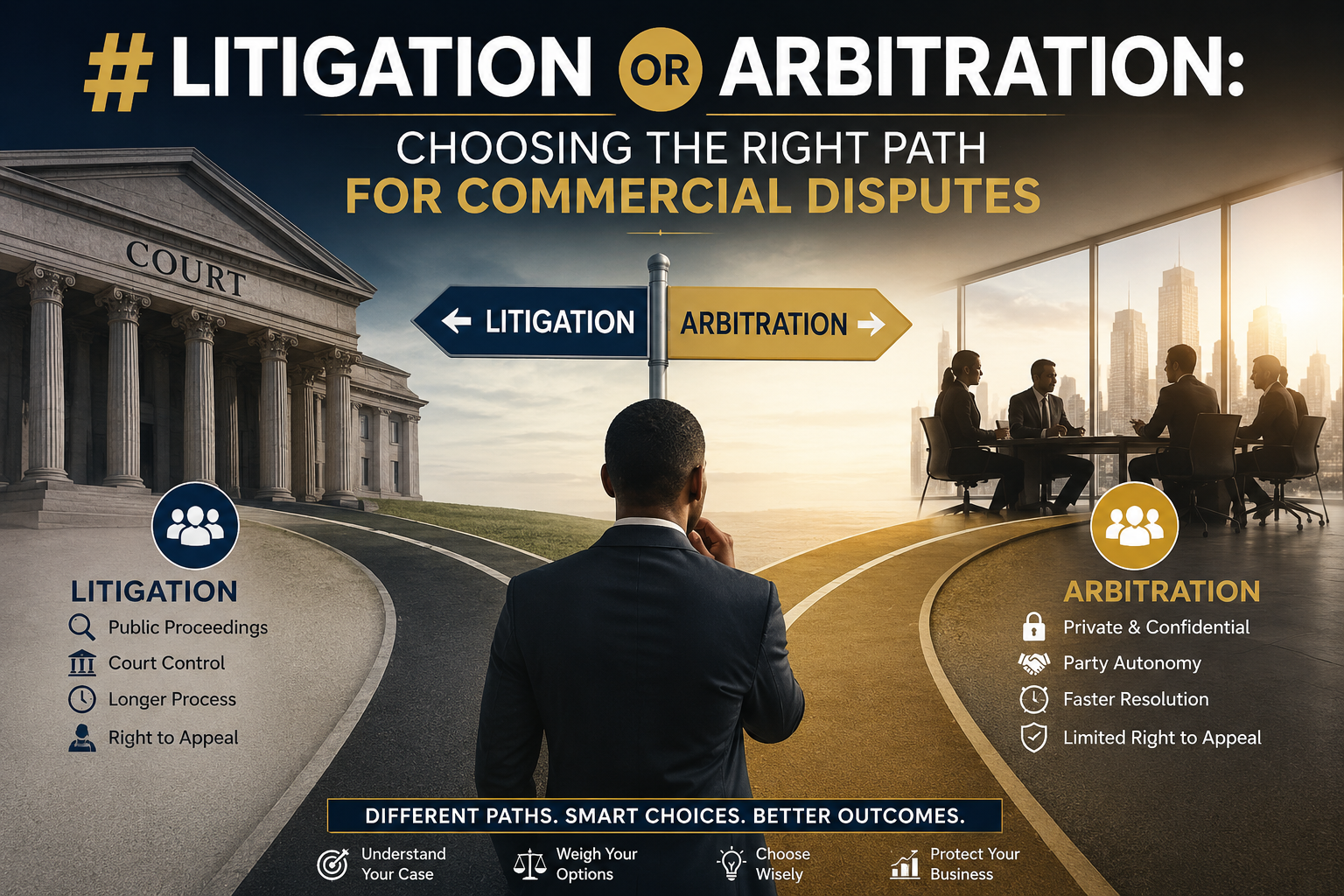
Litigation or Arbitration: Choosing the Right Path for Commercial Disputes
When commercial disputes arise, businesses are often faced with an important strategic decision: should the dispute be resolved through litigation or arbitration?
Both mechanisms provide legally recognized avenues for resolving commercial disagreements, but they operate differently and can produce very different experiences for the parties involved.
The right choice depends on several factors, including the nature of the dispute, the terms of the contract, the value and complexity of the claim, confidentiality concerns, the location of the parties and assets, enforcement considerations, and the commercial relationship between the parties.
Importantly, dispute resolution planning should not begin after a dispute has already escalated. Businesses should consider these issues when negotiating and drafting their contracts so that an appropriate dispute-resolution mechanism is already in place if disagreements arise.
Understanding Commercial Litigation
Litigation involves resolving a dispute through the court system.
For businesses, commercial litigation may arise from a wide range of disputes, including:
- Breach of commercial contracts;
- Debt recovery;
- Shareholder and partnership disputes;
- Property and investment disputes;
- Employment-related claims;
- Construction disputes;
- Intellectual property disputes;
- Corporate and insolvency matters;
- Disputes involving suppliers, customers, or business partners.
One of the principal advantages of litigation is that the courts have extensive procedural and enforcement powers.
Depending on the nature of the proceedings, parties may have access to formal processes for presenting evidence, examining witnesses, obtaining relevant documents, and challenging the opposing party’s case.
Advantages of Litigation for Businesses
Court proceedings may be particularly appropriate where a dispute requires the exercise of judicial powers or where the parties need remedies that are best obtained through the court system.
Formal Procedural Framework
Litigation operates within established procedural rules. These rules provide a structured framework for pleadings, evidence, hearings, judgments, and appeals.
For complex disputes, this formal structure can help ensure that the parties’ respective positions are properly presented and determined.
Court Orders and Remedies
Courts can provide a range of remedies depending on the circumstances and applicable law.
A business may seek remedies such as damages, injunctions, declarations, specific performance, or other appropriate orders.
Where urgent protection is required, court intervention may also be particularly important.
Development of Legal Precedent
Court judgments can contribute to the development and clarification of legal principles.
Where a dispute involves an unsettled or important legal question, judicial determination may provide guidance that extends beyond the immediate parties.
This can be particularly relevant in disputes involving significant questions of commercial or corporate law.
Potential Disadvantages of Litigation
Despite its advantages, litigation can also create challenges for businesses.
Time and Cost
Complex commercial litigation can take considerable time and require substantial legal and administrative resources.
Legal fees, expert expenses, document management, court-related costs, and management time can all contribute to the overall cost of a dispute.
Public Proceedings
Court proceedings are generally subject to principles of public access and transparency, although the specific treatment of information depends on the applicable law and circumstances.
Businesses concerned about commercially sensitive information should therefore consider the potential implications before commencing proceedings.
Strained Commercial Relationships
Litigation can make an already difficult business relationship more adversarial.
Where the parties are long-term business partners, suppliers, investors, or customers, the commencement of court proceedings may make future cooperation more difficult.
Understanding Commercial Arbitration
Arbitration is a private dispute-resolution process in which parties agree to submit their dispute to one or more arbitrators rather than having it determined through ordinary court proceedings.
Arbitration is generally based on the parties’ agreement to arbitrate.
The arbitration clause may be included in the original commercial contract, or parties may agree to arbitration after a dispute has arisen.
The arbitration agreement should be carefully drafted because its wording can affect important issues such as the scope of disputes covered, the seat of arbitration, the applicable rules, the number and appointment of arbitrators, and other procedural matters.
Advantages of Arbitration
Arbitration can offer several advantages in appropriate commercial disputes.
Confidentiality and Privacy
Businesses may prefer arbitration where the dispute involves commercially sensitive information.
The private nature of arbitration can be attractive where parties want to reduce unnecessary public exposure of contractual, financial, technical, or business information, subject to the applicable arbitration rules and legal framework.
Procedural Flexibility
Arbitration can provide parties with greater flexibility in determining aspects of the dispute-resolution process.
Depending on the agreement and applicable rules, parties may have greater input into procedural arrangements, the appointment of arbitrators, and the conduct of the proceedings.
Choice of Decision-Maker
In appropriate cases, parties can select an arbitrator with relevant technical or commercial expertise.
This can be particularly useful where a dispute involves specialized industries such as construction, energy, infrastructure, finance, technology, or other technically complex areas.
Cross-Border Enforcement
International arbitration can be particularly attractive where parties are based in different countries or where assets are located across jurisdictions.
International enforcement frameworks can provide mechanisms for recognition and enforcement of arbitral awards in jurisdictions that are party to the relevant international conventions.
For businesses involved in cross-border transactions, this can be an important consideration when negotiating dispute-resolution provisions.
Potential Disadvantages of Arbitration
Arbitration is not automatically cheaper, faster, or better than litigation.
Arbitration Can Be Expensive
The costs of arbitration can include arbitrators’ fees, institutional fees where applicable, legal fees, expert fees, hearing expenses, and other administrative costs.
In complex matters involving multiple arbitrators and extensive evidence, the overall cost can be substantial.
Limited Appeal Opportunities
Arbitration generally provides more limited opportunities to challenge an award than ordinary court judgments, although the applicable law may provide specific grounds for setting aside or challenging an award.
Businesses should therefore understand the implications of agreeing to arbitration before including an arbitration clause in a contract.
Enforcement Can Still Present Challenges
Although international arbitration can provide significant enforcement advantages, obtaining an award is not necessarily the same as recovering the money.
Businesses should still consider where the opposing party’s assets are located and whether an award is likely to be recognized and enforceable in the relevant jurisdiction.
Litigation vs Arbitration: What Should Businesses Consider?
There is no universal answer to the question of whether litigation or arbitration is better.
The appropriate mechanism depends on the circumstances of the transaction and the dispute.
Businesses should consider several important factors.
1. What Is the Nature of the Dispute?
The subject matter of the dispute may influence the appropriate forum.
Some disputes may benefit from judicial determination, particularly where important legal questions or court-specific remedies are involved.
Other disputes may be better suited to arbitration, particularly where technical expertise, confidentiality, or cross-border considerations are important.
2. How Important Is Confidentiality?
If the dispute involves trade secrets, proprietary technology, sensitive financial information, strategic business plans, or confidential contractual arrangements, privacy may be an important consideration.
Arbitration may be attractive in such circumstances, although businesses should examine the applicable rules and legal framework rather than assume that every aspect of arbitration is automatically confidential.
3. Where Are the Parties and Their Assets Located?
Jurisdiction and enforcement are particularly important in cross-border transactions.
A business should consider not only where the dispute will be heard but also where the opposing party’s assets are located.
An effective dispute-resolution strategy should ideally anticipate the enforcement stage rather than focus solely on obtaining a favorable decision.
4. How Complex Is the Dispute?
Highly technical disputes may benefit from a decision-maker with relevant industry knowledge.
For example, construction, engineering, energy, technology, and infrastructure disputes may involve technical issues that require specialized understanding.
The ability to appoint an arbitrator with relevant expertise may therefore be an important consideration.
5. What Is the Value of the Claim?
The value of a dispute should be considered alongside the likely cost of resolving it.
Businesses should assess whether the expected commercial benefit justifies the anticipated cost and duration of the proceedings.
This does not mean that smaller claims should never be pursued. Rather, businesses should select a dispute-resolution strategy that is proportionate to the commercial stakes involved.
The Importance of the Arbitration Clause
One of the most important lessons for businesses is that dispute resolution should be considered before the dispute arises.
A poorly drafted arbitration clause can create uncertainty about whether arbitration is required, what disputes are covered, which rules apply, and where the arbitration should take place.
A well-drafted clause should be carefully considered in relation to issues such as:
- The scope of disputes subject to arbitration;
- The seat of arbitration;
- The applicable arbitration rules;
- The number and appointment of arbitrators;
- The language of the proceedings;
- Applicable substantive law;
- Enforcement considerations.
Businesses entering significant commercial transactions should therefore avoid treating the dispute-resolution clause as boilerplate.
Cross-Border Transactions Require Additional Planning
For foreign investors, Nigerian businesses entering international transactions, and companies operating across multiple jurisdictions, dispute-resolution provisions can have particularly significant consequences.
A dispute may involve parties in different countries, assets in multiple jurisdictions, and contracts governed by different legal systems.
In such transactions, businesses should consider:
- Where proceedings can be commenced;
- Which law governs the contract;
- Where an award or judgment would need to be enforced;
- Whether the relevant jurisdictions recognize and enforce foreign judgments or arbitral awards;
- Whether the chosen forum is commercially practical.
These issues should be considered during transaction structuring rather than after a dispute has already developed.
Can Businesses Use Negotiation or Mediation Instead?
Litigation and arbitration are not the only options available.
Businesses should also consider negotiation and mediation, particularly where preserving a commercial relationship is important.
A negotiated settlement can allow parties to maintain greater control over the outcome, while mediation can provide a structured process for exploring settlement with the assistance of a neutral third party.
In some cases, a contract may establish a multi-step dispute-resolution process requiring negotiation or mediation before arbitration or litigation.
Businesses should therefore review their contracts carefully before commencing formal proceedings.
Common Dispute-Resolution Mistakes
Businesses can expose themselves to unnecessary risk by failing to properly consider dispute-resolution mechanisms during contract drafting.
Common mistakes include:
- Using a generic dispute-resolution clause without considering the transaction;
- Selecting arbitration without understanding its costs and implications;
- Failing to specify an appropriate seat of arbitration;
- Creating inconsistent jurisdiction and arbitration provisions;
- Ignoring cross-border enforcement considerations;
- Failing to identify the applicable governing law;
- Waiting until a dispute arises before considering enforcement;
- Assuming arbitration is always faster or cheaper than litigation.
Careful drafting at the beginning of a commercial relationship can prevent significant uncertainty later.
Key Risks Businesses Should Consider
Before choosing litigation or arbitration, businesses should consider:
- Jurisdictional risks: Whether the chosen forum has authority to determine the dispute.
- Enforcement risks: Whether a judgment or award can realistically be enforced.
- Cost risks: Whether the anticipated expense is proportionate to the value of the dispute.
- Delay risks: Whether the chosen process is likely to meet the business’s timeline.
- Confidentiality concerns: Whether sensitive commercial information requires additional protection.
- Relationship risks: Whether the dispute-resolution process could damage an important commercial relationship.
- Drafting risks: Whether the contract’s dispute-resolution clause clearly reflects the parties’ intentions.
What This Means for Businesses
The choice between litigation and arbitration should not be made solely because one mechanism appears more attractive in general terms.
The better approach is to consider the specific transaction, the nature of the dispute, the parties involved, the location of assets, the desired remedies, the likely costs, and the enforcement environment.
For businesses entering significant transactions, dispute-resolution planning should form part of the contract-negotiation process.
A carefully considered clause can provide greater certainty and reduce the risk of expensive jurisdictional disputes when a commercial relationship breaks down.
Conclusion
Neither litigation nor arbitration is inherently superior.
Litigation may be appropriate where judicial authority, formal court processes, particular remedies, or authoritative determination of legal questions are important. Arbitration may be attractive where privacy, procedural flexibility, specialist decision-makers, or cross-border enforcement considerations are central to the transaction.
The most effective approach is therefore not to ask, “Which is better—litigation or arbitration?”
The better question is:
“Which dispute-resolution mechanism best protects our commercial interests in this particular transaction?”
Businesses that answer that question before a dispute arises are better positioned to manage risk, protect their contractual rights, control potential costs, and respond strategically when commercial disagreements occur.
A publication of Edidiong Akpanuwa & Co.