
- September 9, 2026
- Edidiong Akpanuwa & Co
- 0
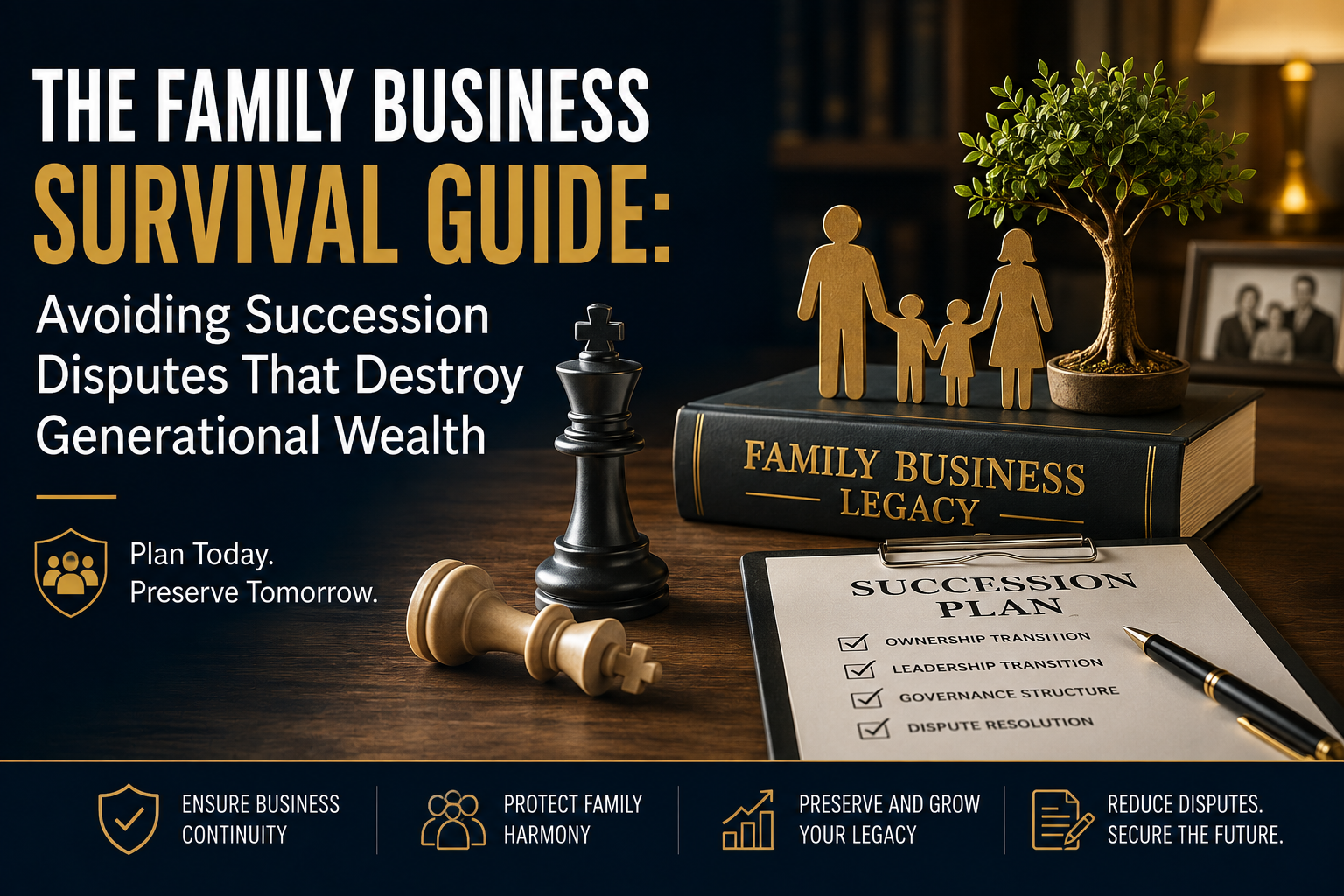
Why Family Businesses Often Struggle After the Founder
Family-owned businesses represent a significant part of private enterprise in Nigeria. Many have been built over decades through hard work, entrepreneurship, and sacrifice. Yet despite their commercial success, some struggle to survive beyond the founding generation.
The problem is often not a lack of profitability or market opportunity. It is the absence of a clear succession plan.
When a founder dies or becomes unable to continue managing the business, questions can quickly arise about ownership, leadership, control, and decision-making. If these issues have not been addressed in advance, family members may find themselves in disputes that threaten both family relationships and the future of the business.
Where Succession Disputes Begin
Succession disputes commonly arise where multiple heirs claim entitlement to leadership positions, ownership structures are unclear, or family members disagree about who should control the business.
Conflicts may also arise where some family members have worked in the business for many years while others have not been involved in its operations but still have ownership or inheritance interests.
In some cases, disputes may extend beyond the family to minority shareholders, investors, directors, or business partners.
Ownership and Management Are Not the Same
One of the most important considerations in succession planning is the distinction between ownership succession and management succession.
Ownership interests may pass to family members without necessarily making every beneficiary suitable to manage the business.
A well-designed succession framework can allow family members to retain ownership while ensuring that management responsibility is entrusted to individuals with the skills, experience, and competence required to operate the business.
This distinction can help preserve both family wealth and the professional management of the enterprise.
Legal Structures That Can Reduce Succession Risk
Several legal and corporate arrangements can help family businesses manage succession and reduce the likelihood of disputes.
Depending on the circumstances, these may include:
- Shareholders’ agreements;
- Family constitutions;
- Trust arrangements;
- Buy-sell agreements;
- Clearly defined corporate governance structures; and
- Proper estate and succession planning.
The appropriate structure will depend on the nature of the business, its ownership arrangement, the family structure, and the long-term objectives of the owners.
The Cost of Poor Succession Planning
When succession is not properly planned, the consequences can extend well beyond family disagreements.
Key risks include:
- A leadership vacuum following the death or incapacity of the founder;
- Disputes among shareholders and family members;
- Uncertainty over ownership and control;
- Loss of employee, customer, or investor confidence;
- Disruption to business operations;
- Decline in enterprise value; and
- Costly litigation.
A business that has taken decades to build can lose significant value if uncertainty is allowed to undermine its operations.
What This Means for Business Owners
Succession planning should be treated as a business continuity strategy, not merely as an estate planning exercise.
Business owners should consider, well in advance:
- Who should own the business in the future;
- Who should manage it;
- How important decisions will be made;
- How ownership interests will be transferred; and
- What should happen if a key founder dies, retires, or becomes unable to participate.
The earlier these questions are addressed, the greater the opportunity to create a structured transition and reduce the risk of conflict.
Key Takeaway
The greatest threat to the survival of many family businesses may not be external competition but internal uncertainty.
A well-designed succession plan can protect family relationships, preserve business value, provide continuity of management, and ensure that the wealth created by one generation can be successfully transferred to the next.
Generational wealth is not preserved by building a successful business alone. It is preserved by planning for what happens when the founder is no longer there to run it.
A publication of Edidiong Akpanuwa & Co.