
- November 20, 2026
- Edidiong Akpanuwa & Co
- 0
You’ve won your case in court—but what happens if the other party refuses to comply?
Many people celebrate after obtaining a favourable judgment, believing that the dispute has finally come to an end. In reality, winning a case and enforcing the judgment are two different stages of the legal process.
A court may declare that you are entitled to money, property, possession or another form of relief. But if the judgment debtor refuses to comply voluntarily, the successful party may have to take further legal steps to turn the judgment into an actual result.
The Supreme Court reaffirmed this important principle in OYE v. ODIDAN & ORS (2024) LPELR-80034(SC), where it held:
“Enforcement of judgment of any Court is normally a post-judgment event, and it must be carried out in line with our laws. Courts in Nigeria which are Courts of record are by Section 6(6) of the Constitution vested with the judicial powers of the Federation.”
The decision highlights an important point: a judgment does not ordinarily enforce itself.
Where the judgment debtor fails or refuses to comply, the successful party must use the enforcement procedures recognised by Nigerian law.
Winning the Case Is Not Always the End
Obtaining judgment is a major legal victory, but it may only be the beginning of the final stage of the dispute.
For example, a court may order a defendant to pay ₦20 million to a successful claimant.
If the defendant pays voluntarily, the matter may effectively come to an end.
But what happens if the defendant refuses to pay?
The claimant cannot simply take the defendant’s property by force. Instead, the claimant must use the appropriate legal mechanism to enforce the judgment.
The same principle applies where a judgment concerns possession of land, delivery of property, performance of an obligation or another form of relief.
The court’s judgment must be enforced through lawful procedures.
What Is Judgment Enforcement?
Judgment enforcement refers to the legal process through which a successful party obtains the benefit of a court judgment when the judgment debtor does not comply voluntarily.
The appropriate procedure depends on the nature of the judgment.
A judgment requiring payment of money may require a different enforcement mechanism from a judgment relating to possession of property or the performance of a particular act.
This is why it is important to identify the precise relief granted by the court before deciding how to proceed.
Monetary Judgments: What Happens When the Debtor Refuses to Pay?
Suppose you successfully sue a business for an unpaid debt and the court enters judgment in your favour for ₦20 million.
The judgment debtor refuses to pay despite the judgment.
The fact that the debtor has refused to comply does not mean that you are entitled to personally seize the debtor’s vehicles, empty the debtor’s bank account or take other property by force.
Instead, you need to invoke the lawful judgment-enforcement procedures available under Nigerian law.
Depending on the circumstances, the appropriate enforcement mechanism may involve recognised processes for recovering the judgment debt from the debtor or property against which enforcement may lawfully proceed.
The precise procedure should be determined by reference to the judgment, the assets involved and the applicable procedural law.
Do Not Use Self-Help
One of the most important lessons from the Supreme Court’s decision is that self-help is not a substitute for lawful enforcement.
Winning a case does not give a successful litigant a licence to take matters into their own hands.
For example, a judgment creditor should not:
- Forcefully seize another person’s vehicle;
- Break into premises to recover property;
- Lock up a debtor’s business;
- Physically remove occupants from property without lawful authority;
- Take money or assets by force; or
- Use private individuals to carry out acts that should properly be undertaken through lawful enforcement procedures.
Even if the judgment is entirely in your favour, taking matters into your own hands can create new legal problems.
A Practical Example: Recovery of ₦20 Million
Imagine that a contractor provides services to a company but is not paid.
The contractor commences an action and eventually obtains judgment for ₦20 million.
The company refuses to pay.
The contractor cannot simply arrive at the company’s premises with workers and remove computers, vehicles or equipment in an attempt to recover the judgment debt.
The proper course is to obtain legal advice and commence the appropriate judgment-enforcement process.
The law provides mechanisms through which a successful litigant may seek to enforce a monetary judgment.
The fact that you have won the case does not eliminate the need to follow the law when enforcing the judgment.
Enforcement of Judgments Relating to Land or Possession
The same principle applies where the judgment concerns land or a building.
Suppose a claimant successfully establishes a right to possession of a property and the court makes an order requiring the occupants to give up possession.
The successful party should not simply gather people and forcibly evict the occupants.
Instead, the judgment should be enforced through the legally recognised process.
This is particularly important because disputes concerning possession can involve additional issues, including the identity of occupants, the precise terms of the judgment and the authority required to execute the order.
Why the Exact Terms of the Judgment Matter
Before taking enforcement steps, the successful party should carefully examine the judgment and the orders actually made by the court.
A party may have won on some issues but not others.
For example, the court may have:
- Awarded damages;
- Granted a declaration;
- Ordered payment of a specific amount;
- Ordered delivery or possession of property;
- Granted an injunction; or
- Made another specific order.
The enforcement procedure must correspond with what the court actually ordered.
It is therefore not enough to say:
“I won the case.”
The more important question is:
“What exactly did the court order, and what lawful procedure is available to give effect to that order?”
Enforcement Must Follow the Law
The Supreme Court’s decision underscores that enforcement is a post-judgment event that must be carried out in accordance with the law.
This protects both sides.
The judgment creditor is protected because there are established mechanisms through which the judgment can be enforced.
The judgment debtor is also protected because enforcement cannot simply be carried out through arbitrary or unlawful means.
This balance is important to maintaining confidence in the judicial system.
What If the Judgment Debtor Has Assets?
A judgment creditor may need to determine what assets or resources are available for lawful enforcement.
This may require appropriate legal investigation and procedural steps.
The fact that a person has obtained a judgment does not automatically mean that every asset belonging to the judgment debtor can be seized.
There may be legal restrictions, ownership issues, third-party interests or other considerations affecting enforcement.
Consequently, asset recovery should be approached strategically and within the limits of the law.
Do Not Delay After Winning
A successful judgment creditor should not necessarily assume that there is no urgency once judgment has been obtained.
If the judgment debtor is unwilling to comply, delay may create additional practical difficulties.
Assets may be transferred, businesses may change, property may become more difficult to locate or other circumstances may arise that complicate recovery.
This does not mean that every judgment must be enforced immediately in exactly the same manner. Rather, it emphasises the importance of obtaining appropriate advice promptly after judgment, particularly where voluntary compliance appears unlikely.
What You Should Do After Obtaining Judgment
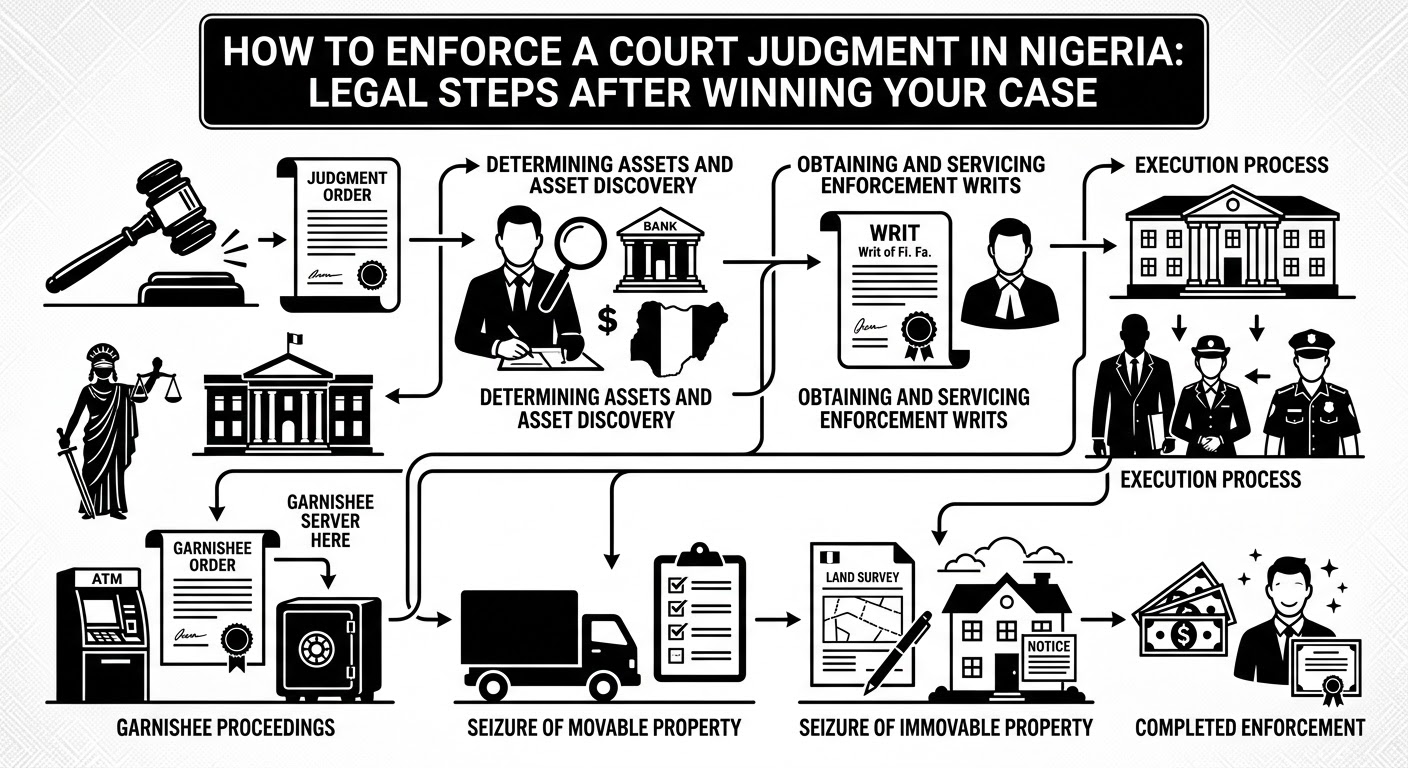
If you have obtained a favourable judgment, consider the following steps:
1. Obtain and Review the Judgment
Read the judgment carefully and identify precisely what the court ordered.
2. Determine Whether the Debtor Will Comply Voluntarily
In some cases, the judgment debtor may comply without the need for formal enforcement proceedings.
3. Assess the Appropriate Enforcement Mechanism
If the debtor refuses to comply, obtain legal advice on the appropriate enforcement procedure for the particular judgment.
4. Identify Relevant Assets or Rights
Where the judgment concerns money, it may be necessary to consider what assets or resources are lawfully available for enforcement.
5. Avoid Self-Help
Do not personally seize property, force occupants out of premises or take other unilateral steps simply because you have won the case.
6. Act Through the Proper Legal Channels
Ensure that all enforcement steps comply with the applicable legislation, rules of court and other legal requirements.
Can a Judgment Be Challenged After It Is Delivered?
A judgment debtor may, depending on the circumstances and applicable law, have avenues available to challenge or appeal a judgment.
This is another reason why judgment enforcement should be handled carefully.
The existence of a judgment does not mean that every enforcement step is automatically permissible in every circumstance.
Issues such as an appeal, a stay of execution or other relevant court orders may affect the appropriate course of action.
For this reason, the judgment should be reviewed by a lawyer before significant enforcement steps are taken.
Practical Takeaway
Winning a lawsuit is an important milestone, but it is not necessarily the end of the legal journey.
If the judgment debtor refuses to comply, the successful party must use the appropriate legal mechanisms to enforce the judgment.
The Supreme Court’s decision in OYE v. ODIDAN & ORS (2024) LPELR-80034(SC) reinforces the principle that enforcement is a post-judgment process that must be carried out in accordance with the law.
Most importantly, do not resort to self-help.
A successful litigant cannot simply seize another person’s property, lock up premises, forcefully recover money or evict occupants merely because a judgment has been obtained.
The proper enforcement process exists for a reason.
The Key Lesson
A judgment gives you a legal right—but enforcing that right still requires lawful procedure.
If you have won your case and the other party refuses to comply, obtain appropriate legal advice on the correct enforcement mechanism.
The objective is not merely to win a judgment. It is to lawfully convert that judgment into the practical result the court ordered.
How to Enforce a Court Judgment in Nigeria: Legal Steps After Winning Your Case
You’ve won your case in court—but what happens if the other party refuses to comply?
Many people celebrate after obtaining a favourable judgment, believing that the dispute has finally come to an end. In reality, winning a case and enforcing the judgment are two different stages of the legal process.
A court may declare that you are entitled to money, property, possession or another form of relief. But if the judgment debtor refuses to comply voluntarily, the successful party may have to take further legal steps to turn the judgment into an actual result.
The Supreme Court reaffirmed this important principle in OYE v. ODIDAN & ORS (2024) LPELR-80034(SC), where it held:
“Enforcement of judgment of any Court is normally a post-judgment event, and it must be carried out in line with our laws. Courts in Nigeria which are Courts of record are by Section 6(6) of the Constitution vested with the judicial powers of the Federation.”
The decision highlights an important point: a judgment does not ordinarily enforce itself.
Where the judgment debtor fails or refuses to comply, the successful party must use the enforcement procedures recognised by Nigerian law.
Winning the Case Is Not Always the End
Obtaining judgment is a major legal victory, but it may only be the beginning of the final stage of the dispute.
For example, a court may order a defendant to pay ₦20 million to a successful claimant.
If the defendant pays voluntarily, the matter may effectively come to an end.
But what happens if the defendant refuses to pay?
The claimant cannot simply take the defendant’s property by force. Instead, the claimant must use the appropriate legal mechanism to enforce the judgment.
The same principle applies where a judgment concerns possession of land, delivery of property, performance of an obligation or another form of relief.
The court’s judgment must be enforced through lawful procedures.
What Is Judgment Enforcement?
Judgment enforcement refers to the legal process through which a successful party obtains the benefit of a court judgment when the judgment debtor does not comply voluntarily.
The appropriate procedure depends on the nature of the judgment.
A judgment requiring payment of money may require a different enforcement mechanism from a judgment relating to possession of property or the performance of a particular act.
This is why it is important to identify the precise relief granted by the court before deciding how to proceed.
Monetary Judgments: What Happens When the Debtor Refuses to Pay?
Suppose you successfully sue a business for an unpaid debt and the court enters judgment in your favour for ₦20 million.
The judgment debtor refuses to pay despite the judgment.
The fact that the debtor has refused to comply does not mean that you are entitled to personally seize the debtor’s vehicles, empty the debtor’s bank account or take other property by force.
Instead, you need to invoke the lawful judgment-enforcement procedures available under Nigerian law.
Depending on the circumstances, the appropriate enforcement mechanism may involve recognised processes for recovering the judgment debt from the debtor or property against which enforcement may lawfully proceed.
The precise procedure should be determined by reference to the judgment, the assets involved and the applicable procedural law.
Do Not Use Self-Help
One of the most important lessons from the Supreme Court’s decision is that self-help is not a substitute for lawful enforcement.
Winning a case does not give a successful litigant a licence to take matters into their own hands.
For example, a judgment creditor should not:
- Forcefully seize another person’s vehicle;
- Break into premises to recover property;
- Lock up a debtor’s business;
- Physically remove occupants from property without lawful authority;
- Take money or assets by force; or
- Use private individuals to carry out acts that should properly be undertaken through lawful enforcement procedures.
Even if the judgment is entirely in your favour, taking matters into your own hands can create new legal problems.
A Practical Example: Recovery of ₦20 Million
Imagine that a contractor provides services to a company but is not paid.
The contractor commences an action and eventually obtains judgment for ₦20 million.
The company refuses to pay.
The contractor cannot simply arrive at the company’s premises with workers and remove computers, vehicles or equipment in an attempt to recover the judgment debt.
The proper course is to obtain legal advice and commence the appropriate judgment-enforcement process.
The law provides mechanisms through which a successful litigant may seek to enforce a monetary judgment.
The fact that you have won the case does not eliminate the need to follow the law when enforcing the judgment.
Enforcement of Judgments Relating to Land or Possession
The same principle applies where the judgment concerns land or a building.
Suppose a claimant successfully establishes a right to possession of a property and the court makes an order requiring the occupants to give up possession.
The successful party should not simply gather people and forcibly evict the occupants.
Instead, the judgment should be enforced through the legally recognised process.
This is particularly important because disputes concerning possession can involve additional issues, including the identity of occupants, the precise terms of the judgment and the authority required to execute the order.
Why the Exact Terms of the Judgment Matter
Before taking enforcement steps, the successful party should carefully examine the judgment and the orders actually made by the court.
A party may have won on some issues but not others.
For example, the court may have:
- Awarded damages;
- Granted a declaration;
- Ordered payment of a specific amount;
- Ordered delivery or possession of property;
- Granted an injunction; or
- Made another specific order.
The enforcement procedure must correspond with what the court actually ordered.
It is therefore not enough to say:
“I won the case.”
The more important question is:
“What exactly did the court order, and what lawful procedure is available to give effect to that order?”
Enforcement Must Follow the Law
The Supreme Court’s decision underscores that enforcement is a post-judgment event that must be carried out in accordance with the law.
This protects both sides.
The judgment creditor is protected because there are established mechanisms through which the judgment can be enforced.
The judgment debtor is also protected because enforcement cannot simply be carried out through arbitrary or unlawful means.
This balance is important to maintaining confidence in the judicial system.
What If the Judgment Debtor Has Assets?
A judgment creditor may need to determine what assets or resources are available for lawful enforcement.
This may require appropriate legal investigation and procedural steps.
The fact that a person has obtained a judgment does not automatically mean that every asset belonging to the judgment debtor can be seized.
There may be legal restrictions, ownership issues, third-party interests or other considerations affecting enforcement.
Consequently, asset recovery should be approached strategically and within the limits of the law.
Do Not Delay After Winning
A successful judgment creditor should not necessarily assume that there is no urgency once judgment has been obtained.
If the judgment debtor is unwilling to comply, delay may create additional practical difficulties.
Assets may be transferred, businesses may change, property may become more difficult to locate or other circumstances may arise that complicate recovery.
This does not mean that every judgment must be enforced immediately in exactly the same manner. Rather, it emphasises the importance of obtaining appropriate advice promptly after judgment, particularly where voluntary compliance appears unlikely.
What You Should Do After Obtaining Judgment
If you have obtained a favourable judgment, consider the following steps:
1. Obtain and Review the Judgment
Read the judgment carefully and identify precisely what the court ordered.
2. Determine Whether the Debtor Will Comply Voluntarily
In some cases, the judgment debtor may comply without the need for formal enforcement proceedings.
3. Assess the Appropriate Enforcement Mechanism
If the debtor refuses to comply, obtain legal advice on the appropriate enforcement procedure for the particular judgment.
4. Identify Relevant Assets or Rights
Where the judgment concerns money, it may be necessary to consider what assets or resources are lawfully available for enforcement.
5. Avoid Self-Help
Do not personally seize property, force occupants out of premises or take other unilateral steps simply because you have won the case.
6. Act Through the Proper Legal Channels
Ensure that all enforcement steps comply with the applicable legislation, rules of court and other legal requirements.
Can a Judgment Be Challenged After It Is Delivered?
A judgment debtor may, depending on the circumstances and applicable law, have avenues available to challenge or appeal a judgment.
This is another reason why judgment enforcement should be handled carefully.
The existence of a judgment does not mean that every enforcement step is automatically permissible in every circumstance.
Issues such as an appeal, a stay of execution or other relevant court orders may affect the appropriate course of action.
For this reason, the judgment should be reviewed by a lawyer before significant enforcement steps are taken.
Practical Takeaway
Winning a lawsuit is an important milestone, but it is not necessarily the end of the legal journey.
If the judgment debtor refuses to comply, the successful party must use the appropriate legal mechanisms to enforce the judgment.
The Supreme Court’s decision in OYE v. ODIDAN & ORS (2024) LPELR-80034(SC) reinforces the principle that enforcement is a post-judgment process that must be carried out in accordance with the law.
Most importantly, do not resort to self-help.
A successful litigant cannot simply seize another person’s property, lock up premises, forcefully recover money or evict occupants merely because a judgment has been obtained.
The proper enforcement process exists for a reason.
The Key Lesson
A judgment gives you a legal right—but enforcing that right still requires lawful procedure.
If you have won your case and the other party refuses to comply, obtain appropriate legal advice on the correct enforcement mechanism.
The objective is not merely to win a judgment. It is to lawfully convert that judgment into the practical result the court ordered.
A publication of Edidiong Akpanuwa & Co.