
- November 4, 2026
- Edidiong Akpanuwa & Co
- 0
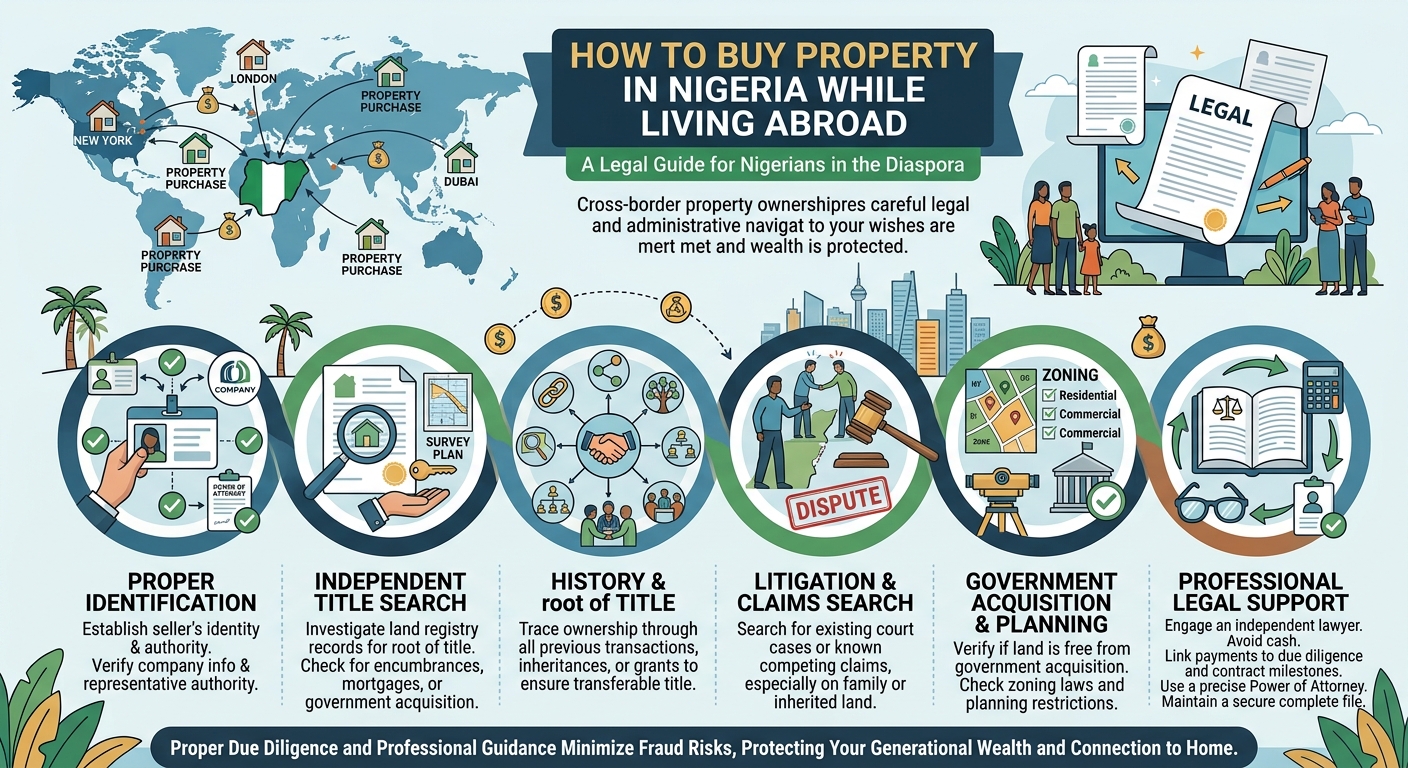
How to Buy Property in Nigeria While Living Abroad: A Legal Guide for Nigerians in the Diaspora
For many Nigerians living abroad, buying property in Nigeria is more than a financial investment. It can represent a connection to home, a plan for retirement, an opportunity to build generational wealth, or a way of securing accommodation for family members.
However, purchasing land or property from overseas comes with particular legal risks. A buyer who is physically absent from Nigeria may be more dependent on agents, relatives, friends or other representatives. This can make it easier for fraudulent sellers, dishonest intermediaries and persons with competing claims to take advantage of the buyer.
The fact that a property is advertised online, shown to a prospective buyer through video calls, or recommended by someone trusted does not establish that the seller has good and transferable title.
Distance should never replace proper legal due diligence.
Why Buying Property From Abroad Requires Careful Planning
A buyer living overseas may not be able to personally inspect the property, visit the relevant land registry, meet the seller or investigate the history of the land.
This creates additional risks.
For example, the person presenting the property may not be the true owner. The property may have been sold previously, may be subject to a family dispute, may be affected by government acquisition, or may have documentation that does not establish the interest the seller claims to possess.
There may also be issues involving customary ownership, family land, inheritance, multiple sales, boundary disputes or pending litigation.
Consequently, a buyer should treat the purchase as a legal transaction requiring independent verification rather than simply as a commercial agreement between a buyer and seller.
Start With Proper Identification of the Seller
Before paying for property, the identity and authority of the seller should be established.
Where the seller is an individual, appropriate identification and evidence of ownership should be requested and independently verified.
Where the property is being sold by a company, the buyer should investigate the company’s identity, ownership, authority to sell and the authority of the person signing the transaction documents.
Where an attorney, family member or agent is acting for the owner, the buyer should verify the authority under which that person is acting.
The person negotiating the sale is not necessarily the person who has the legal capacity to transfer the property.
Conduct an Independent Title Search
One of the most important steps in a property transaction is an independent investigation of title.
The buyer’s lawyer should investigate the relevant land registry and other appropriate records to determine the status and history of the property.
Depending on the circumstances, the investigation may help establish:
- Who holds the relevant interest in the property.
- The nature of the seller’s interest.
- Whether there are registered encumbrances.
- Whether there are mortgages or other interests affecting the property.
- Whether there are competing claims.
- Whether the property is affected by government acquisition.
- Whether there are restrictions affecting the proposed transaction.
- Whether previous transactions relating to the property raise concerns.
A buyer should be cautious about relying exclusively on documents supplied by the seller or agent. Independent verification is essential.
Investigate the History of the Property
A document presented as evidence of ownership should not automatically be treated as conclusive.
The buyer’s solicitor should investigate the root of title and determine how the seller acquired the property.
This is particularly important where the property has passed through several owners or where the seller’s interest derives from an inheritance, family transaction, customary grant, previous conveyance or other historical transaction.
A seemingly attractive property can become a significant financial liability if the seller’s title cannot ultimately be established.
Check for Litigation and Competing Claims
Property disputes can take years to resolve and may significantly affect a buyer’s ability to use, develop or sell a property.
Before completing a purchase, appropriate searches and investigations should therefore be conducted to determine whether the property is involved in litigation or whether there are known competing claims.
Particular caution may be required where the property is family-owned, inherited property, communal land or land that has previously been the subject of multiple transactions.
A buyer living abroad should not assume that the absence of visible conflict at the property means that there is no legal dispute.
Investigate Government Acquisition and Planning Issues
Another important consideration is whether the property is affected by government acquisition, planning restrictions, zoning requirements or other regulatory limitations.
This becomes particularly important where the buyer intends to construct a house, commercial building, estate or other development.
Before committing substantial funds, the buyer should determine whether the proposed use of the property is legally and practically permissible.
Where development is intended, relevant planning approvals and development requirements should also be investigated.
Do Not Rely Solely on Property Agents
Property agents can be useful in identifying properties and facilitating communication between buyers and sellers. However, an agent’s representation should not replace independent legal verification.
Statements such as:
“The documents are genuine.”
“The owner is a well-known person.”
“Everybody buys land here.”
“You can regularise the title later.”
should not be treated as substitutes for proper due diligence.
The buyer’s lawyer should independently investigate the property before the buyer commits significant funds.
Be Careful With Payments
Large payments should not be made simply because an agent or seller is pressuring the buyer to act quickly.
The payment structure should be carefully considered and documented.
Where appropriate, the transaction may be structured so that significant payments are linked to the satisfactory completion of due diligence, execution of the relevant documents and satisfaction of agreed conditions.
The buyer should also maintain proper evidence of all payments, including receipts, bank records and correspondence.
Cash transactions and informal payment arrangements can create significant evidential problems if a dispute subsequently arises.
Use a Properly Drafted Power of Attorney
A Nigerian living abroad may appoint a trusted person in Nigeria to inspect property, negotiate with sellers, sign documents or complete certain aspects of the transaction.
Where this is necessary, a properly drafted Power of Attorney can be useful.
However, the document should clearly define the authority being granted.
It should specify, as appropriate:
- The property or transaction to which the authority relates.
- The acts the representative is authorised to perform.
- Any limitations on the representative’s authority.
- Whether the representative can receive purchase funds.
- Whether the representative can execute transaction documents.
- The circumstances in which the authority terminates.
A broad or poorly drafted Power of Attorney can create unnecessary risks. The buyer should therefore obtain independent legal advice before granting authority to another person.
Ensure the Sale Agreement Is Properly Drafted
A property transaction should not be based solely on informal correspondence, receipts or verbal promises.
A properly prepared agreement should set out the terms of the transaction, including the identities of the parties, description of the property, purchase price, payment arrangements, completion obligations, warranties, possession arrangements and consequences of default.
The documents should also address any specific issues discovered during due diligence.
A professionally drafted agreement gives the parties greater clarity about their respective rights and obligations.
Confirm the Property Boundaries
The physical identity of the property should correspond with the legal description contained in the transaction documents.
Where appropriate, a surveyor should be engaged to confirm the property’s location, boundaries and dimensions.
This can help reduce the risk of purchasing the wrong parcel of land or acquiring property that does not correspond with the description provided by the seller.
For buyers abroad, this is particularly important because they may be unable to personally inspect the boundaries before completing the transaction.
Consider the Intended Use of the Property
The legal and regulatory considerations may differ depending on what the buyer intends to do with the property.
A person purchasing land for a family home may have different requirements from someone acquiring property for:
- Residential development.
- Commercial purposes.
- Agricultural use.
- Industrial development.
- Property development and resale.
- Rental investment.
- Construction of an estate.
The intended use should therefore be communicated to the lawyer from the beginning so that the appropriate legal and regulatory issues can be investigated.
Complete the Required Documentation and Registration
Signing the sale documents is not necessarily the end of the transaction.
Depending on the nature and location of the property and the interest being transferred, additional steps may be required to perfect and register the buyer’s interest.
These may include obtaining relevant consents, paying applicable fees and taxes, registration at the appropriate land registry and completing other perfection requirements.
The buyer should understand these requirements before completing the purchase rather than discovering them after the transaction.
Keep a Complete Property File
A buyer living abroad should maintain a secure record of the entire transaction.
The property file should contain, as applicable:
- Sale and purchase agreements.
- Title documents.
- Survey plans.
- Receipts and evidence of payment.
- Relevant government approvals.
- Search reports.
- Power of Attorney documents.
- Correspondence with the seller and agent.
- Evidence of registration and perfection.
- Building and planning documents.
Digital copies should also be securely maintained, particularly where the buyer lives outside Nigeria.
Common Mistakes Nigerians Abroad Should Avoid
Some common mistakes include:
- Buying property solely because it was recommended by a friend or relative.
- Sending money before title verification.
- Relying entirely on an estate agent.
- Assuming that a receipt is the same as good title.
- Failing to investigate the property’s history.
- Purchasing family land without understanding the ownership structure.
- Granting an unnecessarily broad Power of Attorney.
- Failing to verify the identity and authority of the seller.
- Ignoring planning and development restrictions.
- Assuming that registration and perfection will happen automatically.
- Failing to retain proper transaction records.
Avoiding these mistakes can significantly reduce the risk associated with buying property from overseas.
Practical Steps for Nigerians Living Abroad
Before purchasing property in Nigeria, a prospective buyer should consider the following:
- Engage an independent Nigerian lawyer to represent your interests.
- Conduct appropriate title and land registry searches before committing substantial funds.
- Verify the seller’s identity and ownership.
- Investigate the property’s history and root of title.
- Check for litigation, encumbrances and competing claims.
- Investigate government acquisition and applicable planning restrictions.
- Engage a qualified surveyor where appropriate to verify boundaries and location.
- Do not rely solely on photographs, online advertisements or agents’ representations.
- Use a properly drafted sale agreement and other transaction documents.
- Use a carefully drafted Power of Attorney if someone will act on your behalf.
- Maintain evidence of every payment and transaction document.
- Complete the necessary consent, perfection and registration processes.
- Keep a secure and updated record of the property after purchase.
Why Legal Due Diligence Is Worth the Cost
Some prospective buyers hesitate to engage a lawyer because they consider legal fees an additional expense.
However, the cost of due diligence is generally insignificant when compared with the potential financial and legal consequences of purchasing a property with defective title.
Resolving a property dispute after purchase can involve substantial legal fees, prolonged litigation, additional documentation, loss of development opportunities and significant emotional stress.
It is far better to identify a problem before paying for the property than to discover it after becoming the owner.
Conclusion
Buying property in Nigeria while living abroad can be a worthwhile investment, but distance increases the importance of proper legal and professional support.
A buyer should not allow urgency, attractive prices, family pressure or the confidence of an agent to replace independent due diligence. The seller’s ownership should be investigated, the property’s title should be verified, potential disputes and government interests should be identified, and the transaction should be properly documented and perfected.
For Nigerians in the diaspora, the safest approach is to treat every property purchase as a legal transaction first and an investment opportunity second.
Proper due diligence before payment can protect your investment, reduce the risk of fraud and help ensure that the property you purchase is capable of being lawfully owned, developed and transferred in the future.
A publication of Edidiong Akpanuwa & Co.