
- May 22, 2026
- Edidiong Akpanuwa, Esq
- 0
A fresh legal battle is brewing in Nigeria’s oil sector, and this time, it pits the mighty Dangote Petroleum Refinery against the Federal Government’s fuel import regime.
At the center of the controversy is a simple but explosive question:
Can Nigeria continue importing petrol when local refineries now have the capacity to meet domestic demand?
The answer may determine the future of Nigeria’s downstream petroleum industry, billions of dollars in investments, fuel pricing dynamics, and even the country’s long-standing dependence on imported petroleum products.
According to reports, the Dangote Petroleum Refinery has dragged the Nigerian Midstream and Downstream Petroleum Regulatory Authority (NMDPRA) before the Federal High Court in Lagos over the issuance of fresh fuel import licences to oil marketers in 2026.
The move comes after the regulator had earlier halted the issuance of fresh import permits in February and March 2026, reportedly on the basis that local refining output had improved significantly.
But in what appears to be a dramatic policy reversal, fresh licences were allegedly granted once again, triggering a legal showdown with far-reaching implications.
The Legal Bombshell
Dangote Refinery’s argument is rooted in the Petroleum Industry Act (PIA) 2021.
Specifically, Section 317(9) of the PIA’s transitional provisions appears to state that import licences may only be issued to address “product shortfalls.”
In essence, the law contemplates importation where local production cannot sufficiently satisfy domestic demand.
The relevant provision states:
“Licence to import any product shortfalls may be assigned to companies with active local refining licences or proven track records of international crude oil and petroleum products trading.”
That single phrase, “product shortfalls” may now become one of the most litigated expressions in Nigeria’s petroleum law history.
Dangote Refinery is reportedly arguing that if local refining capacity is now adequate, continued fuel importation violates the spirit and letters of the PIA.
A Battle Beyond the Courtroom
This lawsuit is about far more than legal interpretation.
It is about the future structure of Nigeria’s petroleum economy.
For decades, Africa’s largest oil producer depended heavily on imported refined petroleum products despite exporting crude oil. The situation became a national embarrassment, draining foreign exchange and exposing Nigeria to global supply shocks.
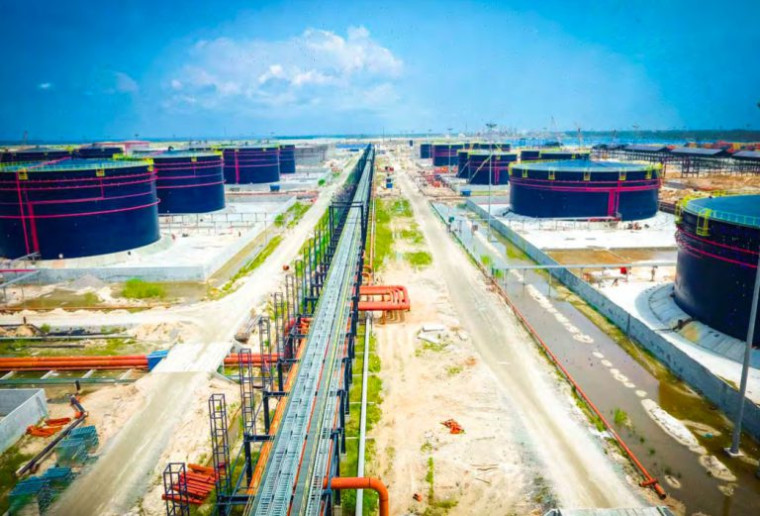
Then came the Dangote Refinery, a multi-billion-dollar industrial project promoted as the solution to Nigeria’s refining crisis.
The expectation was straightforward:
Nigeria refines locally. Imports reduce. Foreign exchange pressure eases. Jobs increase. Energy security improves. But continued import licences threaten to complicate that vision.
Supporters of Dangote argue that allowing unrestricted imports while local refineries struggle for market dominance could discourage investment in domestic refining.
According to that school of thought, no investor would commit billions of dollars to refining infrastructure if the local market remains perpetually flooded with imported fuel.
The Other Side of the Argument
However, the regulators and marketers may also have strong arguments.
The NMDPRA could contend that refining “capacity” on paper does not automatically translate to actual nationwide supply sufficiency.
Questions may arise such as:
1. Is domestic production consistently meeting national demand?
2. Can local refineries guarantee uninterrupted supply?
3. Are distribution networks sufficiently stable?
4. Would restricting imports create scarcity risks?
The government may also argue that maintaining some level of import competition helps prevent monopolistic pricing and protects consumers from supply disruptions.
In other words, this case may ultimately become a delicate balancing act between: protecting local refining investments and ensuring energy security and competitive pricing.
The PIA Faces Its Biggest Test Yet
Ironically, the Petroleum Industry Act was enacted to transform Nigeria’s petroleum sector, attract investment, and create regulatory certainty.
Now, one of the largest investments made under the new petroleum regime is testing the boundaries of that very law.
The Federal High Court’s eventual interpretation could establish a landmark precedent on:
1. fuel importation,
2. market liberalisation,
3. refining protection policies,and
4. the powers of petroleum regulators under the PIA.
Whatever the outcome, one thing is certain: Nigeria’s downstream petroleum industry may never remain the same after this lawsuit.
The courtroom battle between Dangote Refinery and the regulators is no just about fuel imports.
It is now a fight over who truly controls the future of Nigeria’s energy market.