
- October 9, 2026
- Edidiong Akpanuwa & Co
- 0
Cost of Commercial Litigation in Nigeria: What Businesses Need to Know
When businesses become involved in a commercial dispute, attention naturally tends to focus on the legal merits of the case: Who is right? Was a contract breached? Can damages be recovered? What remedy is available?
These questions are important, but they do not tell the whole story.
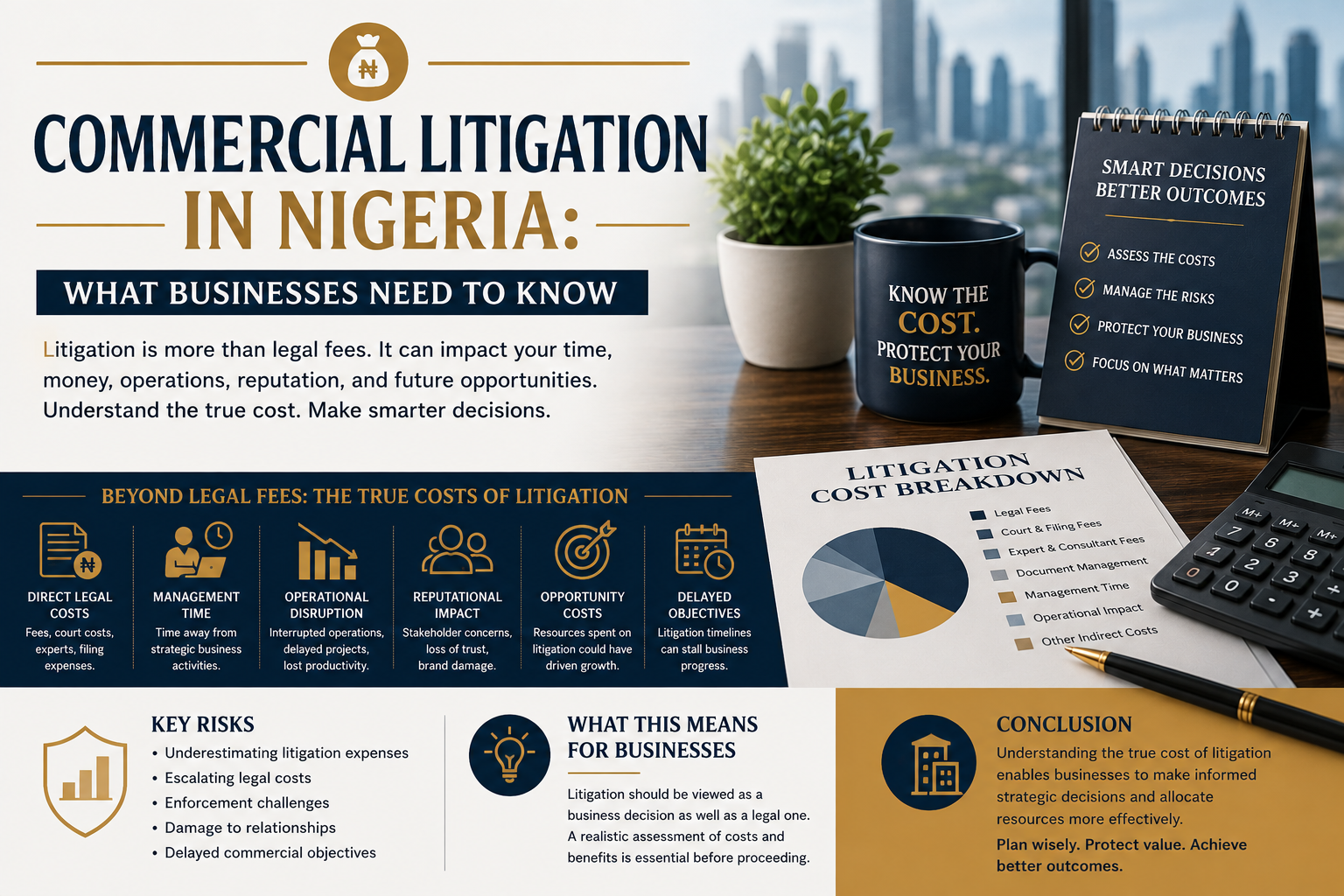
The true cost of commercial litigation extends well beyond legal fees and court expenses. Litigation can consume management time, disrupt business operations, affect commercial relationships, create uncertainty for investors and lenders, and divert financial and human resources away from the company’s core objectives.
For this reason, businesses considering litigation should evaluate a dispute not only as a legal matter but also as a commercial investment decision.
The key question is not simply whether a business has a strong case. It is whether pursuing the case is likely to produce a commercially worthwhile outcome after all relevant costs, risks, and opportunities are considered.
What Does Commercial Litigation Actually Cost?
The cost of litigation can be divided broadly into direct costs and indirect costs.
Direct costs may include legal fees, court-related expenses, expert fees, document management, and other expenses associated with preparing and presenting a case.
Indirect costs can be more difficult to measure but may have an equally significant impact on a business.
These may include:
- Management time;
- Employee distraction;
- Business interruption;
- Loss of commercial opportunities;
- Damage to business relationships;
- Reputational concerns;
- Delayed investment decisions;
- Financing difficulties;
- Enforcement costs.
A realistic litigation assessment should consider both categories.
Direct Legal and Litigation Costs
The most obvious cost of litigation is the professional and procedural expense involved in pursuing or defending a claim.
Depending on the nature and complexity of the dispute, a business may incur costs associated with:
- Legal advice and representation;
- Drafting pleadings and other court documents;
- Court filings and procedural requirements;
- Legal research;
- Evidence preparation;
- Witness preparation;
- Expert advice and reports;
- Document review;
- Hearings and trial preparation;
- Appeals, where applicable;
- Enforcement of judgments.
The complexity, value, duration, and procedural history of a case can all affect the overall cost.
Why Early Cost Assessment Matters
Businesses should seek to understand the likely cost of a dispute as early as possible.
An early assessment can help management establish a realistic litigation budget and determine whether the expected commercial benefit justifies the resources required.
It can also help identify opportunities for early settlement before costs increase significantly.
Management Time Is a Hidden Litigation Cost
One of the costs businesses frequently underestimate is the amount of management time litigation can consume.
Senior executives and business owners may need to:
- Gather and review documents;
- Provide instructions to lawyers;
- Attend meetings;
- Participate in settlement discussions;
- Review witness statements;
- Assist with evidence;
- Attend hearings where required;
- Make strategic decisions throughout the proceedings.
For a large corporation, these responsibilities may be distributed across several departments.
For a smaller or growing business, however, litigation may place a significant burden on the owner or senior management team.
The Opportunity Cost of Management Attention
Every hour spent managing litigation is time that may otherwise have been devoted to growing the business.
Management may be unable to focus fully on:
- New business opportunities;
- Customer relationships;
- Expansion plans;
- Product development;
- Investment;
- Recruitment;
- Strategic planning.
This opportunity cost should form part of the overall assessment of whether litigation is commercially justified.
Litigation Can Disrupt Business Operations
Some disputes directly affect the company’s ability to operate.
For example, a disagreement involving a supplier, distributor, landlord, business partner, employee, or major customer may interfere with normal commercial activities.
A dispute involving business premises, intellectual property, equipment, inventory, contracts, or critical infrastructure may have consequences far beyond the legal claim itself.
Businesses should therefore ask:
What happens to the business while the dispute is being resolved?
If the answer involves significant disruption, the company may need to consider whether urgent protective measures, negotiation, mediation, or another dispute-resolution strategy could reduce the impact.
The Cost of Employee Distraction
Litigation can affect employees as well as management.
Employees may need to locate documents, provide information, attend meetings, participate as witnesses, or respond to requests from legal advisers.
Where the dispute involves allegations of misconduct, workplace issues, or internal corporate disagreements, employee morale may also be affected.
This can create additional operational costs and reduce productivity.
For this reason, businesses should consider how a dispute will be managed internally and who should be responsible for coordinating the company’s response.
Reputational Costs
Some commercial disputes may attract public attention.
This can be particularly relevant where the dispute involves:
- A well-known company;
- Significant financial claims;
- Allegations of misconduct;
- Sensitive customer information;
- Regulated industries;
- Government contracts;
- High-profile shareholders or executives.
Even where a business ultimately succeeds in litigation, the process itself may create reputational challenges.
Businesses should therefore consider whether the dispute could affect the confidence of customers, investors, lenders, employees, suppliers, or strategic partners.
Impact on Investors and Lenders
Litigation can create uncertainty for existing and prospective investors.
An unresolved dispute involving significant financial exposure may affect how investors assess the company’s risk profile.
Similarly, lenders may consider material litigation when evaluating a company’s financial position and ability to meet its obligations.
Businesses seeking investment or financing should therefore understand how significant litigation could affect their broader financial strategy.
Commercial Relationships May Be Affected
Litigation can permanently change commercial relationships.
A dispute with a customer, supplier, shareholder, joint-venture partner, or strategic investor may make future cooperation more difficult.
This is particularly important where the relationship remains commercially valuable.
A business should therefore consider whether the dispute can be resolved through negotiation or mediation before resorting to full-scale litigation.
This does not mean businesses should tolerate serious breaches of their rights. Rather, it means the value of the relationship should be considered alongside the legal claim.
The Opportunity Cost of Litigation
One of the most important questions businesses should ask is:
What could we be doing with the resources committed to this dispute?
A company spending substantial amounts on litigation may have fewer resources available for:
- Expansion;
- Technology investment;
- New employees;
- Marketing;
- Acquisitions;
- Product development;
- New market entry;
- Business restructuring.
This is the opportunity cost of litigation.
A claim may be legally strong but still require careful commercial analysis if pursuing it would prevent the company from taking advantage of more valuable opportunities.
Enforcement Costs Matter
Obtaining a judgment or arbitral award is not necessarily the end of a dispute.
A business may still need to take additional steps to enforce the decision.
If the opposing party does not voluntarily comply, enforcement may involve additional legal work and expenses.
The financial position and location of the opposing party’s assets should therefore be considered from the beginning.
Winning Does Not Always Mean Recovering
A favorable judgment may have limited commercial value if the judgment debtor does not have sufficient assets against which enforcement can realistically be pursued.
This is particularly important in debt-recovery disputes.
Businesses should consider enforcement prospects before committing substantial resources to litigation.
Cross-Border Litigation Can Increase Complexity
Where a dispute involves parties or assets in different countries, additional issues may arise.
These may include:
- Jurisdiction;
- Applicable law;
- Recognition of foreign judgments;
- Enforcement of judgments or arbitral awards;
- Translation;
- Evidence located abroad;
- Foreign legal advice;
- Travel and hearing arrangements.
Cross-border disputes can therefore require additional planning and resources.
For businesses involved in international transactions, dispute-resolution clauses should be carefully considered when contracts are negotiated.
The Cost of Delay
Time itself can have a financial value.
A dispute that remains unresolved for several years may prevent a business from making important commercial decisions.
For example, uncertainty over ownership of property, shares, business assets, or contractual rights may prevent the company from selling, refinancing, restructuring, or investing in those assets.
The longer a dispute continues, the greater the potential commercial impact.
Businesses should therefore consider whether the expected benefit of litigation justifies the likely duration of the proceedings.
Should Every Strong Claim Be Litigated?
Not necessarily.
A strong legal claim does not automatically mean that litigation is the best commercial strategy.
Before commencing proceedings, businesses should consider:
- The strength of the evidence;
- The value of the claim;
- The likely legal costs;
- The expected duration;
- The financial position of the opposing party;
- Enforcement prospects;
- The importance of the commercial relationship;
- Reputational considerations;
- Alternative dispute-resolution options.
A claim that appears attractive from a legal perspective may be less attractive when all commercial factors are considered.
Negotiation and Mediation Can Reduce Costs
Where appropriate, negotiation and mediation can provide businesses with opportunities to resolve disputes without incurring the full cost of litigation.
Early settlement can help businesses:
- Reduce legal expenses;
- Minimize management distraction;
- Preserve commercial relationships;
- Protect confidential information;
- Obtain payment or another remedy sooner;
- Reduce uncertainty.
Settlement should not be viewed as a sign that a business lacks confidence in its position.
In many circumstances, it is simply a commercially rational decision.
Early Legal Advice Can Save Money
One of the most effective ways to manage litigation costs is to obtain legal advice early.
Early advice can help a business:
- Identify whether a genuine legal claim exists;
- Preserve important evidence;
- Understand potential remedies;
- Assess the strength of the case;
- Identify weaknesses;
- Evaluate settlement options;
- Estimate likely costs;
- Consider enforcement prospects.
Early intervention can also prevent relatively manageable disputes from becoming significantly more expensive.
Effective Case Management Is Essential
Once litigation begins, active case management can help control costs.
Businesses and their legal advisers should regularly review:
- The status of the proceedings;
- Legal costs incurred;
- Expected future costs;
- The strength of the evidence;
- New developments;
- Settlement opportunities;
- The prospects of success;
- Enforcement considerations.
A litigation strategy should evolve as the facts and circumstances change.
Conduct a Cost-Benefit Analysis
Before committing significant resources to litigation, businesses should conduct a realistic cost-benefit assessment.
The analysis should consider:
Potential benefits
- Amount potentially recoverable;
- Value of protecting a business asset;
- Importance of enforcing contractual rights;
- Strategic value of the claim;
- Preservation of commercial interests.
Potential costs
- Legal fees;
- Court and procedural expenses;
- Expert fees;
- Management time;
- Operational disruption;
- Reputational impact;
- Enforcement expenses;
- Opportunity costs.
The purpose is not to predict the outcome with certainty. It is to provide management with enough information to make a rational commercial decision.
Key Risks Businesses Should Consider
Before commencing or continuing commercial litigation, businesses should consider:
- Underestimating litigation expenses: The total cost may be significantly higher than initial legal fees.
- Operational disruption: Litigation can interfere with normal business activities.
- Management distraction: Senior personnel may spend substantial time dealing with the dispute.
- Reputational damage: Public disputes may affect stakeholder confidence.
- Opportunity costs: Resources committed to litigation cannot be deployed elsewhere.
- Enforcement difficulties: A successful judgment may still be difficult to recover.
- Delayed commercial objectives: Litigation may prevent businesses from making important strategic decisions.
- Relationship damage: Litigation may permanently affect valuable commercial relationships.
What This Means for Businesses
Commercial litigation should be viewed as both a legal and business decision.
Before commencing proceedings, businesses should understand not only whether they have a strong legal case, but also what pursuing that case will cost in financial, operational, strategic, and reputational terms.
The objective should be to select the strategy that provides the best overall commercial outcome.
Sometimes that may mean pursuing litigation firmly.
In other circumstances, it may mean negotiating, mediating, restructuring the commercial relationship, or pursuing another dispute-resolution mechanism.
Conclusion
Understanding the true cost of commercial litigation enables businesses to make better strategic decisions.
The cost of a dispute is not limited to the lawyer’s invoice or court fees. It can include management time, operational disruption, employee distraction, reputational concerns, lost opportunities, enforcement expenses, and the uncertainty created by a prolonged dispute.
Businesses that assess these factors early are better positioned to determine whether litigation is worthwhile, whether settlement should be explored, and how the dispute should be managed if proceedings become necessary.
The strongest litigation strategy is not necessarily the one that leads to the courtroom. It is the one that produces the best commercially sensible outcome while protecting the company’s legal and business interests.
A publication of Edidiong Akpanuwa & Co.