
- November 13, 2026
- Edidiong Akpanuwa & Co
- 0
Before You Sign Any Agreement, Know This Important Legal Rule
A signature can create legal obligations that may last for years. Before you sign an agreement, it is therefore important to understand exactly what you are agreeing to—and what the law may require you to do once you have signed.
Many people enter into contracts in a hurry, assuming that if circumstances later change, they can simply renegotiate the terms or ask a court to release them from obligations that have become inconvenient.
That assumption can be dangerous.
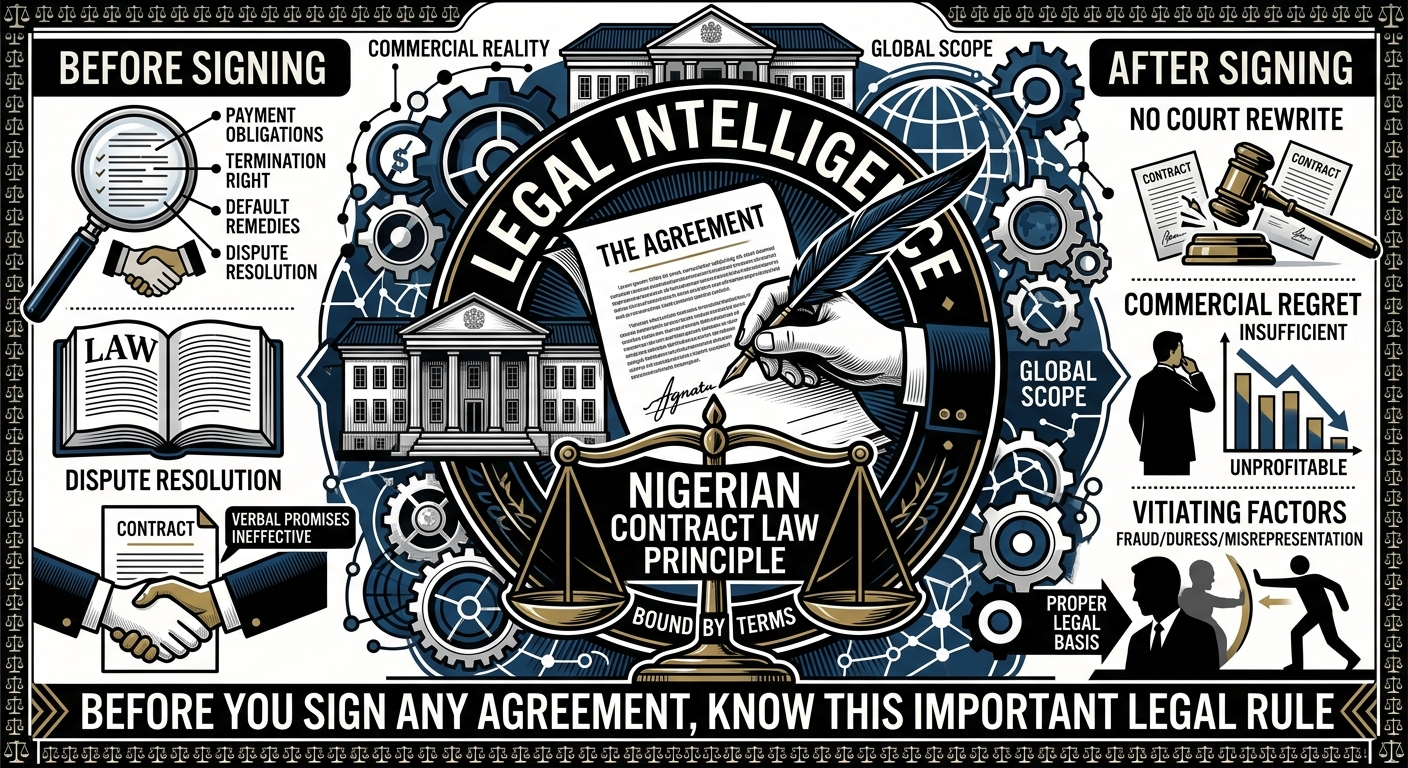
Under Nigerian contract law, the general principle is that parties who voluntarily enter into a valid contract are bound by its terms.
Where the language of an agreement is clear and unambiguous, the court will generally give effect to what the parties agreed. It is not the court’s role to rewrite a contract simply because one party subsequently considers the bargain unfair, inconvenient or commercially disadvantageous.
A Contract Is More Than Just a Signature
A contract represents the agreement reached between the parties.
Once a valid contract has been concluded, each party is generally expected to perform the obligations it has undertaken.
This means that signing an agreement without reading it carefully does not ordinarily provide an escape from its terms.
A party cannot simply say:
“I did not know that clause was there.”
or:
“I thought we had agreed something different.”
If the written agreement clearly contains the relevant provision and there is no recognised legal basis for setting it aside or departing from it, the court may enforce the agreement as written.
This is why careful review before signing is one of the most important forms of legal protection available to a contracting party.
When the Court Will Not Rewrite Your Contract
Courts are generally concerned with enforcing the bargain the parties actually made, rather than creating a new bargain for them.
For example, suppose two businesses agree that a contract will run for three years and that either party may terminate it only in specified circumstances.
If one party later decides that the arrangement is no longer commercially attractive, that party cannot ordinarily ask the court to rewrite the termination clause simply because the original bargain has become inconvenient.
The court’s task is to interpret and enforce the agreement according to the applicable principles of contract law—not to renegotiate the transaction on behalf of the parties.
What If the Contract Becomes Unprofitable?
This is particularly important for businesses.
Imagine a business owner signs a three-year supply agreement at an agreed price. Six months later, the cost of importing the relevant goods increases dramatically. The supplier’s costs rise, inflation affects the business and the agreement becomes substantially less profitable.
The business owner may understandably regret entering into the agreement.
But commercial regret, by itself, does not necessarily invalidate the contract.
If the agreement clearly sets out the parties’ obligations and there is no contractual mechanism for adjusting the price, the fact that performance has become more expensive or less profitable does not automatically give one party the right to abandon the agreement.
This is one reason why commercial contracts should be negotiated with future risks in mind, rather than only focusing on the circumstances existing on the day the agreement is signed.
What If You Were Misled Into Signing?
The position may be different where there is evidence that genuine consent to the contract was compromised.
The law recognises circumstances that may affect the validity or enforceability of an agreement, including recognised vitiating factors such as fraud, misrepresentation and duress, depending on the facts and applicable legal principles.
For example, if a person was induced to enter into an agreement because of a material fraudulent representation, that may raise fundamentally different legal questions from a situation in which the person simply failed to read the contract.
Similarly, where a party can establish that the agreement was entered into under legally recognised duress or another vitiating circumstance, the court may have grounds to grant appropriate relief.
The important point is that there must be a proper legal basis for challenging the agreement.
Simply changing your mind after signing is generally not enough.
Do Not Rely Solely on Verbal Promises
One of the most common sources of contractual disputes is the difference between what parties discussed orally and what was eventually written into the agreement.
A party may say:
“That is not what we agreed.”
But if the written contract contains clear provisions dealing with the subject matter, the court may have to consider the document itself in determining the parties’ rights and obligations.
This is why important promises should not be left as informal assurances.
If a particular representation, concession, payment arrangement, deadline, termination right or obligation is important to you, make sure it is properly reflected in the written agreement.
Pay Particular Attention to These Clauses
Before signing an important agreement, do not focus only on the headline terms.
Pay attention to provisions dealing with:
Payment Obligations
Check exactly how much you are required to pay, when payment becomes due, whether interest or penalties apply and what happens if payment is delayed.
Termination
Understand how the agreement can be terminated, who has the right to terminate it and whether notice is required.
Default
Find out what constitutes a breach and what remedies the other party may have if you fail to perform your obligations.
Renewal
Some agreements automatically renew unless one party gives notice within a specified period. Missing the relevant deadline may have consequences.
Dispute Resolution
Check whether disputes must be resolved through litigation, arbitration, mediation or another agreed mechanism.
Governing Law and Jurisdiction
The agreement may specify the law that governs the contract and the courts or arbitral tribunal that will have jurisdiction over disputes.
Indemnities and Liability
These provisions can create significant financial exposure and should not be treated as standard wording that can simply be ignored.
What You Should Do Before Signing
The safest time to identify a contractual problem is before the contract becomes binding, not after a dispute has already arisen.
Before signing an important agreement:
- Read every clause carefully.
- Ask questions about any provision you do not understand.
- Do not rely on verbal assurances that are not reflected in the written agreement.
- Ensure important promises and understandings are documented.
- Check the payment, termination, default and dispute-resolution provisions.
- Consider the consequences of a breach before accepting the obligation.
- Seek legal advice where the agreement involves substantial financial, commercial or legal obligations.
You should also resist the temptation to sign immediately simply because the other party says the agreement is “standard” or “nothing to worry about.”
What is standard for one transaction may be highly disadvantageous in another.
The Importance of Negotiating Before You Sign
Contract negotiation is not necessarily a sign of distrust.
It is an opportunity for both parties to clarify their expectations and allocate commercial risks before they become disputes.
For example, if you are entering into a long-term supply agreement, you may want to consider whether the contract should contain provisions dealing with significant changes in costs, inflation, supply disruptions or other foreseeable commercial risks.
Similarly, if you are purchasing property, investing money in a business, borrowing funds or entering into a partnership, the agreement should address the risks that are particularly relevant to that transaction.
Once the contract has been signed, your negotiating leverage may be significantly reduced.
What Happens When a Contractual Dispute Reaches Court?
When a dispute arises, the court will examine the contract and the surrounding legal issues in accordance with applicable principles.
Where the language of the agreement is clear, the court will generally seek to give effect to the parties’ agreement.
This means that litigation should not be viewed as an opportunity to obtain a better bargain than the one originally negotiated.
The court is there to determine the legal rights and obligations of the parties—not ordinarily to renegotiate their commercial arrangement.
Practical Takeaway
The most important lesson is simple:
Do not wait until a contractual dispute arises before taking your agreement seriously.
Before signing, understand what you are promising, what the other party is promising, what happens if either party defaults, how the agreement can be terminated and how disputes will be resolved.
If circumstances later become difficult, the fact that the agreement has become inconvenient or commercially unattractive will not necessarily release you from your contractual obligations.
There may be legal remedies where a contract was affected by fraud, misrepresentation, duress or another recognised vitiating circumstance, but those grounds require a proper factual and legal basis.
The Key Lesson
The safest time to protect your interests is before you sign.
Read the agreement. Ask questions. Negotiate important terms. Document significant promises. And where the transaction involves substantial financial or legal consequences, obtain appropriate legal advice before committing yourself.
A few hours spent understanding a contract before signing it may prevent years of litigation after the dispute begins.
A publication of Edidiong Akpanuwa & Co.