
- September 22, 2026
- Edidiong Akpanuwa & Co
- 0
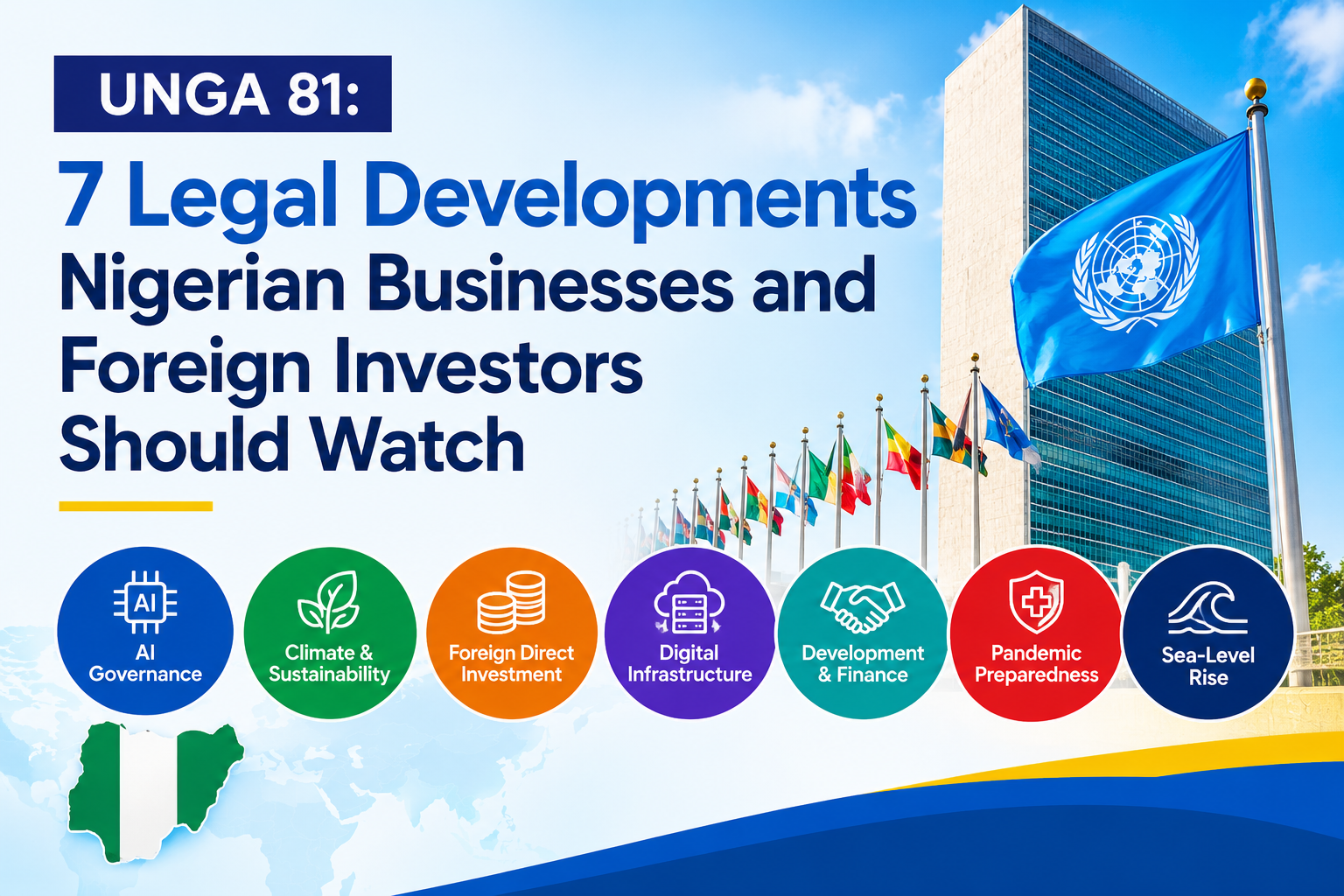
The 81st Session of the United Nations General Assembly is underway in New York, bringing together governments and senior representatives from across the world at a time of significant changes in international law, technology, trade, investment, climate policy and global governance.
The theme of this year’s session is “Restoring trust, managing transformation: a United Nations that delivers for all.” The high-level week runs from 22 to 28 September 2026 and includes the General Debate as well as high-level meetings addressing the right to development, climate action, sea-level rise, pandemic preparedness and other global issues.
For Nigerian businesses, foreign investors, technology companies and legal practitioners, however, the significance of UNGA goes beyond diplomatic speeches.
The discussions taking place in New York may influence the direction of international standards, regulatory thinking, investment policy, digital governance and development cooperation that increasingly affect businesses operating across borders.
1. UNGA is not simply about diplomacy — it is also about the development of international norms
One important legal distinction should be kept in mind.
The United Nations General Assembly is not a global parliament whose resolutions automatically become binding domestic law in Nigeria or other Member States.
Nevertheless, its resolutions, declarations, political commitments and international processes can contribute to the development of international norms and policy frameworks. They can also influence subsequent treaty negotiations, national legislation, regulatory policies and the interpretation of international commitments.
For businesses operating internationally, therefore, the important question is often not simply:
“What law was passed at UNGA?”
It is:
“What international policy direction is emerging, and could that direction eventually affect the regulatory environment in which we operate?”
That distinction is particularly important in areas such as artificial intelligence, climate regulation, digital infrastructure, human rights, development finance and cross-border investment.
2. Artificial Intelligence: The emerging international governance question
Artificial intelligence is one of the most legally significant themes surrounding the current UN process.
The UN’s Global Digital Compact, adopted as part of the Pact for the Future, calls for a balanced, inclusive and risk-based approach to AI governance. It identifies issues including transparency, accountability, human oversight, interoperability, capacity-building and respect for international law and human rights.
The UN has also established an Independent International Scientific Panel on AI pursuant to General Assembly Resolution A/RES/79/325. The Panel is intended to provide scientific assessments concerning the opportunities, impacts and risks associated with AI.
The President of the 81st General Assembly has already identified AI governance as an important part of the session’s agenda, including discussions around access to AI capacity, infrastructure, data and skills, as well as safety, accountability, human oversight and interoperability.
Why does this matter to Nigerian businesses?
For Nigerian companies deploying AI in:
- banking and fintech;
- healthcare;
- telecommunications;
- legal services;
- recruitment;
- insurance;
- education;
- government contracting;
- data centres;
- cybersecurity; and
- digital platforms,
international discussions on AI governance could eventually translate into stronger expectations concerning data governance, transparency, accountability, risk management, human oversight and responsible deployment.
For technology businesses, the direction of international AI governance is therefore becoming a corporate legal issue rather than merely a technology issue.
For lawyers, it creates another emerging advisory field: AI governance and AI risk management.
3. The developing world’s access to AI infrastructure is becoming a legal and investment issue
An important feature of the UN’s AI discussions is that the conversation is not limited to controlling AI risks.
It also concerns access.
The Global Digital Compact recognises the need for developing countries to build capacity to access, develop, use and govern AI systems. It also identifies AI infrastructure, skills, data and technological capacity as areas requiring international cooperation.
This has particular relevance to Africa.
The next phase of AI development will require enormous investments in:
- data centres;
- electricity generation and transmission;
- fibre-optic infrastructure;
- cloud computing;
- semiconductor and hardware supply chains;
- cybersecurity;
- data infrastructure; and
- technical human capital.
Consequently, AI governance and foreign direct investment (FDI) are increasingly interconnected.
For Nigeria, this creates an opportunity to attract investment into the infrastructure necessary to support the digital economy.
It also creates legal questions concerning land acquisition, power supply, tax, data protection, telecommunications regulation, environmental compliance, financing, foreign investment structures and government incentives.
4. Climate change is increasingly becoming a corporate legal issue
Climate action and the just transition are also prominent on the UNGA 81 agenda.
The UN has scheduled a high-level meeting on climate action and the just transition for 23 September 2026. The meeting is intended to address cooperation on energy security, climate justice and acceleration of the energy transition.
The legal implications extend beyond environmental law.
Companies may increasingly encounter climate-related considerations in:
Financing → Investment → Corporate governance → Procurement → Infrastructure → Insurance → Disclosure → Supply chains
For Nigerian companies seeking international capital, climate-related expectations may therefore become relevant even where Nigerian domestic law does not impose an identical requirement.
Foreign investors may apply their own environmental, social and governance standards to transactions.
This means that a Nigerian company seeking foreign investment may increasingly need to consider climate and sustainability issues before the transaction reaches the negotiation table.
5. The Right to Development: why this matters to developing countries
On 23 September, UNGA 81 will commemorate the 40th anniversary of the Declaration on the Right to Development.
The Declaration, adopted by the General Assembly in 1986, recognises development as a framework involving economic, social, cultural and political development and participation in the development process.
The 2026 high-level meeting is being held pursuant to General Assembly resolutions 79/170 and 80/207.
For African economies, the concept has implications extending beyond human-rights discourse.
Development requires:
- capital;
- infrastructure;
- technology;
- access to markets;
- energy;
- education;
- healthcare;
- institutional capacity; and
- an environment capable of attracting and retaining investment.
For Nigeria, the legal and policy challenge is therefore how international development objectives translate into domestic investment frameworks and commercially viable projects.
6. Sea-level rise has implications for Nigerian coastal investment
UNGA 81 will also hold a high-level meeting on 24 September 2026 addressing the threats posed by sea-level rise.
The UN describes the meeting as focusing on coordinated action, financing, resilience and cooperation in responding to the risks associated with rising sea levels.
This issue is particularly relevant to coastal economies.
Nigeria’s coastal geography means that climate resilience can become relevant to:
- real estate development;
- ports;
- shipping;
- oil and gas infrastructure;
- power infrastructure;
- telecommunications infrastructure;
- manufacturing facilities; and
- large-scale urban developments.
The legal consequences may eventually include questions concerning environmental impact assessments, planning approvals, insurance, contractual risk allocation, project finance and climate-related due diligence.
For investors, physical climate risk can increasingly become a transaction issue.
7. Pandemic preparedness is also a corporate legal issue
On 25 September, the General Assembly will hold a high-level meeting on pandemic prevention, preparedness and response.
The legal significance extends beyond public health authorities.
Businesses learned during COVID-19 that pandemics can affect:
- contractual performance;
- supply chains;
- employment;
- international travel;
- insurance;
- financing;
- construction projects;
- commercial leases; and
- regulatory compliance.
Consequently, pandemic preparedness has become relevant to commercial contracting.
Businesses should pay particular attention to how their contracts address events that interfere with performance, including force majeure, frustration, business interruption, supply-chain disruption and regulatory intervention.
What should Nigerian businesses be watching?
The most important legal intelligence coming out of UNGA 81 may not be a single resolution.
It may be the direction of international regulatory thinking.
Nigerian businesses and investors should monitor at least five areas:
A. AI Governance
Companies using AI should begin considering governance frameworks covering accountability, human oversight, data, transparency, cybersecurity and risk management.
B. Digital Infrastructure
Investors should monitor international initiatives concerning AI infrastructure, data, digital connectivity and technological capacity in developing countries.
C. Climate and ESG
Businesses seeking international capital should anticipate increasing scrutiny of environmental and climate-related risks.
D. Cross-Border Investment
FDI transactions may increasingly involve international standards relating to sustainability, technology, human rights, data and responsible investment.
E. Commercial Contracts
Businesses should review whether their contractual risk-allocation mechanisms adequately address increasingly complex global disruptions.
The Legal Intelligence Takeaway
The significance of UNGA 81 for Nigerian businesses is not that the United Nations will suddenly create laws directly applicable to every Nigerian company.
The more important development is the gradual internationalisation of regulatory standards.
AI governance, climate resilience, digital infrastructure, development financing, human rights, pandemic preparedness and responsible investment are increasingly interconnected.
A Nigerian company seeking to operate only within Nigeria may therefore still encounter international standards through its:
investors → lenders → technology providers → insurers → international customers → joint-venture partners → regulators.
For lawyers, this creates an important shift.
International developments increasingly need to be translated into practical Nigerian legal advice.
The question is no longer simply what international institutions are discussing.
The question for businesses is:
How might those emerging international standards affect the contracts we sign, the investments we make, the technology we deploy and the risks we assume?
This Legal Intelligence is provided for general informational purposes and does not constitute legal advice on any specific transaction, investment or regulatory matter.
A publication of Edidiong Akpanuwa & Co.