
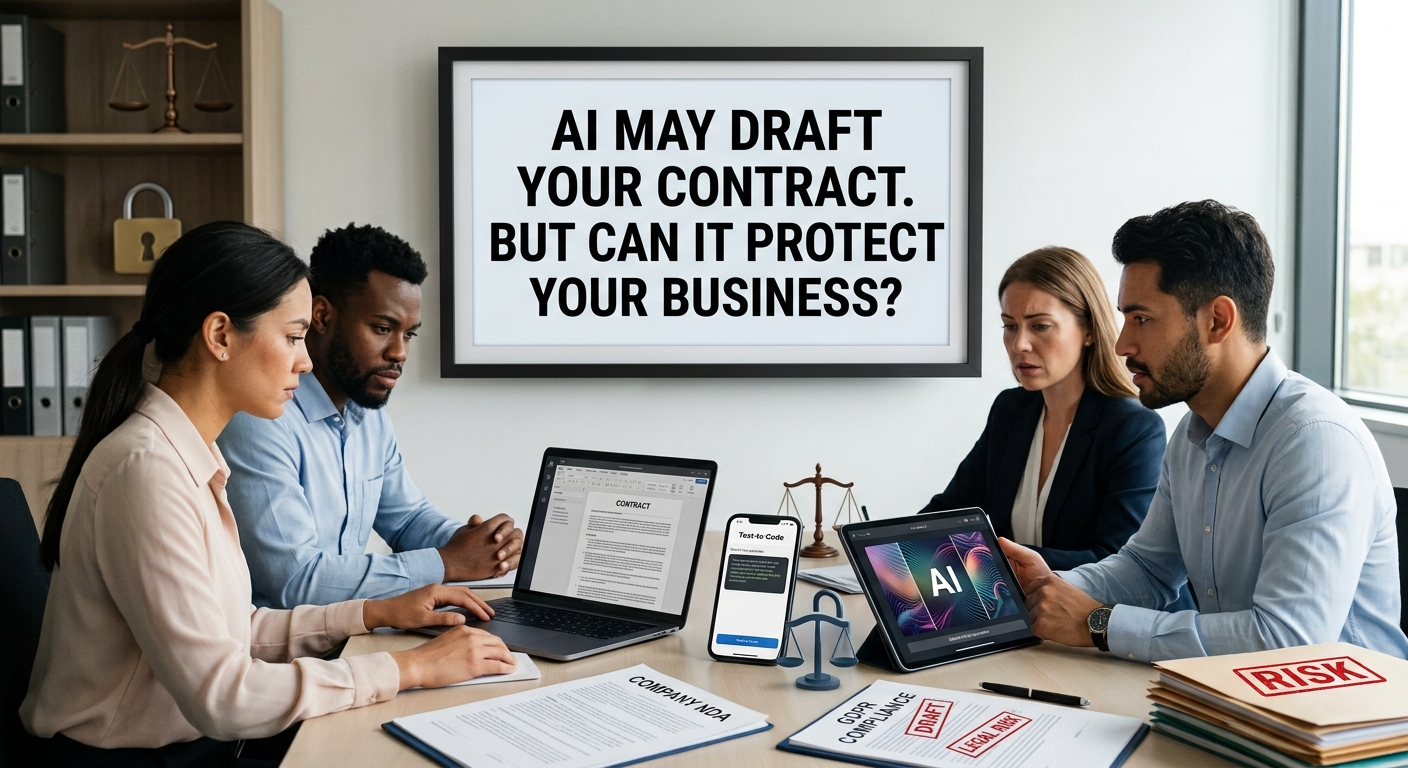
AI May Draft Your Contract. But Can It Protect Your Business?
Artificial Intelligence (AI) has rapidly become a valuable business tool. Today, a business owner can ask an AI platform to draft an employment contract, prepare a non-disclosure agreement, write a supplier agreement, or even generate an entire shareholders’ agreement within minutes.
For many SMEs and startups, this is appealing. It saves time, reduces costs, and appears to eliminate the need for professional legal services.
But there is an important question every business should ask:
Can an AI-drafted contract truly protect your business when a dispute arises?
The answer is more complex than many people realise.
The Rise of AI in Contract Drafting
Businesses across Nigeria are increasingly adopting AI-powered tools to prepare legal documents. Entrepreneurs, consultants, freelancers, and even established companies are using AI to draft contracts before sending them to clients or business partners.
While AI can produce well-written documents, it cannot understand your commercial objectives, industry-specific risks, or the legal realities surrounding your transaction in the same way an experienced lawyer can.
A contract is not merely a collection of legal clauses. It is a risk management tool designed to protect your interests before problems arise.
The Hidden Risks of AI-Generated Contracts
1. One Size Does Not Fit All
AI generates documents based on patterns learned from vast amounts of information. It does not know the unique circumstances of your business unless you provide detailed instructions—and even then, it may overlook critical issues.
For example, a technology startup, a construction company, and an agricultural business may all require entirely different contractual protections, even when entering similar commercial relationships.
Using a generic AI-generated contract may leave significant gaps that expose your business to unnecessary legal risk.
2. Nigerian Law Matters
Many AI tools are trained on legal materials from multiple jurisdictions, particularly the United States and the United Kingdom.
As a result, an AI-generated contract may include clauses that are unsuitable or ineffective under Nigerian law or fail to reflect mandatory legal requirements.
Businesses operating in Nigeria should ensure that their contracts comply with applicable legislation, regulations, and judicial decisions.
3. AI Cannot Negotiate for You
The strongest contracts are rarely created by simply filling in a template.
Effective contracts result from careful negotiation.
Questions such as:
- Who bears the financial risk?
- What happens if payment is delayed?
- How will disputes be resolved?
- Can either party terminate the agreement without penalty?
- What happens if confidential information is leaked?
These are strategic commercial issues requiring legal judgment, not simply automated drafting.
4. Confidential Information May Be at Risk
Many AI platforms process user inputs to improve their services or under terms that may not be suitable for highly sensitive information.
Uploading confidential contracts, customer information, pricing structures, trade secrets, or litigation documents into public AI systems without understanding the applicable privacy terms may expose a business to unnecessary risks.
Companies should establish internal policies governing how employees use AI tools, particularly where confidential information is involved.
5. Ambiguous Clauses Can Be Costly
AI-generated clauses may sound impressive but still create uncertainty.
In commercial disputes, ambiguity often becomes expensive.
Poorly drafted provisions relating to payment obligations, liability, indemnities, intellectual property ownership, or dispute resolution can lead to prolonged disagreements and costly litigation.
A Practical Example
Imagine a Nigerian logistics company using AI to draft a transportation agreement with a major client.
The AI produces a professional-looking document.
However, the agreement fails to:
- limit the company’s liability;
- allocate responsibility for damaged goods;
- address delays caused by force majeure;
- specify the governing law and dispute resolution procedure.
Several months later, valuable goods are damaged during transportation.
The client claims substantial compensation.
The company discovers that its AI-generated contract provides little protection because the critical risk allocation provisions were either missing or poorly drafted.
What initially appeared to be a cost-saving measure becomes an expensive legal problem.
AI should not replace professional legal advice on important commercial transactions.
Key Takeaways
Artificial Intelligence is transforming the way businesses prepare legal documents. It offers speed, convenience, and efficiency.
However, businesses should not confuse speed with legal protection.
The true value of a contract lies not in how quickly it is produced but in how effectively it manages legal risk, allocates responsibility, protects commercial interests, and withstands scrutiny when disputes arise.
AI can draft a contract.
Only careful legal analysis can ensure that the contract genuinely protects your business.
A publication of Edidiong Akpanuwa & Co.