
- November 16, 2026
- Edidiong Akpanuwa & Co
- 0
Before You Rely on Any Agreement: Make Sure These 5 Legal Requirements Are Present
Not every agreement between two people is automatically a legally enforceable contract.
This is an important distinction that individuals and businesses should understand before committing money, transferring property, supplying goods, providing services or beginning performance under an arrangement.
People often assume that once two parties have discussed a transaction and reached some form of understanding, a binding contract must have been created.
That is not necessarily the case.
For an agreement to become a legally enforceable contract, certain essential requirements must be satisfied. If a fundamental requirement is missing, there may be no binding contract capable of enforcement by a court.
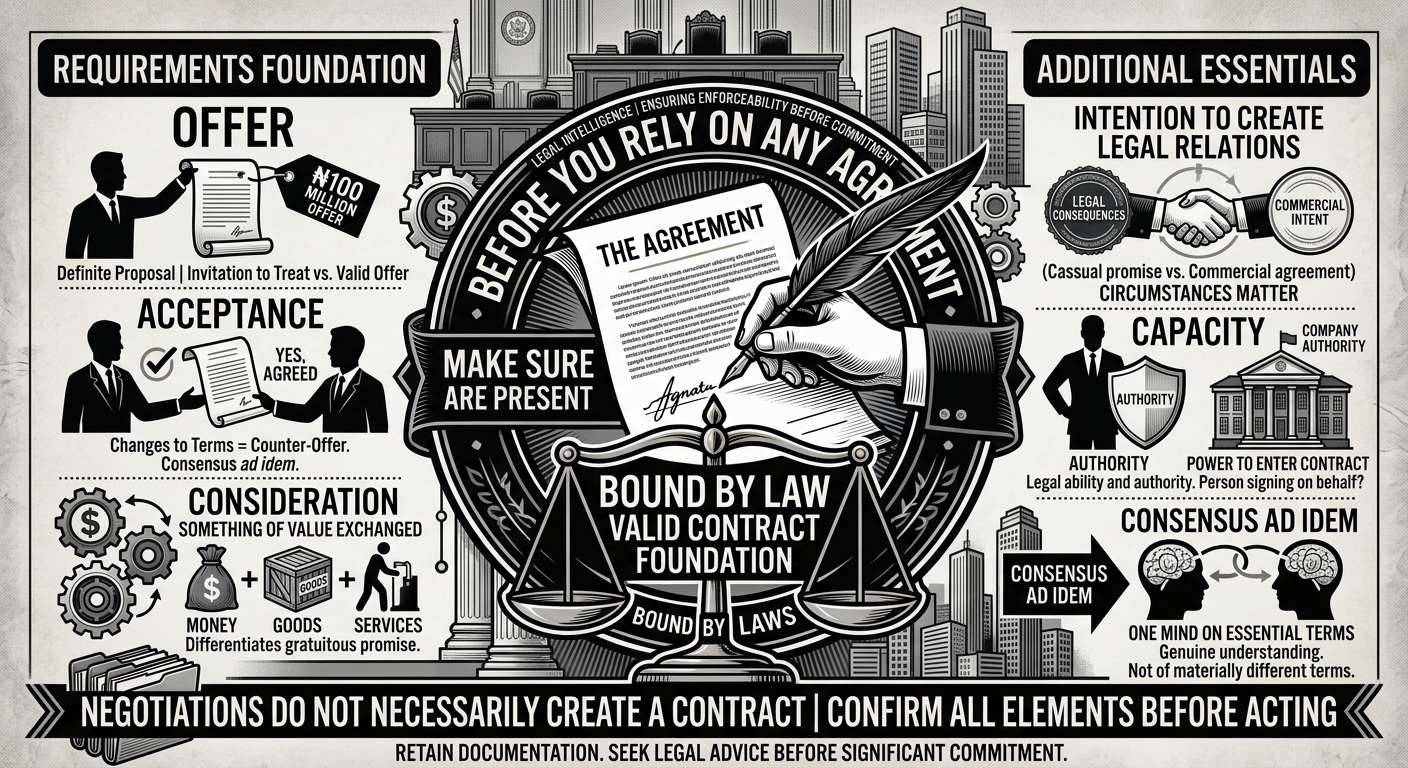
The 5 Essential Requirements of a Valid Contract
The five essential elements are:
- Offer
- Acceptance
- Consideration
- Intention to Create Legal Relations
- Capacity
These requirements operate together. A party should therefore not assume that the existence of negotiations or an apparent agreement automatically means that a legally enforceable contract has been formed.
1. Offer — There Must Be a Definite Proposal
The first requirement is an offer.
An offer is a clear and definite proposal made by one party to another, indicating a willingness to enter into a contract on specified terms.
The importance of this requirement is that the other party must know what exactly is being proposed before they can accept it.
For example, if a property owner tells a potential buyer:
“I am willing to sell this property to you for ₦30 million.”
Depending on the circumstances and the terms of the communication, this may constitute an offer.
However, not every statement made during negotiations amounts to an offer.
An advertisement, preliminary discussion or expression of interest may simply be an invitation to treat or an invitation for another party to make an offer.
Offer Is Not the Same as an Invitation to Treat.
This distinction can be particularly important in commercial transactions.
For example, a business owner might say:
“We are considering selling this business and are looking for offers around ₦100 million.”
That statement does not necessarily mean the owner has made a binding offer to sell the business for ₦100 million.
It may simply be an invitation for interested parties to submit proposals.
The precise wording and circumstances will determine the legal effect of the communication.
2. Acceptance — The Offer Must Be Accepted
An offer alone does not create a contract.
There must ordinarily be acceptance by the other party.
Acceptance involves agreeing to the terms of the offer in the manner required by law.
Importantly, acceptance should not be confused with making a counter-offer.
Acceptance Must Not Change the Terms.
Imagine that a property owner decides to sell land for ₦30 million.
The prospective buyer responds:
“I will buy it for ₦25 million.”
That is not an acceptance of the ₦30 million offer.
Until the property owner accepts the new proposal, the parties may not have reached a binding agreement on the sale at ₦25 million.
This is why parties should pay close attention to communications exchanged during negotiations.
A simple change to price, quantity, delivery terms or another essential provision may mean that the response is not an acceptance of the original offer but a new proposal requiring acceptance.
3. Consideration — Something of Legal Value Must Usually Be Exchanged
Another important requirement is consideration.
In simple terms, consideration refers to something of legal value given or promised in exchange for the other party’s promise.
It may involve:
- Money;
- Goods;
- Services.
For example, in an ordinary sale of land, the purchaser’s payment of the agreed purchase price constitutes consideration for the seller to transfer the property in accordance with the agreement.
Consideration is therefore one of the features that distinguishes a legally enforceable bargain from a mere gratuitous promise.
4. Intention to Create Legal Relations
The parties must also intend that their agreement should have legal consequences.
Not every promise made between individuals is intended to create a legally enforceable obligation.
The circumstances surrounding the agreement matter.
For example, a casual promise between friends may not necessarily be intended to create legal relations in the same way as a carefully negotiated commercial agreement between two companies.
In commercial transactions, however, there is generally a stronger basis for finding an intention that the parties should be legally bound.
The key question is whether, objectively considered in the circumstances, the parties intended their arrangement to have legal consequences.
5. Capacity — Can the Parties Legally Enter the Contract?
The parties must also have the legal capacity to enter into the agreement.
Capacity concerns whether the person or entity entering into the contract has the legal ability and authority to do so.
This can raise important issues in transactions involving individuals, companies, estates, partnerships, trusts or property.
For example, where a company enters into an agreement, it may be necessary to establish that the person signing on behalf of the company has the appropriate authority.
Similarly, where property is being transferred, it is important to establish that the person purporting to transfer the property actually has the legal interest or authority necessary to do so.
A document may therefore look perfectly valid on its face while serious questions remain concerning the capacity or authority of the person who entered into it.
All the Essential Elements Must Come Together
The existence of one or two elements is not enough.
The Court has reaffirmed that a valid contract comes into existence only where the parties are of one mind — consensus ad idem — on the essential terms of the agreement.
In practical terms, this means that the parties must have reached a sufficiently definite agreement on what they are actually contracting to do.
If one party believes they are agreeing to one set of terms while the other party believes they are agreeing to materially different terms, there may be no true consensus on the essential terms.
Negotiations Do Not Necessarily Create a Contract
This is one of the most common sources of misunderstanding in commercial transactions.
Parties may exchange emails, hold meetings, discuss prices and even prepare draft agreements without having reached a final and enforceable contract.
For example, imagine two businesses are negotiating a supply arrangement.
They agree on the general idea of the transaction but continue negotiating:
- The price;
- Delivery dates;
- Minimum quantities;
- Payment terms;
- Termination rights; and
- Other important provisions.
If the parties have made it clear that they do not intend to be bound until a final agreement is executed, the negotiations may not amount to a completed contract.
Therefore, a willingness to negotiate is not necessarily an offer, and ongoing negotiations are not necessarily a concluded agreement.
A Practical Example: Sale of Land
Consider this scenario.
A property owner advertises a parcel of land for ₦30 million.
A prospective buyer responds:
“I will buy the land for ₦25 million.”
The buyer has not accepted the owner’s stated price.
Instead, the buyer has proposed a different price.
The property owner may accept the ₦25 million proposal, reject it or make a counter-offer.
Until the parties reach agreement on the essential terms, there may be no concluded contract.
This simple example demonstrates why it is dangerous to assume that every conversation about a transaction creates immediate legal obligations.
Why Written Agreements Matter
Although not every contract must necessarily be contained in a single formal document, important transactions should ordinarily be properly documented.
A written agreement can help establish:
- What the parties agreed;
- The price or consideration;
- The obligations of each party;
- The time for performance;
- Conditions that must be satisfied;
- Events constituting default;
- Termination rights;
- Dispute-resolution mechanisms; and
- Other important contractual terms.
A written contract can therefore significantly reduce uncertainty and the possibility of disputes over what was actually agreed.
However, simply putting something in writing does not automatically make it legally enforceable. The underlying legal requirements must still be considered.
Before You Pay, Transfer Property or Begin Performance
Before committing substantial resources to a transaction, take time to determine whether a legally enforceable contract has actually been formed.
Ask:
Was there a clear offer?
Was that offer properly accepted?
Is there valid consideration?
Did the parties intend to create legal relations?
Do the parties have the necessary legal capacity and authority?
Have the essential terms actually been agreed?
If the answer to any of these questions is uncertain, it may be worth obtaining legal advice before proceeding.
What You Should Do
To reduce the risk of future disputes:
- Ensure important agreements contain clear and definite terms.
- Confirm that there has been a valid offer and acceptance.
- Do not treat negotiations as a concluded contract without confirming that the parties intended to be bound.
- Identify the consideration supporting the agreement.
- Confirm that the parties have the legal capacity and authority to enter into the transaction.
- Ensure that essential terms have been agreed and properly documented.
- Reduce important commercial arrangements to writing.
- Seek legal advice before committing significant money, property or business obligations.
The Key Lesson
Not every agreement becomes a contract.
A conversation, handshake, email exchange or preliminary negotiation may not, by itself, create an enforceable contractual obligation.
Before relying on an agreement, make sure the essential elements of a valid contract are present: offer, acceptance, consideration, intention to create legal relations and capacity.
The parties must also be of one mind — consensus ad idem — on the essential terms.
Taking the time to confirm these requirements before committing money, transferring property or commencing performance can prevent costly disputes and help protect your legal rights.
The safest time to determine whether you have a contract is before you act on it—not after the relationship has broken down.
A publication of Edidiong Akpanuwa & Co.