
- November 9, 2026
- Edidiong Akpanuwa & Co
- 0
How to Get Your Case Determined Speedily in Court: When Originating Summons May Be Appropriate
For litigants seeking a speedy determination of their disputes, the choice of procedure used to commence an action can have a significant impact on the progress of the case.
While no procedural mechanism can guarantee that a case will be concluded within a particular period, choosing the appropriate mode of commencement can help ensure that a matter follows the procedure best suited to the nature of the dispute.
One of the procedures specifically designed to provide a relatively quick determination of appropriate cases is the originating summons procedure.
However, originating summons is not a shortcut that can properly be used for every type of dispute. It is a special procedure intended for cases in which the material facts are substantially undisputed and the principal question for determination concerns the interpretation or application of the law.
What Is an Originating Summons?
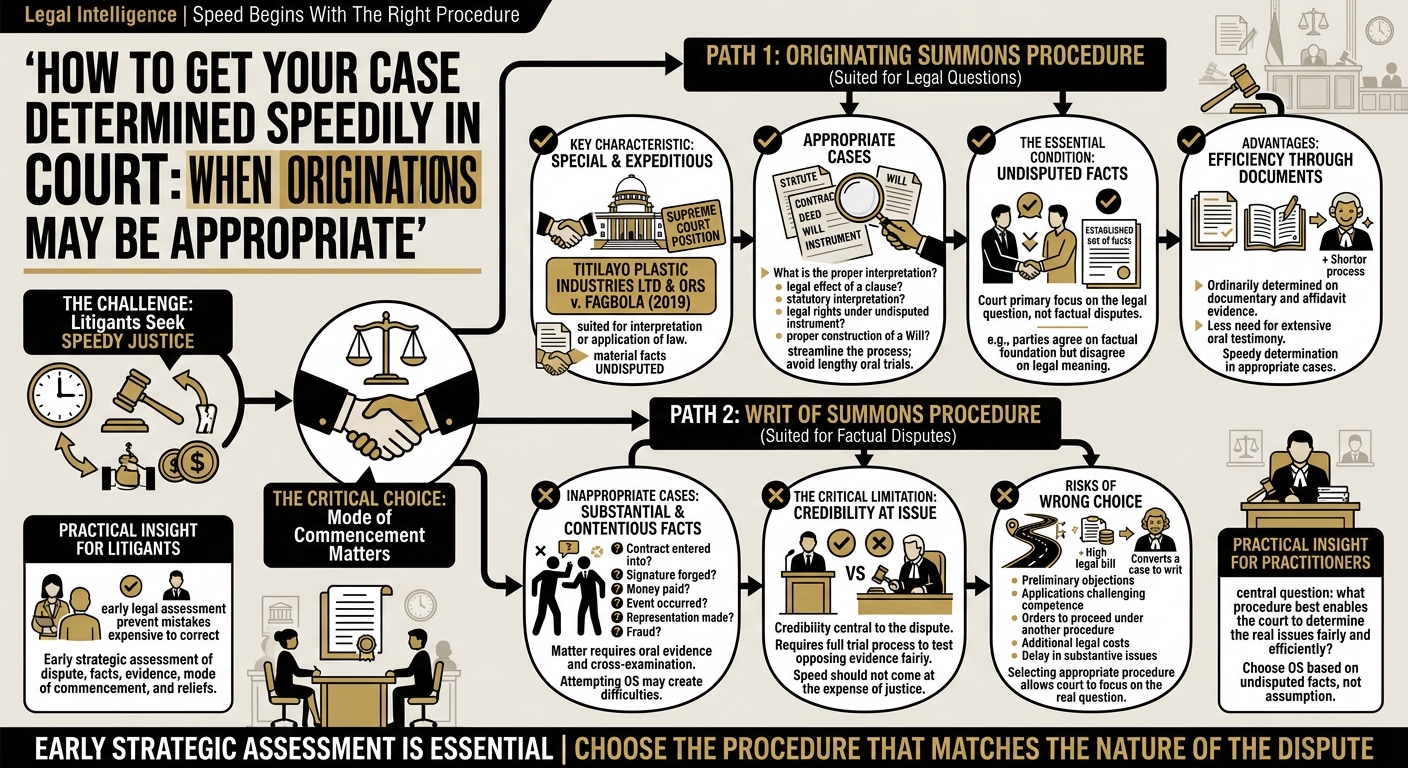
An originating summons is a mode of commencing proceedings in which the claimant or applicant asks the court to determine specific legal questions arising from established or substantially undisputed facts.
Unlike a conventional action commenced by writ of summons, an originating summons proceeding will ordinarily be determined substantially on documentary evidence and affidavit evidence.
The procedure is particularly useful where the court is being asked to interpret a legal instrument, statute or other document, or to determine the legal rights of parties based on facts that are not seriously contested.
This can make the procedure more streamlined than conventional litigation.
The Supreme Court’s Position in Titilayo Plastic Industries Ltd & Ors v. Fagbola
The Supreme Court, in TITILAYO PLASTIC INDUSTRIES LTD & ORS v. FAGBOLA (2019), reaffirmed the special and expeditious character of proceedings commenced by originating summons.
The Court recognised originating summons as a procedure particularly suited to cases involving questions of law, including the construction of a deed, will, contract or other written instrument, or the interpretation of a statute.
The important point, however, is that the procedure is appropriate where the material facts are not in dispute or are unlikely to be substantially disputed.
This distinction is critical.
Originating summons may provide a more direct route to a judicial determination where the parties essentially agree on the underlying facts but disagree about their legal meaning or consequences.
When Is Originating Summons Appropriate?
Originating summons may be appropriate where the principal issue before the court involves a question such as:
- What is the proper interpretation of a contract?
- What is the legal effect of a particular clause in a deed?
- How should a statute be interpreted?
- What are the legal rights of parties under an undisputed instrument?
- What is the proper construction of a Will?
- What is the legal consequence of an established set of facts?
In such cases, the court may be able to determine the dispute without requiring the parties to call numerous witnesses and undergo a lengthy oral trial.
The Importance of Undisputed Facts
The suitability of originating summons depends heavily on the factual circumstances of the case.
Where the parties agree, or are unlikely to seriously disagree, about the material facts, the court can concentrate primarily on the legal question requiring determination.
For example, if both parties accept the contents and validity of a written agreement but disagree about what a particular provision means, an originating summons may be suitable where the applicable rules permit it.
The court is essentially being asked to answer a legal question arising from an established factual foundation.
When Originating Summons May Be Inappropriate
Originating summons is generally unsuitable where the dispute involves substantial and contentious questions of fact.
For example, if the parties disagree about:
- Whether a contract was actually entered into.
- Whether a signature was forged.
- Whether money was paid.
- Whether a particular event occurred.
- Whether a representation was made.
- Whether a party committed fraud.
- Who was physically present at a particular event.
- Whether a witness’s version of events is truthful.
then the matter may require oral evidence and cross-examination.
In such circumstances, attempting to proceed by originating summons may create procedural difficulties and potentially delay rather than accelerate the determination of the dispute.
Originating Summons Is Not a Shortcut for Every Case
There is sometimes a misconception that originating summons is simply a faster alternative to writ of summons.
That is not the correct approach.
The procedure is faster in appropriate cases because of the nature of the dispute, not because a litigant can choose it merely to avoid a conventional trial.
Where the dispute is fundamentally factual, the court needs an appropriate procedure through which conflicting evidence can be tested.
Trying to force a factually contentious dispute into an originating summons proceeding may result in objections, conversion to another procedure or other procedural complications.
A procedure intended to save time can therefore become a source of additional delay if it is wrongly selected.
Documentary Evidence Can Make Proceedings More Efficient
One of the advantages of originating summons proceedings is the emphasis on documentary and affidavit evidence.
Where the relevant facts are contained in documents and are not substantially disputed, there may be little need for extensive oral testimony.
This allows the court to focus on questions of interpretation and legal effect.
For example, where the dispute concerns the proper interpretation of a written agreement, the relevant contract itself may provide the factual foundation upon which the court determines the legal question.
The Role of Affidavit Evidence
Originating summons proceedings ordinarily rely significantly on affidavit evidence.
The parties place their respective positions and supporting documents before the court, allowing the judge to consider the legal issues arising from the material presented.
However, the presence of affidavit evidence does not mean that factual disputes can simply be ignored.
Where affidavits reveal substantial conflicts on material facts, the court may need to consider whether the originating summons procedure remains appropriate.
This is another reason why careful preparation before commencing proceedings is important.
Speedy Justice Still Requires Proper Preparation
Although originating summons can provide an expeditious route to determination in appropriate cases, the procedure does not eliminate the need for proper legal preparation.
A practitioner should carefully identify:
- The precise legal question requiring determination.
- The material facts supporting that question.
- The relevant statute, contract, deed, Will or other instrument.
- Whether the material facts are genuinely undisputed.
- The applicable rules of court.
- The reliefs being sought.
- The documentary evidence required to support the application.
A poorly formulated originating summons may create unnecessary procedural disputes and undermine the very objective of obtaining a speedy determination.
What About Cases Involving Serious Factual Disputes?
Where substantial factual disputes exist, commencing the action by writ of summons may be more appropriate.
The conventional trial process allows parties to call witnesses, present documentary evidence and test opposing evidence through cross-examination.
This is particularly important where the credibility of witnesses is central to the dispute.
Although such proceedings may take longer, the objective of the court process is not simply speed. It is also to ensure that the parties receive a fair opportunity to present and challenge the evidence relevant to the dispute.
Speed Should Not Come at the Expense of Justice
The desire for a quick judgment is understandable, particularly where litigation involves significant financial, commercial or personal consequences.
However, procedural efficiency must be balanced against the need for a fair determination of the issues.
A case should therefore be commenced using the procedure that best fits the nature of the dispute.
The fastest procedure is not necessarily the one with the shortest formal process. It is the procedure that allows the real issues in dispute to be determined without unnecessary procedural complications.
Practical Insight for Litigants
For individuals and businesses considering litigation, an important lesson is that legal advice should be obtained before commencing proceedings.
A potential claimant should not simply instruct a lawyer to “file a case” without first discussing:
- The nature of the dispute.
- The facts that can be established.
- The evidence available.
- The appropriate court.
- The applicable limitation period.
- The appropriate mode of commencement.
- The reliefs that should be sought.
- The likely procedural challenges.
- The potential costs and duration of the proceedings.
Early strategic assessment can prevent mistakes that may otherwise become expensive to correct.
Practical Insight for Legal Practitioners
For practitioners, the decision to commence proceedings by originating summons should be based on the character of the dispute rather than an assumption that the procedure is automatically faster.
Where the dispute principally concerns construction or interpretation of an instrument or statute and the material facts are undisputed or unlikely to be disputed, originating summons may provide an efficient mechanism for obtaining the court’s determination.
Where substantial factual controversies exist, however, writ proceedings may be more appropriate.
The central question should therefore be:
What procedure best enables the court to determine the real issues in dispute fairly and efficiently?
Key Takeaways
Before commencing an action, litigants and their lawyers should consider:
- Identify the real issue: Is the dispute primarily legal or factual?
- Assess the evidence: Are the material facts genuinely undisputed?
- Consider originating summons: Where the dispute involves interpretation of a statute, deed, Will, contract or other instrument and the relevant facts are substantially undisputed.
- Consider writ of summons: Where substantial factual disputes require oral evidence and cross-examination.
- Review the applicable rules: The rules of the relevant court should always be considered before selecting the mode of commencement.
- Prepare carefully: A clear formulation of the questions and reliefs can help avoid unnecessary procedural complications.
- Do not prioritise speed over suitability: An inappropriate procedure can cause more delay and expense than the conventional route.
Conclusion
Obtaining a speedy determination in court begins, in appropriate cases, with selecting a procedure that matches the nature of the dispute.
The originating summons procedure can provide an efficient and expeditious means of obtaining judicial determination where the material facts are not substantially disputed and the principal issues concern questions of law, including the construction of statutes, contracts, deeds, Wills and other written instruments.
However, it is not a universal shortcut. Where substantial disputes of fact exist, a conventional action commenced by writ of summons may be more appropriate because it allows the parties to present oral evidence and subject conflicting testimony to cross-examination.
The lesson from TITILAYO PLASTIC INDUSTRIES LTD & ORS v. FAGBOLA (2019) is therefore not simply that originating summons is faster. It is that the right procedure, selected for the right kind of dispute, can contribute significantly to the efficient administration of justice.
A publication of Edidiong Akpanuwa & Co.