
- November 2, 2026
- Edidiong Akpanuwa & Co
- 0
How to Protect Your Assets in Multiple Countries Through Effective Estate Planning
For Nigerians living abroad, owning assets across different countries can create significant opportunities for wealth creation and long-term financial security. However, cross-border ownership also introduces legal and administrative complexities that should not be overlooked.
A person may own a house in Nigeria, a bank account in the United Kingdom, investments in the United States, shares in a company in another jurisdiction, or business interests spread across several countries. While these assets may form part of one person’s overall wealth, they may not all be governed by the same succession laws or dealt with through the same probate process.
Effective estate planning helps ensure that these assets are properly accounted for and that a person’s wishes are respected after death.
Why Cross-Border Estate Planning Matters
Estate planning becomes more complicated when assets are located in multiple jurisdictions because each country may have its own rules governing succession, inheritance, probate, taxation, property ownership and the recognition of Wills.
A Will prepared in Nigeria, for example, may not by itself provide a straightforward solution for dealing with assets located in another country. Similarly, a Will prepared overseas may not adequately address assets situated in Nigeria.
Without proper planning, beneficiaries may have to deal with separate legal processes in different countries. This can result in delays, additional legal costs, administrative difficulties and, in some cases, disputes among family members.
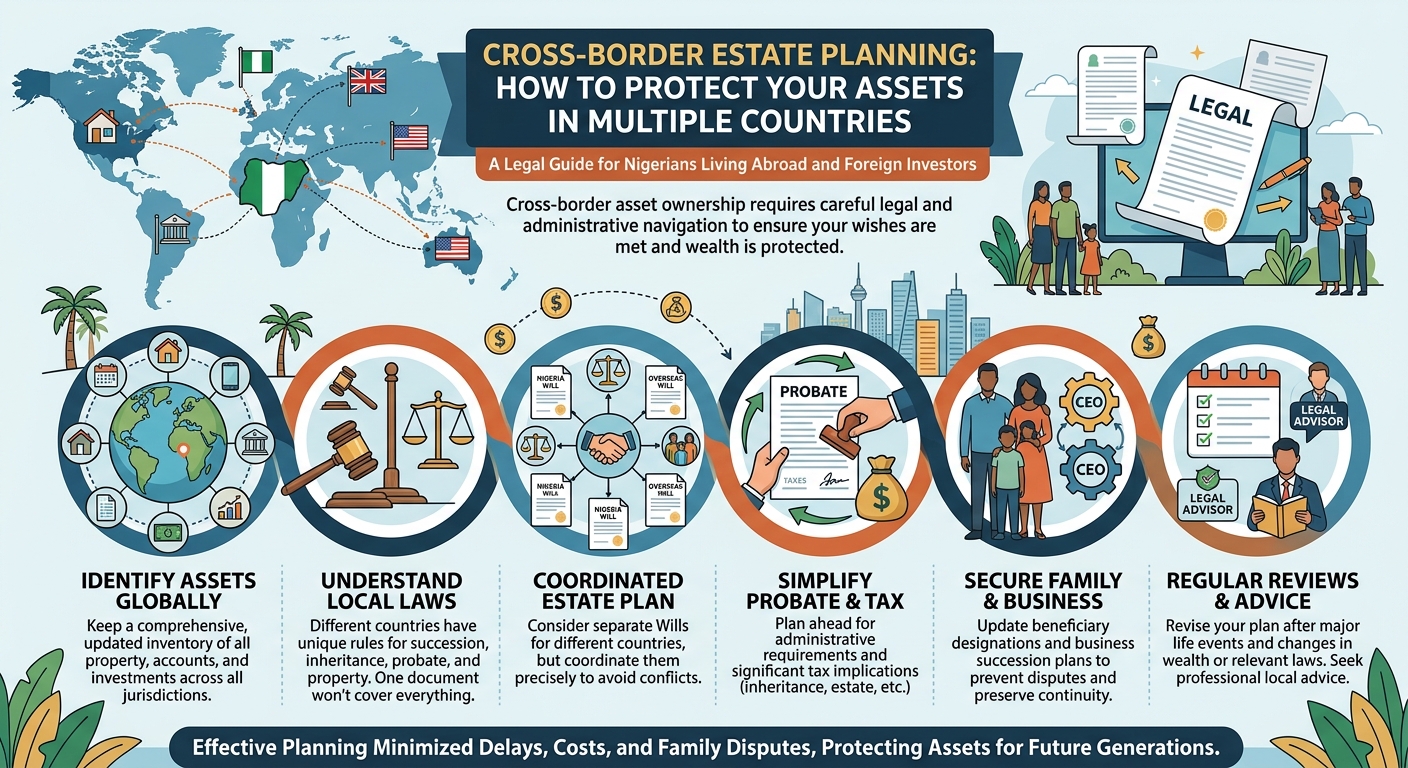
Identify All Assets and Where They Are Located
The first step in effective estate planning is to establish a clear picture of the estate.
This should include a comprehensive inventory of assets in every relevant jurisdiction, such as:
- Residential and commercial properties.
- Land and other real estate interests.
- Bank and savings accounts.
- Shares and other investment portfolios.
- Pension and retirement interests.
- Business ownership interests.
- Intellectual property and royalties.
- Life insurance policies.
- Digital assets and online accounts.
- Valuable personal property.
It is also important to identify how each asset is owned. Joint ownership, corporate ownership, trusts and individual ownership can have different legal consequences when the owner dies.
Understand the Laws of Each Jurisdiction
One of the most important principles of cross-border estate planning is that the laws applicable to one asset may differ from those applicable to another.
The location and nature of an asset can influence which succession and probate rules apply. Real property, in particular, may be subject to the laws of the jurisdiction where the property is situated.
There may also be differences in how countries treat spouses, children, dependants and other beneficiaries.
Consequently, estate planning should not be approached on the assumption that one document will automatically resolve every issue in every country.
Consider Whether Separate Wills Are Appropriate
For individuals with assets in multiple countries, it may sometimes be appropriate to have separate Wills dealing with assets in different jurisdictions.
However, this must be handled carefully. Poorly coordinated Wills can unintentionally revoke one another or create inconsistencies regarding the distribution of the estate.
Where separate testamentary documents are considered, they should be prepared as part of a coordinated estate-planning strategy. The documents should clearly define their respective scope and should be reviewed by appropriate lawyers in the relevant jurisdictions.
The objective is not simply to have multiple Wills, but to ensure that the entire estate is properly covered without creating conflicting instructions.
Consider Probate and Administration Requirements
A Will does not necessarily eliminate the need for probate or other estate administration procedures.
Where assets are located in different countries, beneficiaries may need to obtain legal authority to deal with assets in each jurisdiction. This can involve applications for probate, resealing of grants, recognition of foreign documents, transmission of property or other local procedures.
Proper planning can help identify these requirements in advance and reduce unnecessary delays for beneficiaries.
Review Tax and Inheritance Implications
Cross-border estates may also have tax implications.
Depending on the countries involved, an estate may potentially be affected by inheritance taxes, estate taxes, capital gains taxes, stamp duties or other forms of taxation.
Tax rules can also change over time. A structure that was appropriate when an asset was acquired may become less effective as the value of the estate increases or as the person’s circumstances change.
For this reason, substantial cross-border estates should be reviewed periodically with appropriate legal and tax advisers.
Keep Ownership and Estate Documents Updated
Estate planning is not limited to preparing a Will. The supporting documentation should also be properly organised and kept up to date.
Important documents may include:
- Property title documents.
- Company and shareholding records.
- Bank and investment account information.
- Insurance policies.
- Pension documentation.
- Loan and liability records.
- Existing Wills and codicils.
- Trust documents, where applicable.
- Identification and corporate documents.
Beneficiaries and executors should also be able to locate the relevant documents when they are needed.
Review Beneficiary Designations
Certain assets may pass through beneficiary designations rather than solely through the provisions of a Will.
Life insurance policies, pension arrangements and some investment accounts may have designated beneficiaries. If these nominations are outdated, the intended beneficiaries may not receive the benefit in the manner contemplated by the overall estate plan.
Beneficiary designations should therefore be reviewed whenever there is a significant change in family circumstances or asset ownership.
Consider Business and Corporate Interests
Business owners with interests in multiple countries should give particular attention to succession planning.
The death of a shareholder, director or business owner can have consequences beyond the distribution of the person’s personal wealth. It may affect voting rights, management, ownership structures and the continuity of the business.
Estate planning should therefore consider how shares or other business interests will be transferred and whether the company’s constitutional documents, shareholders’ agreements or other contractual arrangements contain provisions that affect succession.
Update Your Estate Plan After Major Life Events
An estate plan should not be treated as a document that is prepared once and forgotten.
It should be reviewed following significant events such as:
- Marriage or divorce.
- Birth or adoption of a child.
- Death of a beneficiary or executor.
- Acquisition or disposal of significant property.
- Relocation to another country.
- Establishment or sale of a business.
- Significant changes in wealth.
- Changes in family relationships.
- Changes in relevant laws or tax rules.
Regular reviews help ensure that the estate plan continues to reflect the person’s wishes and circumstances.
Practical Steps for Nigerians With Assets Abroad
For Nigerians who own assets in multiple jurisdictions, the following steps can provide a useful starting point:
- Prepare or review your Will with all relevant jurisdictions and assets in mind.
- Maintain an updated asset inventory showing what you own, where it is located and how it is held.
- Keep ownership documents secure and ensure that trusted persons can locate them when necessary.
- Review beneficiary designations on insurance, pension and investment accounts.
- Consider whether separate Wills are appropriate for assets in different jurisdictions.
- Obtain local legal advice before acquiring significant property or investments overseas.
- Review the tax implications of transferring or inheriting assets across borders.
- Consider business succession arrangements where you own shares or operate businesses.
- Update your estate plan after major personal, financial or family changes.
Do Not Wait Until a Crisis
Cross-border estate planning is considerably easier when it is done while the owner is alive, competent and able to make informed decisions.
Waiting until a serious illness, family dispute or other crisis occurs can make the process more complicated. Beneficiaries may then be left to navigate different legal systems without clear instructions or adequate documentation.
Early planning provides an opportunity to identify potential problems and address them before they become disputes.
Conclusion
Owning assets in multiple countries requires more than simply preparing a standard Will. Effective estate planning should take into account the location and ownership of assets, the succession laws of relevant jurisdictions, probate requirements, taxation, beneficiary designations and the continuity of business interests.
For Nigerians living abroad and investors with assets in Nigeria, a properly coordinated estate plan can provide greater certainty and reduce the legal and administrative burden placed on beneficiaries.
Thoughtful cross-border estate planning helps protect wealth, minimise avoidable disputes and ensure that assets accumulated over a lifetime are transferred as effectively as possible to the next generation.
A publication of Edidiong Akpanuwa & Co.