
- October 14, 2026
- Edidiong Akpanuwa & Co
- 0
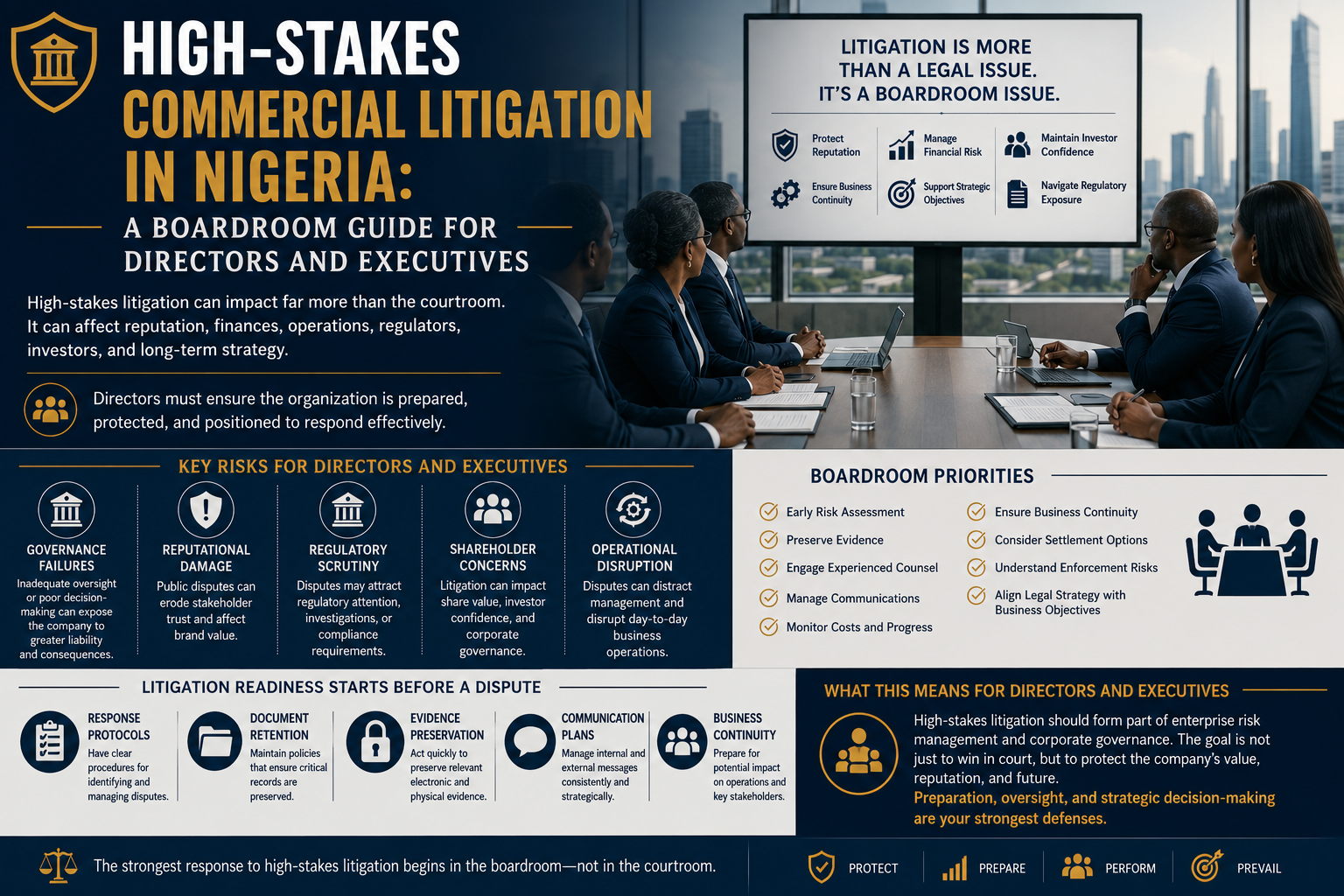
High-Stakes Commercial Litigation in Nigeria: A Boardroom Guide for Directors and Executives
High-stakes commercial litigation can present risks that extend far beyond the courtroom.
For a company facing a major dispute, the consequences may affect corporate reputation, investor confidence, regulatory relationships, business continuity, financial performance, and long-term strategic objectives.
A significant lawsuit can also demand substantial management attention. Directors and executives may be required to make difficult decisions while simultaneously ensuring that the company’s ordinary operations continue.
For this reason, major litigation should not be treated solely as a matter for the legal department.
High-stakes litigation is also a boardroom and corporate governance issue.
Boards of directors and senior executives should understand the potential legal, financial, operational, regulatory, and reputational consequences of a major dispute and ensure that the organization has an appropriate strategy for managing them.
What Makes Litigation “High-Stakes”?
Not every commercial dispute requires board-level involvement.
However, a dispute may become high-stakes where it involves significant financial exposure, critical business assets, major shareholders, regulators, key contracts, intellectual property, corporate control, or issues capable of materially affecting the company’s reputation or operations.
Examples may include disputes involving:
- Major commercial contracts;
- Shareholder and ownership disputes;
- Mergers and acquisitions;
- Joint ventures;
- Infrastructure and construction projects;
- Banking and finance transactions;
- Intellectual property;
- Regulatory matters;
- Corporate control;
- Significant debt or asset recovery;
- Business-critical suppliers or customers.
The potential consequences may extend well beyond the amount claimed in the lawsuit.
Why the Board Should Be Involved
Directors have responsibilities relating to the oversight and governance of the company.
Where litigation could materially affect the company’s financial position, strategic direction, reputation, or operations, the board may need sufficient information to exercise appropriate oversight.
This does not mean that directors should attempt to manage the legal case themselves.
Rather, the board should ensure that management and legal advisers have the appropriate resources, authority, and information to manage the dispute effectively.
Legal Strategy and Corporate Strategy Must Align
A legal strategy should support the company’s broader business objectives.
For example, the best legal strategy may not always be to pursue every available claim to the fullest extent.
The company may instead need to consider whether the dispute should be settled, whether a commercial relationship should be preserved, whether certain assets need protection, or whether litigation could interfere with a larger strategic transaction.
These are ultimately business considerations as well as legal ones.
Conduct an Early Risk Assessment
The earlier a company identifies the potential significance of a dispute, the more options it may have.
Management and the board should consider:
- What is the nature of the dispute?
- What is the potential financial exposure?
- What assets or contracts are at risk?
- Who are the key stakeholders?
- Could regulators become involved?
- Could the dispute affect investors or lenders?
- Could business operations be disrupted?
- Is there a risk of reputational damage?
- What is the likely duration of the dispute?
- What remedies may be available?
An early risk assessment can help determine whether the dispute requires escalation to the board and what response measures should be implemented.
Understand the Financial Exposure
One of the first questions in a high-stakes dispute is the potential financial impact.
The financial exposure may include more than the amount claimed.
A company may also face:
- Legal fees;
- Expert fees;
- Court or arbitration costs;
- Potential damages or compensation;
- Enforcement expenses;
- Business interruption;
- Lost revenue;
- Contract termination;
- Financing consequences;
- Management costs.
The board should therefore receive a realistic assessment of the potential financial exposure rather than focusing solely on the headline claim.
Preserve Evidence Immediately
Evidence preservation is one of the most important aspects of high-stakes litigation preparation.
Relevant evidence may include:
- Contracts;
- Emails;
- Board papers;
- Financial records;
- Accounting documents;
- Internal reports;
- Meeting minutes;
- Instant messages;
- Electronic files;
- Transaction records;
- CCTV footage;
- Mobile-device information.
Businesses should have appropriate procedures for identifying and preserving relevant information when litigation is reasonably anticipated.
Avoid Routine Destruction of Relevant Information
Companies often have ordinary document-retention and data-deletion processes.
However, once a serious dispute emerges, those processes may need to be reviewed to ensure that potentially relevant evidence is not inadvertently destroyed.
The legal team, management, IT personnel, compliance officers, and relevant employees may need to coordinate the preservation process.
Establish a Litigation Response Team
High-stakes litigation should not be managed through an unstructured collection of individuals responding independently.
A company may benefit from establishing a defined litigation response team consisting of appropriate representatives from:
- The board;
- Senior management;
- Legal;
- Finance;
- Risk and compliance;
- IT;
- Communications;
- Relevant operational departments.
The composition will depend on the nature of the dispute.
The purpose is to establish clear responsibility for decision-making, information flow, evidence preservation, communications, and business continuity.
Choose the Right Legal Counsel
The selection of legal counsel can be particularly important in major disputes.
The company should consider the nature and complexity of the dispute and whether the legal team has appropriate experience in the relevant area.
Depending on the matter, the company may require expertise in:
- Commercial litigation;
- Corporate law;
- Arbitration;
- Regulatory matters;
- Banking and finance;
- Construction;
- Energy;
- Technology;
- Intellectual property;
- Cross-border disputes.
The objective should be to ensure that the legal team understands both the legal issues and the commercial context of the dispute.
Consider Conflicts of Interest
High-stakes disputes can create potential conflicts involving directors, officers, shareholders, employees, or related companies.
The company should carefully consider whether individuals involved in decision-making have interests that may differ from those of the company.
Where appropriate, independent legal advice may be necessary to help address potential conflicts.
This is particularly important in shareholder disputes, related-party transactions, corporate-control disputes, and matters involving directors or senior executives personally.
Protect Privilege and Confidentiality
High-stakes litigation can involve sensitive legal and commercial information.
Companies should establish appropriate processes for handling confidential communications and legal advice.
Directors and employees should understand that not every communication involving a lawyer is automatically protected from disclosure.
The legal team should therefore advise the company on appropriate communication protocols and the circumstances in which legal privilege may apply.
Manage Internal Communications
Employees should know how to respond when litigation is anticipated or ongoing.
Uncontrolled internal communications can create unnecessary risks.
Employees should be reminded, where appropriate, to:
- Preserve relevant documents;
- Avoid deleting potentially relevant communications;
- Direct legal inquiries appropriately;
- Avoid speculative comments about the dispute;
- Follow company communication protocols;
- Refer external inquiries to authorized personnel.
The objective is not to prevent employees from communicating normally, but to ensure that communications relating to a major dispute are handled responsibly.
Manage External Communications and Reputation
A major lawsuit can attract attention from customers, employees, investors, regulators, journalists, competitors, and the general public.
The company should therefore consider who is authorized to speak publicly about the dispute.
A coordinated communications strategy can help prevent inconsistent statements and reduce unnecessary reputational exposure.
Avoid Commenting Beyond What Is Necessary
Public statements about ongoing litigation can create additional risks.
Companies should consider carefully what information needs to be disclosed and how statements may affect the legal proceedings, commercial relationships, regulatory obligations, and reputation.
Legal and communications teams should coordinate where appropriate.
Consider Regulatory Implications
Some disputes may attract the attention of regulators or other public authorities.
This may be particularly relevant in regulated sectors such as financial services, telecommunications, energy, healthcare, infrastructure, and other industries subject to significant regulatory oversight.
A board should therefore ask whether the underlying dispute could trigger:
- Regulatory inquiries;
- Reporting obligations;
- Licensing concerns;
- Compliance reviews;
- Investigations;
- Additional disclosure requirements.
The legal strategy should take these potential consequences into account.
Protect Business Continuity
One of the biggest risks associated with high-stakes litigation is disruption to ordinary business operations.
A dispute involving a major supplier, customer, lender, property, technology platform, license, or strategic partner could interfere with the company’s ability to operate.
Management should therefore consider contingency arrangements.
This may involve identifying alternative suppliers, securing replacement services, protecting critical assets, or developing alternative operational plans.
Litigation Should Not Paralyze the Business
The company must continue operating while the dispute is being resolved.
Boards should therefore ensure that sufficient attention is given to business continuity rather than allowing the litigation to consume the organization’s entire management capacity.
Consider Settlement Early
Preparing for litigation does not mean that settlement should be ignored.
A board should understand the potential benefits and risks of settlement at appropriate stages of the dispute.
Settlement may allow the company to:
- Control costs;
- Reduce uncertainty;
- Protect confidential information;
- Preserve commercial relationships;
- Avoid prolonged management distraction;
- Resolve the dispute more quickly.
A settlement can be a strategic decision rather than an admission of wrongdoing or weakness.
Prepare for the Possibility of Trial
Even where settlement is being explored, a company should prepare its case properly.
A strong litigation position can improve the company’s negotiating leverage.
Preparation may include:
- Identifying key witnesses;
- Preserving documents;
- Reviewing contracts;
- Establishing the factual chronology;
- Assessing legal arguments;
- Identifying weaknesses;
- Understanding the opposing party’s case;
- Evaluating potential remedies.
The board should receive appropriate updates without interfering unnecessarily in the day-to-day conduct of the litigation.
Understand the Enforcement Question
Where the company expects to recover money or property, the board should consider what happens after a successful judgment or award.
Questions may include:
- Does the opposing party have identifiable assets?
- Where are those assets located?
- Are they subject to existing claims or security interests?
- Can a judgment or arbitral award realistically be enforced?
- Will enforcement require proceedings in another jurisdiction?
A favorable decision is valuable only if it can ultimately produce a meaningful commercial result.
Monitor Litigation Costs
High-stakes disputes can generate significant legal and professional expenses.
Boards should receive appropriate information about litigation costs and potential future exposure.
Cost monitoring should consider:
- Legal fees;
- Expert costs;
- Court or arbitration expenses;
- Document review;
- Investigations;
- Travel;
- Potential appeals;
- Enforcement.
The company should periodically reassess whether the cost of continuing the dispute remains proportionate to the commercial objectives involved.
Board Oversight Does Not Mean Micromanagement
An important distinction should be maintained between board oversight and day-to-day litigation management.
The board’s role is generally to provide appropriate governance, oversight, and strategic direction.
The legal team and management should be responsible for handling the detailed conduct of the dispute within the authority given to them.
Micromanaging legal strategy can create confusion and interfere with the efficient conduct of the case.
The board should instead ensure that it receives sufficient information to make informed decisions on matters that require board-level attention.
Key Risks for Directors and Executives
Boards and senior management should be particularly alert to:
- Governance failures: Inadequate oversight of a material dispute.
- Evidence preservation failures: Loss or destruction of relevant information.
- Reputational damage: Poorly managed external communications.
- Regulatory scrutiny: Failure to identify regulatory implications.
- Shareholder concerns: Insufficient communication or oversight.
- Operational disruption: Failure to maintain business continuity.
- Uncontrolled costs: Litigation expenses exceeding expectations.
- Conflicts of interest: Personal or related-party interests affecting decision-making.
- Poor strategic alignment: Pursuing litigation without considering broader business objectives.
- Enforcement difficulties: Obtaining a favorable judgment without a realistic recovery strategy.
Litigation Preparedness Should Begin Before the Dispute
The best time to prepare for high-stakes litigation is before a serious dispute arises.
Businesses should consider establishing:
- Litigation response protocols;
- Document retention policies;
- Evidence preservation procedures;
- Legal escalation processes;
- Crisis communication procedures;
- Business continuity plans;
- Appropriate insurance arrangements;
- Board reporting procedures.
These measures can help the organization respond more quickly and effectively when a major dispute emerges.
What This Means for Directors and Executives
High-stakes litigation should form part of broader enterprise risk management and corporate governance.
Directors and executives should ensure that significant disputes are assessed not only for their legal merits but also for their financial, operational, regulatory, reputational, and strategic implications.
The objective is to create a coordinated response that protects the company while allowing management to continue running the business.
Conclusion
High-stakes commercial litigation is rarely just a legal problem.
It can become a corporate governance issue, a financial risk, an operational challenge, a reputational concern, and a strategic business problem.
Organizations that prepare for disputes before they arise are generally better positioned to respond when litigation becomes unavoidable.
Boards and executives should therefore focus on early risk assessment, evidence preservation, appropriate legal representation, effective communication, cost control, regulatory awareness, and business continuity.
The strongest response to high-stakes litigation begins in the boardroom—not in the courtroom.
A publication of Edidiong Akpanuwa & Co.