
- October 12, 2026
- Edidiong Akpanuwa & Co
- 0
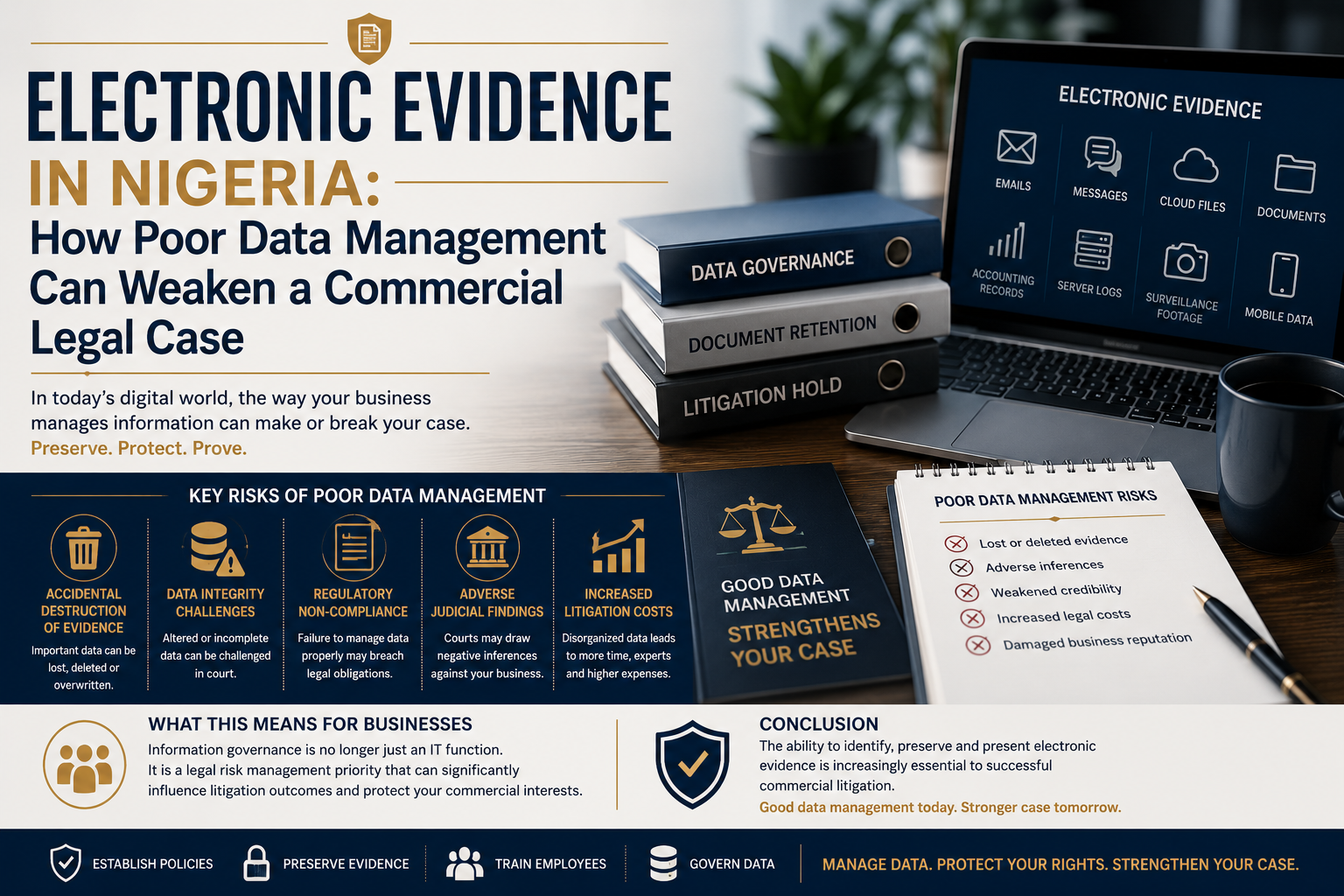
Electronic Evidence in Nigeria: How Poor Data Management Can Weaken a Commercial Legal Case
Modern commercial disputes are increasingly shaped by electronic evidence.
The days when a legal case depended primarily on signed contracts, physical letters, and paper records are long gone. Businesses now generate enormous volumes of information through email, instant messaging, cloud platforms, accounting systems, enterprise software, mobile devices, transaction platforms, access-control systems, surveillance systems, and other digital technologies.
In a commercial dispute, any of these records may become important evidence.
A business may have a strong legal position and a potentially valuable claim, but poor information management can make it significantly harder to prove what happened.
Missing emails, deleted messages, altered records, inaccessible files, incomplete accounting data, or poorly preserved electronic communications can create evidentiary difficulties that weaken an otherwise strong case.
For businesses operating in Nigeria, electronic evidence should therefore be treated as an important component of legal risk management, corporate governance, and litigation preparedness.
Why Electronic Evidence Matters in Commercial Litigation
Electronic records can provide contemporaneous evidence of what parties said, agreed, received, approved, paid for, or did.
For example, an email exchange may establish the terms of a transaction. An instant message may demonstrate that a party was aware of a contractual obligation. An accounting record may help establish whether payment was made. A transaction log may show when an event occurred.
Digital evidence can therefore help establish the chronology and context of a commercial dispute.
It may support claims involving:
- Breach of contract;
- Debt recovery;
- Fraud allegations;
- Shareholder disputes;
- Employment disputes;
- Intellectual property disputes;
- Property transactions;
- Corporate misconduct;
- Regulatory investigations;
- Commercial negotiations.
The challenge is that electronic evidence can be easily deleted, overwritten, modified, misplaced, or rendered inaccessible.
What Counts as Electronic Evidence?
Electronic evidence is broader than email.
Depending on the nature of the dispute, relevant information may include:
- Emails and attachments;
- WhatsApp and other instant messages;
- SMS messages;
- Cloud-based documents;
- Accounting records;
- Bank and payment records;
- Customer databases;
- Transaction logs;
- Website records;
- Access-control records;
- CCTV or surveillance footage;
- Digital photographs;
- Audio and video files;
- Company databases;
- Internal collaboration platforms;
- Mobile-device records;
- Electronic contracts and signatures.
The relevance of a particular category will depend on the facts of the dispute.
The Problem With Deleted or Missing Evidence
One of the greatest risks businesses face is the loss of potentially relevant information.
Data may disappear for innocent reasons.
An employee may delete old emails to free up storage. A company may replace a computer system. A messaging application may automatically delete older conversations. CCTV footage may be overwritten after a certain period.
However, once a dispute has arisen—or a business reasonably anticipates that a dispute may arise—careless handling of relevant evidence can create serious problems.
The issue is not merely whether the business has lost information. It may also become necessary to explain how, when, and why the information was lost.
Evidence Can Be Destroyed Without Anyone Intending It
Businesses sometimes assume that evidence preservation only becomes necessary after a lawsuit has been filed.
That approach can be risky.
A commercial dispute may develop gradually. There may first be a complaint, a failed negotiation, a demand letter, or a disagreement over performance.
During this period, relevant electronic records may continue to be deleted under ordinary company retention practices.
For example, an employee’s mailbox may automatically delete older messages. A departing employee’s account may be deactivated. A device may be reset. A cloud account may be closed.
If potentially relevant information disappears during this period, the business may later have difficulty reconstructing the events.
The Importance of Litigation Holds
Where litigation is reasonably anticipated, businesses should consider appropriate procedures for preserving potentially relevant information.
A litigation hold, sometimes referred to as a legal hold, is a process designed to prevent the routine destruction or deletion of information that may be relevant to a dispute or investigation.
The exact requirements will depend on the circumstances and applicable legal framework, but the underlying principle is straightforward:
Once relevant evidence needs to be preserved, ordinary deletion practices may need to be suspended for that information.
This requires coordination between legal advisers, management, IT personnel, compliance teams, and relevant employees.
Identify the People Who May Hold Relevant Evidence
A business should not assume that all relevant information sits with the legal or finance department.
Important evidence may be held by:
- Directors;
- Managers;
- Sales personnel;
- Procurement teams;
- Account officers;
- Project managers;
- IT personnel;
- Human resources staff;
- External consultants;
- Contractors;
- Other employees involved in the transaction.
Identifying the individuals who participated in the underlying events can therefore be an important part of evidence preservation.
Personal Devices and Messaging Applications
Modern businesses increasingly use smartphones and messaging applications for commercial communications.
Employees may communicate with customers, suppliers, business partners, and colleagues through messaging platforms rather than traditional email.
This creates additional challenges.
Relevant communications may exist on personal or company-owned devices, and the business may need to understand what information exists, who controls it, and how it can appropriately be preserved.
Businesses should establish clear policies governing the use of personal devices and messaging applications for business communications.
Cloud Storage Creates New Evidence Risks
Cloud-based systems provide significant benefits, but they also create evidence-management challenges.
Documents may be stored across different platforms, accounts, folders, or jurisdictions.
Access permissions may change. Files may be overwritten. Accounts may be deleted. Employees may leave the company while retaining access to important information.
Businesses should therefore understand where important corporate information is stored and who has authority to access or modify it.
Data Integrity Is Just as Important as Data Preservation
Preserving a document is not necessarily enough.
The business may also need to demonstrate that the electronic record is reliable and has not been improperly altered.
This is particularly important where the authenticity or accuracy of an electronic record is challenged.
Businesses should therefore consider maintaining appropriate records concerning how important electronic information is created, stored, accessed, transferred, and preserved.
The objective is to maintain the integrity and reliability of the evidence.
Electronic Evidence and the Nigerian Legal Environment
Electronic evidence has become increasingly important within Nigeria’s legal and commercial environment.
The admissibility and evidential weight of electronic records can depend on the applicable legal framework and the circumstances in which the records were created, stored, retrieved, and presented.
Businesses should therefore avoid assuming that simply possessing a digital document guarantees that it will automatically establish the fact they want to prove.
The way the evidence was generated and preserved may also matter.
For significant disputes, businesses should obtain appropriate legal advice on the evidential requirements applicable to the particular case.
Authentication and Reliability Matter
A document presented in court may be challenged on questions relating to authenticity, accuracy, completeness, or reliability.
For example, a party may dispute:
- Who created the document;
- Whether the document was altered;
- Whether the communication is complete;
- Whether the account belonged to the person alleged;
- Whether the record was generated in the ordinary course of business;
- Whether the system from which the record came was reliable.
Good information governance can make it easier to address such questions.
Poor Data Management Can Increase Litigation Costs
When electronic evidence is poorly organized, legal teams may have to spend considerably more time identifying and reviewing relevant information.
This can increase the cost of litigation.
For example, if a business has thousands of poorly organized files spread across multiple devices and cloud platforms, significant resources may be required to identify which records are relevant.
By contrast, businesses with organized document-management systems may be able to identify important evidence more efficiently.
Good data management can therefore provide both a legal and financial advantage.
Employees Leaving the Business Can Create Evidence Gaps
Employee departures can create significant information-management challenges.
A departing employee may have:
- Emails;
- Customer communications;
- Project files;
- Contracts;
- Business messages;
- Access to cloud platforms;
- Files stored on company devices;
- Information relating to ongoing disputes.
Businesses should have appropriate procedures for handling company information when employees leave, particularly where the employee was involved in significant transactions or disputes.
Document Retention Policies Matter
A well-designed document retention policy can help businesses manage information systematically.
The policy should identify, where appropriate:
- What information should be retained;
- How long different categories should be retained;
- Where information should be stored;
- Who has access;
- How information is securely destroyed;
- What happens when litigation or an investigation is anticipated.
The policy should also be consistent with applicable legal, regulatory, contractual, and business requirements.
Data Governance Is a Legal Risk Issue
Data governance is sometimes treated as an IT function.
That is increasingly inadequate.
The way a business manages information can directly affect:
- Litigation;
- Regulatory compliance;
- Contract enforcement;
- Internal investigations;
- Corporate governance;
- Data protection;
- Commercial negotiations.
Legal, compliance, IT, and management teams should therefore work together to establish appropriate information-governance practices.
What Happens When Evidence Has Been Altered or Destroyed?
The consequences of evidence loss depend on the circumstances.
A court may scrutinize the circumstances surrounding missing evidence, particularly where the information was potentially relevant and there are concerns about how it was handled.
In appropriate cases, the loss or destruction of evidence may affect the court’s assessment of the credibility of a party’s case or lead to other procedural or evidential consequences.
Businesses should therefore avoid taking the position that deleted or missing records are automatically irrelevant.
The safest approach is to preserve potentially relevant information and seek legal guidance when a serious dispute is anticipated.
Protecting Evidence Before a Dispute Becomes Litigation
The best time to think about evidence preservation is not necessarily after a claim has already been filed.
Businesses should have systems in place before disputes arise.
This may include:
- Document retention policies;
- Data classification procedures;
- Secure backup systems;
- Access controls;
- Employee training;
- Appropriate use-of-device policies;
- Contract-management systems;
- Clear procedures for preserving records when disputes arise.
These measures can significantly improve a company’s ability to respond when litigation becomes necessary.
Electronic Evidence Can Strengthen a Case
Poor data management can weaken litigation, but good data management can also provide a significant advantage.
Well-preserved electronic records can help establish:
- What the parties agreed;
- When communications occurred;
- Who approved a transaction;
- Whether payment was made;
- Whether contractual obligations were performed;
- What representations were made;
- How a dispute developed.
Contemporaneous records can sometimes be more persuasive than recollections formed long after the event.
Key Risks Businesses Should Consider
Businesses should be particularly alert to the following risks:
- Accidental destruction of evidence: Relevant information may be deleted through routine business processes.
- Data integrity challenges: Opposing parties may question whether records have been altered.
- Incomplete records: Important communications may be scattered across multiple platforms.
- Employee departure: Relevant information may become inaccessible when employees leave.
- Poor retention practices: Documents may be destroyed before a dispute is identified.
- Increased litigation costs: Poorly organized information can make document review more expensive.
- Regulatory exposure: Inadequate information governance may create additional compliance concerns.
- Adverse evidential consequences: Poor handling of relevant information may affect how a court assesses the case.
What This Means for Businesses
Information governance is no longer solely an IT concern.
For businesses, it is also a legal risk-management priority.
A company that maintains reliable records, understands where important information is stored, trains employees appropriately, and has procedures for preserving evidence can be significantly better prepared for commercial disputes.
Businesses should also consider involving legal advisers early when a serious dispute is emerging.
Early legal guidance can help identify potentially relevant evidence, determine what should be preserved, and reduce the risk of inadvertent destruction or mishandling of information.
Conclusion
Modern commercial litigation increasingly depends on electronic evidence.
Emails, instant messages, cloud documents, accounting records, transaction logs, surveillance footage, and other digital information can determine whether a business is able to prove its case effectively.
A strong legal claim can be undermined by poor information management, while a well-organized evidence trail can significantly strengthen a company’s position.
Businesses should therefore treat data governance, document retention, and evidence preservation as part of their broader litigation-readiness strategy.
The best time to protect electronic evidence is before it becomes critical to your case.
A publication of Edidiong Akpanuwa & Co.