
- October 7, 2026
- Edidiong Akpanuwa & Co
- 0
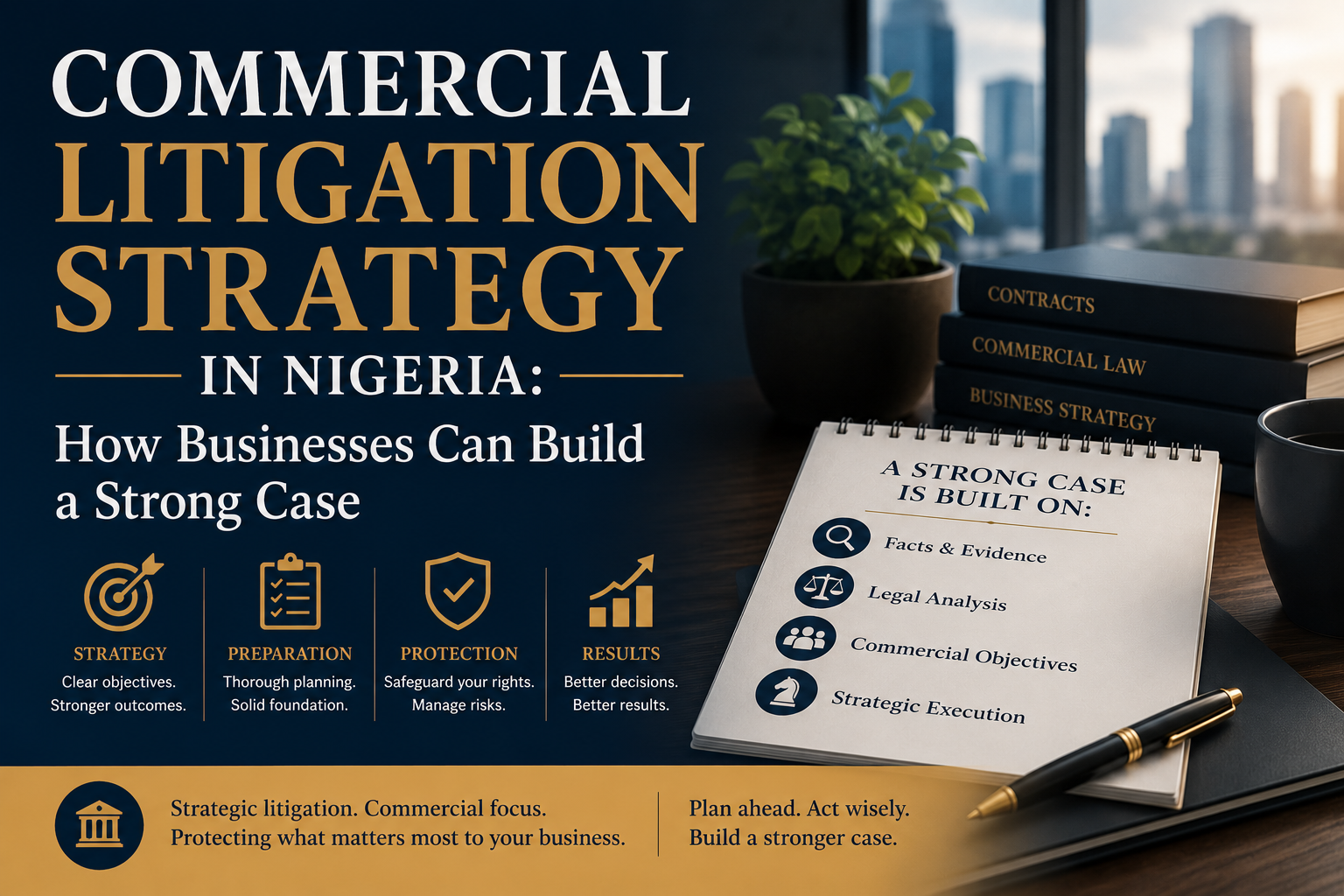
Commercial Litigation Strategy in Nigeria: How Businesses Can Build a Strong Case
Successful commercial litigation is rarely the result of chance. It is typically the product of careful preparation, sound legal analysis, strategic decision-making, and disciplined execution.
For businesses, litigation is not simply about presenting arguments before a court. It is about protecting commercial interests, managing risk, preserving valuable evidence, and pursuing an outcome that supports the company’s broader objectives.
A business may have a legitimate claim, but legal entitlement alone does not guarantee a successful outcome. The strength of the evidence, the applicable law, the available remedies, the conduct of the opposing party, and the overall litigation strategy can all influence the result.
This is why businesses should begin thinking strategically about a dispute as soon as a serious legal issue emerges—and, ideally, have systems in place to manage disputes before they arise.
What Is a Litigation Strategy?
A litigation strategy is the overall plan for managing a legal dispute from the initial assessment through settlement, trial, judgment, and, where necessary, enforcement.
It involves answering important questions such as:
- What is the legal basis of the claim or defence?
- What evidence is available?
- What outcome does the business want?
- What are the strengths and weaknesses of the case?
- What remedies are available?
- What are the likely costs and risks?
- Should the dispute be settled or litigated?
- How can the business protect its commercial interests while the dispute is ongoing?
A well-developed strategy allows a business to make decisions based on evidence and commercial objectives rather than emotion or pressure.
Start With the Facts
A strong litigation strategy begins with a thorough understanding of what actually happened.
Businesses should establish a clear chronology of events and identify the individuals, transactions, communications, and documents connected to the dispute.
This may involve reviewing:
- Contracts and agreements;
- Invoices and payment records;
- Emails and correspondence;
- Board and shareholder resolutions;
- Company records;
- Internal reports;
- Meeting minutes;
- Electronic communications;
- Delivery and transaction records;
- Relevant regulatory documents.
The objective is to move beyond assumptions and establish the facts that can be supported by evidence.
Build a Clear Timeline
A detailed chronology can be particularly valuable in commercial disputes.
It can help identify when obligations arose, when communications took place, when payments were made, when breaches allegedly occurred, and what actions followed.
A clear timeline can also reveal weaknesses in either side’s position that may not be immediately apparent.
Preserve Evidence Early
Evidence preservation is one of the most important aspects of litigation preparation.
Once a business becomes aware that a dispute may result in legal proceedings, relevant documents and electronic communications should be carefully preserved.
This may include emails, contracts, WhatsApp messages, accounting records, photographs, electronic files, company records, and other materials relevant to the dispute.
Businesses should be particularly careful about deleting or altering potentially relevant information.
Why Evidence Preservation Matters
A case can be weakened considerably if important evidence is lost or becomes difficult to retrieve.
Conversely, well-preserved records can provide a business with a much stronger foundation for negotiations and, where necessary, court proceedings.
Evidence can also reveal inconsistencies in the opposing party’s position and help counsel identify the strongest arguments available.
Assess the Legal Position
Once the facts have been established, the next step is to determine how the law applies to those facts.
Legal analysis should consider the relevant legislation, contractual provisions, judicial decisions, procedural requirements, and potential remedies.
The business should understand not only why it believes it is right, but also how the opposing party is likely to respond.
Identify the Strengths and Weaknesses
No case is completely risk-free.
A proper litigation assessment should identify both the strengths and weaknesses of the claim or defence.
Questions may include:
- Is there a clear contractual obligation?
- Can a breach be established?
- Is there sufficient evidence?
- Has the business suffered a legally recoverable loss?
- Are there procedural obstacles?
- Could the opposing party raise a credible defence?
- Are there limitation or jurisdictional issues?
- Is the remedy being sought legally available?
Identifying weaknesses early gives the business an opportunity to address them before they become significant problems.
Define the Commercial Objective
Litigation should serve a purpose.
A business should determine what it actually wants to achieve before proceedings are commenced.
For example, the objective may be to:
- Recover an outstanding debt;
- Obtain compensation;
- Enforce a contractual obligation;
- Protect intellectual property;
- Preserve confidential information;
- Recover or protect business assets;
- Prevent a transaction from taking place;
- Resolve a shareholder dispute;
- Preserve a valuable commercial relationship.
The desired outcome should influence the litigation strategy.
Winning Is Not Always the Same as Success
A business can technically win a case and still experience an unsatisfactory commercial outcome.
For example, a judgment may be difficult to enforce, the litigation may have consumed significant management time, or the relationship with an important customer may have been permanently damaged.
The real objective should therefore be to achieve a commercially meaningful result, not simply a favorable legal judgment.
Evaluate the Opposing Party
Understanding the other side is an important part of litigation strategy.
Businesses should consider the opposing party’s financial position, commercial objectives, likely arguments, available evidence, and willingness to negotiate.
Where the dispute involves debt recovery, for example, the financial position of the defendant may be particularly important.
A favorable judgment may have limited commercial value if the judgment debtor has no accessible assets against which enforcement can realistically be pursued.
Consider the Available Remedies
Businesses should understand what they are actually asking the court to do.
Depending on the circumstances, possible remedies may include damages, injunctions, declarations, specific performance, recovery of property, or other forms of relief available under applicable law.
The remedy sought should be connected to the commercial objective.
For example, if the primary concern is preventing the disposal of a valuable business asset, simply pursuing damages after the asset has been transferred may not adequately address the company’s immediate concern.
Consider Urgent Protective Measures
Some disputes require immediate attention.
Where there is a genuine risk that assets may be transferred, destroyed, dissipated, or otherwise placed beyond effective recovery, delay can significantly affect the position of the business.
Similarly, disputes involving confidential information, intellectual property, business assets, or ongoing contractual obligations may require urgent legal consideration.
The appropriate response depends on the circumstances, but businesses should recognize that some litigation decisions cannot safely be postponed.
Settlement Should Be Part of the Strategy
Preparing for litigation does not mean abandoning the possibility of settlement.
In many commercial disputes, settlement may provide a faster, more predictable, and commercially sensible outcome.
Businesses should therefore consider negotiation and mediation alongside formal proceedings.
A settlement may allow a company to:
- Reduce legal costs;
- Avoid prolonged uncertainty;
- Protect confidential information;
- Preserve commercial relationships;
- Obtain payment sooner;
- Reduce management distraction.
Settlement Does Not Mean Giving Up
A carefully negotiated settlement can be a strategic success.
The question is not whether the business has “won” or “lost” by settling. The more important question is whether the settlement achieves an outcome that is better than the likely result of continuing the dispute.
Manage Litigation Costs
Commercial litigation can become expensive if it is not actively managed.
Businesses should understand the likely costs and regularly reassess whether continued litigation remains commercially justified.
Cost management may involve:
- Establishing a litigation budget;
- Prioritizing the most important issues;
- Avoiding unnecessary procedural disputes;
- Regularly reviewing the prospects of success;
- Considering settlement at appropriate stages;
- Monitoring legal and expert costs.
The financial value of the claim should always be considered alongside the expected cost of pursuing it.
Consider the Impact on the Business
Litigation can affect more than the legal department.
Senior executives may need to provide instructions, attend meetings, review documents, participate in negotiations, and give evidence.
The dispute may also affect relationships with customers, suppliers, employees, investors, regulators, and business partners.
A strong litigation strategy therefore considers the wider commercial consequences of the dispute.
Protect the Company’s Reputation
Some disputes may attract public attention, particularly where they involve significant companies, prominent individuals, regulated industries, or sensitive allegations.
Businesses should consider how litigation may affect their reputation and stakeholder relationships.
This does not mean avoiding legitimate claims because of publicity concerns. Rather, it means ensuring that litigation decisions are made with an understanding of the broader consequences.
Use Experts Where Necessary
Some commercial disputes involve technical, financial, accounting, engineering, valuation, or other specialist issues.
Expert evidence may become important where the court needs assistance in understanding matters outside ordinary knowledge.
Businesses should identify early whether specialist input is likely to be required.
Early expert assessment can also help determine whether a claim is financially or technically viable before substantial resources are committed to litigation.
Prepare for Trial From the Beginning
Even where settlement remains the preferred objective, businesses should prepare their case as though the dispute may ultimately proceed to trial.
This means understanding:
- The evidence required;
- The witnesses who may be important;
- The documents that support the case;
- The weaknesses in the opposing party’s position;
- The applicable legal principles;
- The remedies being sought.
A well-prepared case can also strengthen the business’s negotiating position.
When the opposing party recognizes that a claimant has prepared thoroughly and can present a credible case, meaningful settlement discussions may become more likely.
Review the Strategy as the Case Develops
A litigation strategy should not remain fixed regardless of what happens.
New documents may emerge. Witnesses may provide unexpected evidence. The opposing party may change its position. A court may make an important procedural ruling.
Businesses should therefore regularly reassess:
- The prospects of success;
- The likely cost of continuing;
- The strength of the evidence;
- The commercial value of the claim;
- The possibility of settlement;
- The enforcement prospects.
Strategic flexibility can be just as important as careful preparation.
Key Risks in Commercial Litigation
Businesses should be alert to several common litigation risks:
- Poor case preparation: Entering proceedings without fully understanding the facts.
- Inadequate evidence preservation: Losing important documents or electronic records.
- Weak legal analysis: Failing to identify potential weaknesses or defences.
- Escalating costs: Allowing litigation expenses to become disproportionate to the value of the dispute.
- Strategic miscalculations: Pursuing a legal victory that does not achieve the desired commercial outcome.
- Enforcement difficulties: Obtaining judgment without a realistic path to recovery.
- Management distraction: Allowing litigation to interfere with normal business operations.
- Reputational damage: Failing to consider the wider consequences of contentious proceedings.
The Importance of Early Case Assessment
Early case assessment can provide businesses with a significant strategic advantage.
Before committing substantial resources to litigation, the business should understand the legal merits, evidentiary position, potential remedies, likely costs, enforcement prospects, and available alternatives.
This assessment can help management decide whether to:
- Pursue litigation;
- Negotiate;
- Mediate;
- Make a settlement offer;
- Defend a claim;
- Seek urgent protective measures;
- Reconsider the commercial relationship.
The earlier these questions are addressed, the more options the business may have.
What This Means for Businesses
The strongest commercial cases are often built long before a matter reaches the courtroom.
Businesses that preserve evidence, understand their legal position, define their objectives, assess risk, and prepare strategically are better positioned to respond effectively when disputes arise.
Litigation should be approached as both a legal and commercial exercise.
The objective is not simply to commence proceedings. It is to develop a strategy that protects the company’s rights, manages its exposure, preserves its commercial interests, and maximizes the prospects of achieving a meaningful outcome.
Conclusion
Building a winning litigation strategy requires more than having a potentially valid claim.
It requires careful preparation, strong evidence, sound legal analysis, realistic assessment of risk, effective cost management, and a clear understanding of what the business ultimately wants to achieve.
Businesses should assess disputes early, preserve relevant evidence, consider settlement opportunities, understand enforcement risks, and remain prepared to adapt their strategy as circumstances change.
The strongest litigation strategy is one that begins before the claim is filed. Preparation creates options, strategy manages risk, and disciplined execution gives businesses the best opportunity to protect their commercial interests.
A publication of Edidiong Akpanuwa & Co.