
- October 2, 2026
- Edidiong Akpanuwa & Co
- 0
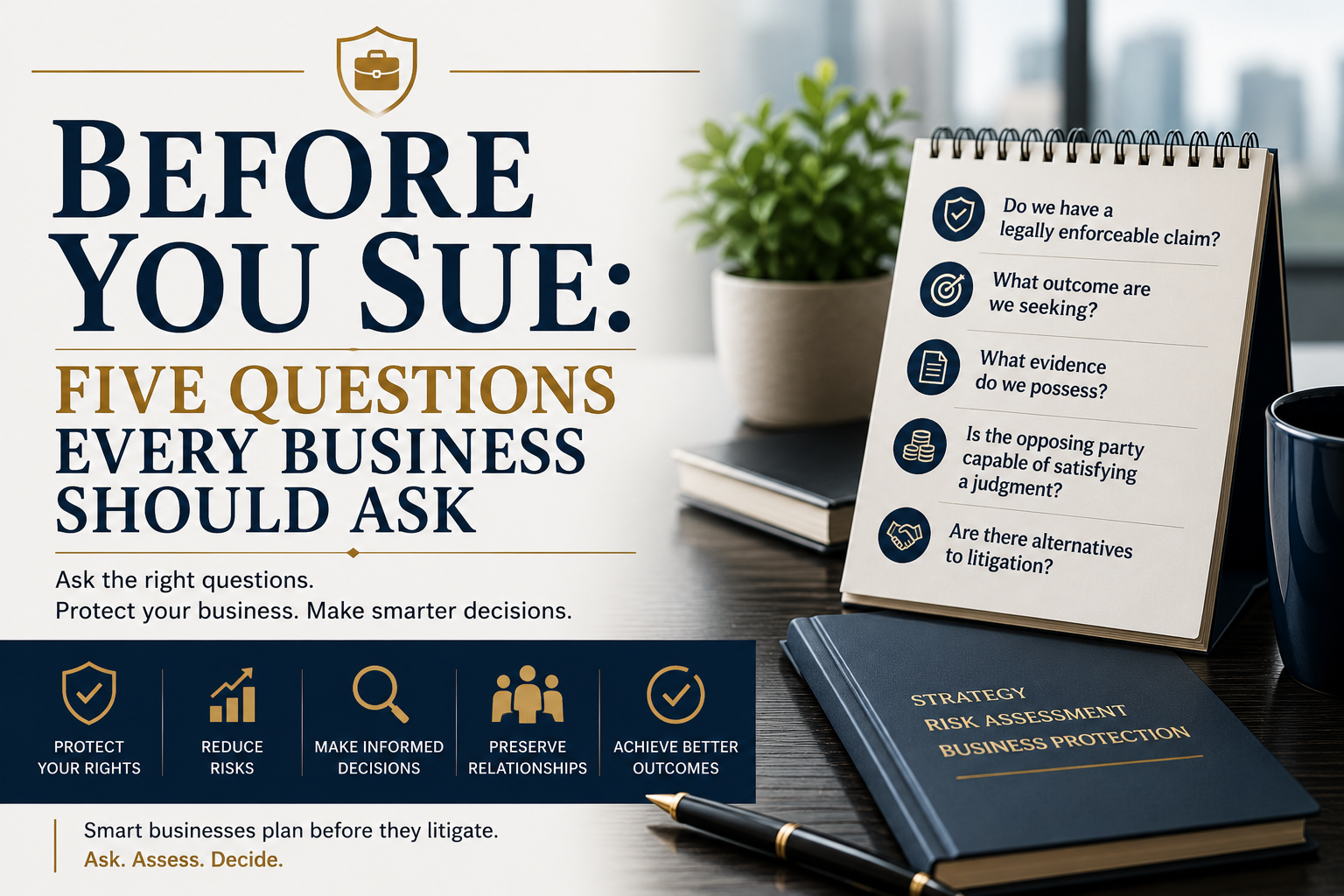
Before You Sue: Five Questions Every Business Should Ask
Litigation can be an effective tool for protecting contractual rights, recovering debts, preserving business assets, enforcing commercial obligations, and resolving serious disputes. However, filing a lawsuit should not automatically be the first response to every disagreement.
Commercial litigation can be expensive, time-consuming, and disruptive. It can require significant management attention, expose sensitive business information, strain commercial relationships, and create uncertainty about the ultimate outcome.
For this reason, businesses should approach litigation as a strategic commercial decision, not simply as a reaction to a dispute.
Before commencing legal proceedings, every business should carefully consider five fundamental questions.
1. Do We Have a Legally Enforceable Claim?
The first question is whether there is a genuine legal basis for bringing a claim.
A commercial disagreement does not automatically amount to a legal cause of action. A business may believe that it has been treated unfairly, suffered a financial loss, or been let down by a business partner, but the relevant facts must be assessed against the applicable law.
The legal assessment may involve reviewing:
- Contracts and agreements;
- The obligations of each party;
- Whether a breach has occurred;
- Payment records;
- Correspondence between the parties;
- Applicable statutory requirements;
- Evidence of financial loss;
- Any relevant contractual remedies;
- Limitation or other procedural considerations.
A careful assessment at the beginning can help determine whether litigation is justified and what legal remedies may realistically be available.
A Strong Business Grievance Is Not Always a Strong Legal Claim
One of the mistakes businesses can make is confusing commercial frustration with legal entitlement.
For example, a company may be dissatisfied because a supplier failed to meet expectations, a customer delayed payment, or a business partner failed to perform as anticipated. The circumstances may justify legal action, but that conclusion should be based on the actual contractual and legal obligations involved.
Obtaining legal advice before filing a claim can help distinguish between a dispute that should be litigated and one that may be better resolved through another approach.
2. What Outcome Are We Actually Seeking?
Before commencing proceedings, a business should identify what it wants to achieve.
The objective of litigation should not simply be to “win” a case. The more important question is what practical commercial result the business needs.
Depending on the circumstances, the desired outcome may include:
- Recovery of an outstanding debt;
- Compensation for financial losses;
- Enforcement of contractual obligations;
- An order preventing certain conduct;
- Recovery or preservation of business assets;
- Specific performance of contractual obligations;
- Protection of confidential information;
- Resolution of a shareholder or partnership dispute;
- Preservation of an ongoing commercial relationship.
Understanding the desired outcome helps determine the appropriate legal strategy.
The Remedy Should Match the Commercial Objective
A business seeking payment of a debt may require a different strategy from a business trying to prevent the transfer of valuable property.
Similarly, a company may decide that preserving a long-term commercial relationship is more important than pursuing every possible claim for damages.
This is why litigation strategy should be connected to the company’s broader commercial objectives.
3. What Evidence Do We Have?
Evidence is often one of the most important factors in commercial litigation.
A business may have a strong understanding of what happened, but the court will ultimately consider the evidence presented in support of the claim and the defence.
Businesses should therefore identify and preserve relevant documents before commencing proceedings.
These may include:
- Contracts and agreements;
- Invoices and receipts;
- Payment records;
- Bank statements;
- Emails;
- Letters and formal correspondence;
- WhatsApp or other business communications;
- Board resolutions;
- Company records;
- Delivery documents;
- Meeting notes;
- Electronic records;
- Photographs or other relevant materials.
Preserve Evidence Before a Dispute Escalates
Businesses should avoid deleting, altering, or casually disposing of documents that may become relevant to a dispute.
Electronic communications can be particularly important in commercial disputes. An apparently informal message may become significant evidence when the circumstances surrounding a transaction are later examined.
Companies should therefore have appropriate document-retention practices and ensure that relevant records are preserved once a serious dispute emerges.
4. Can the Opposing Party Satisfy a Judgment?
Winning a lawsuit does not necessarily mean recovering money.
A business may obtain a favorable judgment but still face difficulties enforcing it if the opposing party does not have sufficient assets or income against which the judgment can be enforced.
This makes the financial position of the opposing party an important practical consideration before commencing litigation, particularly where the primary objective is debt recovery or compensation.
Businesses may need to consider:
- Whether the opposing party owns identifiable assets;
- Whether those assets are accessible for enforcement;
- Whether the business is operational;
- Whether there are competing creditors;
- Whether assets have been transferred or encumbered;
- Whether the defendant is likely to remain solvent;
- Whether enforcement may involve property or assets in another jurisdiction.
A Judgment Is Only Part of the Strategy
The commercial value of litigation should be considered from beginning to end.
A business should ask not only, “Can we win?”, but also, “If we win, can we realistically recover what is owed to us?”
This practical assessment can help businesses avoid spending significant resources pursuing claims where enforcement may ultimately prove difficult.
5. Are There Alternatives to Litigation?
Litigation is only one method of resolving a commercial dispute.
Depending on the nature of the disagreement, negotiation, mediation, or arbitration may provide a more appropriate solution.
Negotiation
Negotiation can allow parties to resolve a dispute directly without immediately commencing formal proceedings.
A negotiated settlement may be particularly useful where the parties have an ongoing commercial relationship or where both sides have an interest in avoiding the costs and uncertainty associated with litigation.
Mediation
Mediation provides a structured process through which parties attempt to reach an agreed resolution with the assistance of a neutral third party.
It can be useful where communication between the parties has broken down but there remains an opportunity for a negotiated settlement.
Arbitration
Where the parties have agreed to arbitration, or where arbitration is otherwise available under the applicable legal framework, it may provide an alternative forum for resolving certain commercial disputes.
The suitability of arbitration depends on the contractual arrangements, the nature of the dispute, the applicable rules, and the commercial objectives of the parties.
Settlement Is Not a Sign of Weakness
Businesses sometimes view settlement as an admission that their position is weak.
That is not necessarily the case.
A settlement can be a strategic business decision where it allows a company to control costs, reduce uncertainty, protect confidential information, preserve a commercial relationship, or redirect management attention toward the business.
The objective should be to achieve the best commercially sensible outcome, not simply to pursue litigation for its own sake.
Understanding the Cost of Litigation
Before filing proceedings, businesses should consider the likely financial cost of the dispute.
Legal fees are only one component.
There may also be costs associated with:
- Court processes;
- Experts and professional advisers;
- Document management;
- Management time;
- Travel;
- Enforcement;
- Delays to business operations;
- Internal investigations;
- Public relations or reputational management.
A dispute that appears financially significant at first may become less attractive when the total cost of pursuing it is considered.
This does not mean businesses should avoid legitimate claims. Rather, it means litigation should be approached with a realistic understanding of its commercial consequences.
Consider the Impact on the Business Relationship
Not every commercial dispute occurs between strangers.
A disagreement may involve a long-term supplier, major customer, shareholder, investor, business partner, employee, or strategic commercial relationship.
Commencing litigation can fundamentally alter the relationship between the parties.
Before suing, businesses should therefore consider whether the relationship is worth preserving and whether there is a realistic possibility of resolving the dispute without permanently damaging it.
In some circumstances, a carefully negotiated settlement may achieve the desired result while allowing the relationship to continue.
In others, litigation may be necessary to protect the company’s interests.
Consider the Reputational and Operational Impact
Commercial disputes can sometimes attract attention from customers, employees, investors, regulators, or other stakeholders.
Businesses should consider whether litigation could expose commercially sensitive information or create reputational concerns.
There may also be significant operational consequences.
Senior management may need to spend time gathering documents, providing instructions, attending meetings, reviewing evidence, and participating in the litigation process.
For a growing business, these distractions can have a meaningful commercial cost.
Act Quickly When Assets Are at Risk
While careful assessment is important, businesses should also recognize that some disputes require urgent action.
Where there is a genuine risk that assets may be transferred, dissipated, destroyed, or otherwise placed beyond effective recovery, delaying legal advice can create additional risks.
Similarly, disputes involving confidential information, intellectual property, business assets, or ongoing contractual obligations may require urgent consideration of appropriate protective measures.
The appropriate legal response will depend on the facts and applicable law.
Key Risks Businesses Should Consider
Before commencing litigation, businesses should carefully consider the following risks:
- Premature litigation: Filing proceedings before fully understanding the legal and commercial position.
- Weak evidentiary foundation: Having insufficient documentation to support the claim.
- Unrecoverable costs: Spending substantial resources without a realistic prospect of recovery.
- Enforcement difficulties: Obtaining a judgment but facing obstacles in enforcing it.
- Damage to commercial relationships: Turning a manageable disagreement into a permanent business breakdown.
- Management distraction: Diverting senior personnel from running the business.
- Reputational concerns: Creating unwanted exposure for the company.
- Uncertain outcomes: Recognizing that litigation always carries some degree of risk.
The Importance of Pre-Litigation Legal Assessment
A strong litigation strategy often begins before a claim is filed.
Pre-litigation legal assessment can help a business understand the strengths and weaknesses of its position, identify relevant evidence, assess potential remedies, evaluate settlement options, and determine whether proceedings are commercially justified.
It can also provide an opportunity to send an appropriate pre-action communication or engage the opposing party before the dispute becomes more entrenched.
In some cases, the process of preparing a strong legal position is enough to encourage the other party to negotiate seriously.
What This Means for Businesses
Strategic litigation begins long before a claim is filed.
Businesses should resist the temptation to commence proceedings simply because a dispute has become frustrating or contentious. Instead, they should consider the legal basis of the claim, the evidence available, the desired outcome, the financial position of the opposing party, and the availability of alternative dispute-resolution mechanisms.
The right question is not simply:
“Can we sue?”
It is:
“Is litigation the right strategy for achieving our commercial objective?”
Conclusion
Litigation can be an important mechanism for protecting business interests, enforcing contractual rights, recovering debts, and resolving serious commercial disputes. However, the decision to litigate should be guided by legal merit, evidence, commercial objectives, cost, enforceability, and the broader interests of the business.
Businesses that undertake a careful assessment before commencing proceedings are often better positioned to make informed decisions, manage risk, and pursue outcomes that support their long-term commercial interests.
Before you sue, understand your claim, define your objective, assess your evidence, consider enforcement, and explore your alternatives. Strategic legal action is not about going to court as quickly as possible; it is about choosing the right strategy to protect the business.
A publication of Edidiong Akpanuwa & Co.